
India's AI Underdog Takes on ChatGPT's Billion-User Empire
Sarvam AI launches Indus chat app with 105B parameter model, challenging OpenAI and Google in India's booming AI market. Can local expertise beat global scale?
The $100 Billion Market Just Got a New Challenger
ChatGPT commands 100 million weekly users in India alone. Claude claims the country as its second-largest market. Into this dominated landscape steps Sarvam AI, a scrappy Indian startup that just launched its Indus chat app, armed with homegrown AI and a bold bet: local beats global.
Friday's launch isn't just another chatbot entering an overcrowded market. It's the opening move in a high-stakes game of AI nationalism, where 1.4 billion people and technological sovereignty hang in the balance.
The Language Advantage Play
While OpenAI and Google speak to India in translation, Sarvam promises to speak with India in its native tongues. The Indus app runs on the company's newly unveiled 105-billion parameter model, designed specifically for Indian languages and cultural contexts.
Currently in beta across iOS, Android, and web, users can type or speak queries and receive text and audio responses. Sign-up works through phone numbers, Google accounts, or Apple IDs, though the service remains India-exclusive for now.
But the limitations are telling. Users can't delete chat history without nuking their entire account. The app's reasoning feature, which sometimes slows responses, can't be turned off. Most revealing: Sarvam warns users they might hit waitlists due to "limited compute capacity."
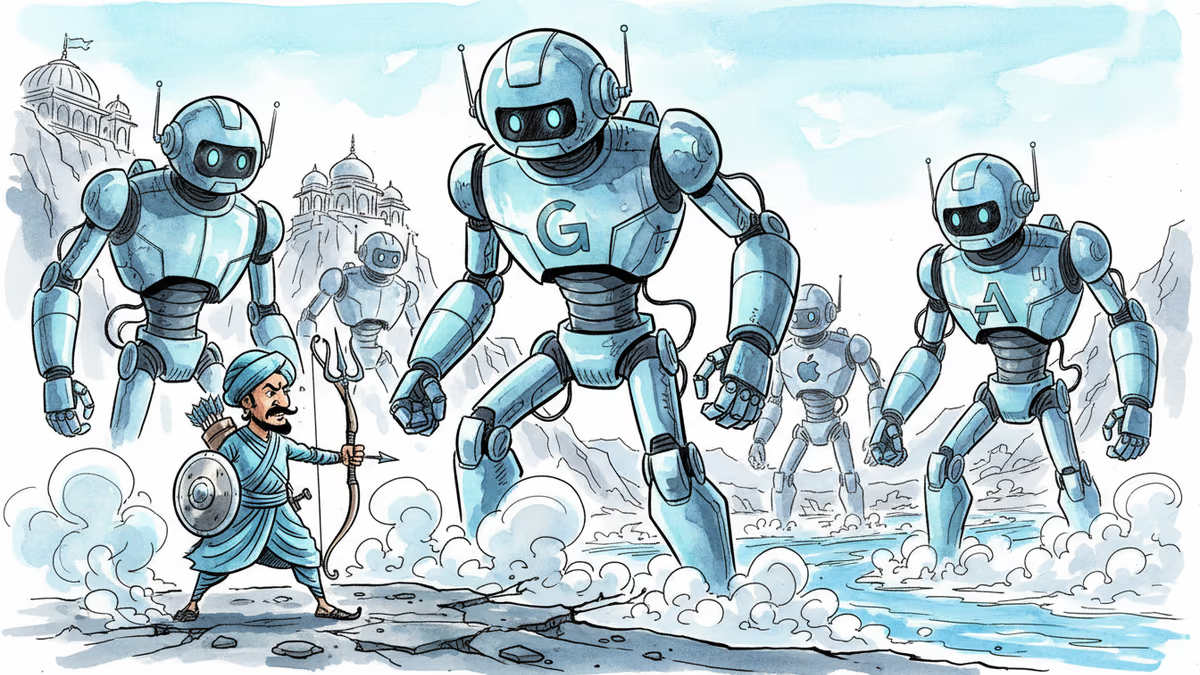
David vs. Goliath, AI Edition

The battle lines reveal fascinating strategic tensions. Global players bring overwhelming computational resources and established user bases. Anthropic'sClaude already captures 5.8% of usage from India—second only to the US—while ChatGPT's Indian user base rivals entire countries' populations.
Local challengers counter with cultural intelligence and linguistic nuance. Can a model trained on Indian contexts better understand a Hindi poem's emotional undertones or navigate complex family relationships in Tamil culture? Sarvam bets yes.
Government stakeholders see this through a sovereignty lens. Just as China built its AI ecosystem behind protective walls, India wants domestic alternatives to reduce technological dependence. The startup's partnerships with HMD for Nokia feature phones and Bosch for automotive AI signal broader infrastructure ambitions.
Enterprise customers face a classic build-vs-buy dilemma. Global platforms offer proven scale and reliability. Local alternatives promise customization and data sovereignty but come with execution risks.
The $41 Million Question
Sarvam's funding round—backed by Lightspeed Venture Partners, Peak XV Partners, and Khosla Ventures—validates investor appetite for AI localization plays. But money alone won't solve the fundamental challenge: competing with companies that spend billions on compute infrastructure.
The startup's gradual rollout strategy reveals the reality check. While global players can instantly serve millions, Sarvam must carefully manage capacity. It's a reminder that in AI, infrastructure often trumps innovation.
Beyond India's Borders
This isn't just an Indian story. Similar dynamics play out globally as countries grapple with AI dependency. European initiatives like Mistral AI in France or regional language models in Southeast Asia reflect the same tension between global efficiency and local control.
For developers and businesses worldwide, Sarvam's approach offers a template: identify cultural or linguistic gaps in global platforms, then build specialized solutions. The question is whether venture capital and user adoption can sustain these efforts against well-funded giants.
Authors
Related Articles
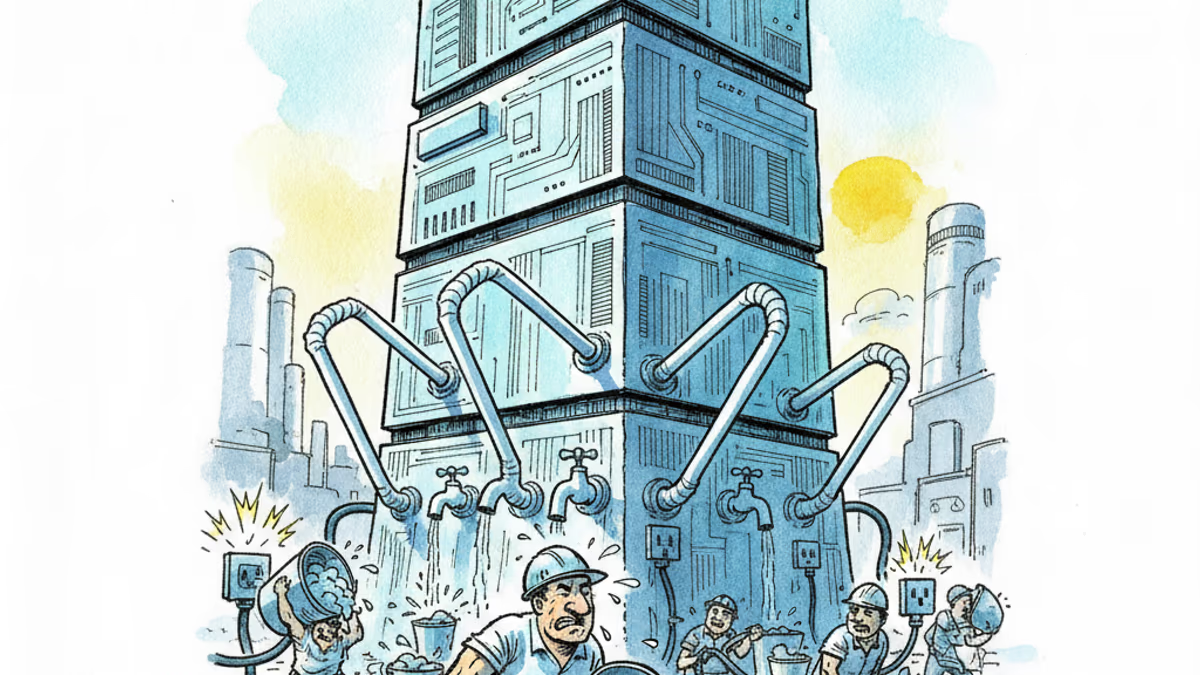
Samsung and SK unveiled a chip and AI investment package worth thousands of trillions of won on June 29. The headline number swings wildly by outlet, but the real contest isn't capital — it's water and power.

SolarSquare is raising $55-60M at a $450-500M valuation, more than doubling its worth in 18 months. Here's what's driving investor conviction in India's residential solar market.

Viral videos show 2026 graduates jeering executives who praise AI at commencement ceremonies. It's not just rudeness — it's a signal about who pays for technological optimism.

Filipino virtual assistants using AI to ghost-manage LinkedIn profiles for executives is now a structured industry. 30 comments a day, fake engagement rings, and a platform struggling to tell real from fabricated.
Samsung and SK unveiled a chip and AI investment package worth thousands of trillions of won on June 29. The headline number swings wildly by outlet, but the real contest isn't capital — it's water and power.
SolarSquare is raising $55-60M at a $450-500M valuation, more than doubling its worth in 18 months. Here's what's driving investor conviction in India's residential solar market.
Viral videos show 2026 graduates jeering executives who praise AI at commencement ceremonies. It's not just rudeness — it's a signal about who pays for technological optimism.
Filipino virtual assistants using AI to ghost-manage LinkedIn profiles for executives is now a structured industry. 30 comments a day, fake engagement rings, and a platform struggling to tell real from fabricated.
Thoughts
Share your thoughts on this article
Sign in to join the conversation