
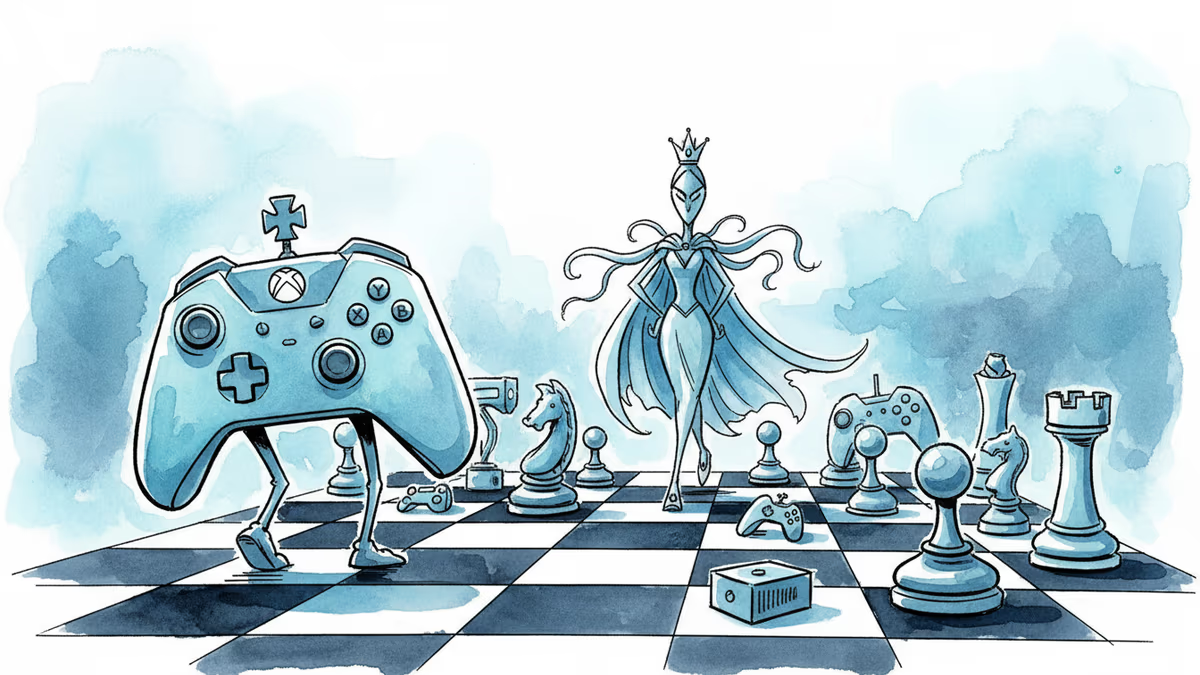
The Spencer Era Ends: What Xbox's Leadership Shakeup Really Means
Phil Spencer retires after 12 years leading Xbox, with CoreAI's Asha Sharma taking over. Sarah Bond also exits. What does this mean for Microsoft's gaming future?
After 38 years at Microsoft and 12 years transforming Xbox from console underdog to gaming powerhouse, Phil Spencer is stepping down. But here's the twist that nobody saw coming: his replacement isn't Sarah Bond, the Xbox President many assumed was next in line. Instead, Asha Sharma from Microsoft's CoreAI division is taking the reins.
The timing feels deliberate, almost surgical. Spencer announced his retirement just as the gaming industry grapples with AI integration, cloud gaming's slow adoption, and the aftermath of Microsoft's $68.7 billionActivision Blizzard acquisition. Bond's simultaneous departure only adds to the intrigue.
The AI Pivot Nobody Expected
Sharma's appointment signals something bigger than a routine succession. While Spencer spent a decade building Xbox's hardware credibility and subscription services, Sharma brings AI expertise to an industry on the verge of transformation. Her background suggests Microsoft sees gaming's future less in console wars and more in intelligent, adaptive experiences.
Consider the context: OpenAI partnerships, Copilot integration across Microsoft's ecosystem, and the company's $13 billion AI investment spree. Placing an AI executive at Xbox's helm isn't coincidence—it's strategic repositioning.
Matt Booty's promotion to Chief Content Officer also makes sense through this lens. While Sharma handles the technical transformation, Booty can focus on what gamers actually care about: great games. It's a classic Microsoft move—separate the platform innovation from content creation.
What Sarah Bond's Exit Really Tells Us

Bond's departure might be the most telling piece of this puzzle. As Xbox President, she championed hardware innovation and developer relations. Her exit alongside Spencer suggests this isn't just about retirement—it's about philosophical direction.
Industry insiders whisper that Bond favored traditional console evolution, while Microsoft's board increasingly sees gaming as a services and AI play. Her resignation might reflect disagreement with this pivot, or simply recognition that the role she was groomed for no longer exists in the form she expected.
The $3 billionGame Pass subscriber base Spencer built becomes Sharma's foundation. But will she prioritize growing that number, or transforming what Game Pass actually delivers?
The Broader Gaming Landscape Shift
This leadership change comes as competitors make their own bold moves. Sony doubles down on exclusive blockbusters, Nintendo maintains its hardware-software integration, and Steam continues dominating PC gaming. Meanwhile, cloud gaming promises remain largely unfulfilled, and mobile gaming generates more revenue than consoles.
Spencer's legacy includes making Xbox games available everywhere—PC, mobile, even competing consoles through cloud streaming. Sharma inherits this "gaming without boundaries" philosophy but with AI tools that could redefine what "everywhere" means.
The summer transition period Spencer mentioned isn't just corporate politeness. It's recognition that this handover involves more than keys to the executive washroom—it's transferring relationships with Bethesda, Activision, and hundreds of independent developers who trusted Spencer's vision.
Authors
Related Articles

GitHub confirmed hackers stole data from 3,800 internal repositories via a poisoned VS Code extension. Here's why developer tools are now the most dangerous attack surface in tech.
Sony is pulling its major single-player PlayStation games from PC. After six years of multiplatform expansion, the reversal raises hard questions about exclusivity, hardware sales, and who really controls gaming's future.
Emails revealed in the Musk v. Altman trial show Microsoft executives were deeply skeptical of OpenAI in 2017–2018. What actually changed their minds?
Xbox hardware revenue dropped 33% in Q1 2026, yet Microsoft posted $82.9B in total revenue. What this tells us about the future of gaming—and who actually loses.
GitHub confirmed hackers stole data from 3,800 internal repositories via a poisoned VS Code extension. Here's why developer tools are now the most dangerous attack surface in tech.
Sony is pulling its major single-player PlayStation games from PC. After six years of multiplatform expansion, the reversal raises hard questions about exclusivity, hardware sales, and who really controls gaming's future.
Emails revealed in the Musk v. Altman trial show Microsoft executives were deeply skeptical of OpenAI in 2017–2018. What actually changed their minds?
Xbox hardware revenue dropped 33% in Q1 2026, yet Microsoft posted $82.9B in total revenue. What this tells us about the future of gaming—and who actually loses.
Thoughts
Share your thoughts on this article
Sign in to join the conversation