
PRISM Weekly Digest: Third Week of March 2026
BTS dropped 'ARIRANG' and 22,000 fans filled Gwanghwamun. The Fed warned of stagflation. Anthropic released an AI that refuses military use. Qatar began mediating the Hormuz blockade.
Mar Week 3, 2026 | The Night Arirang Played — The War Continued, and Seoul Sang
On the night of March 21, 22,000 people gathered at Gwanghwamun Square.
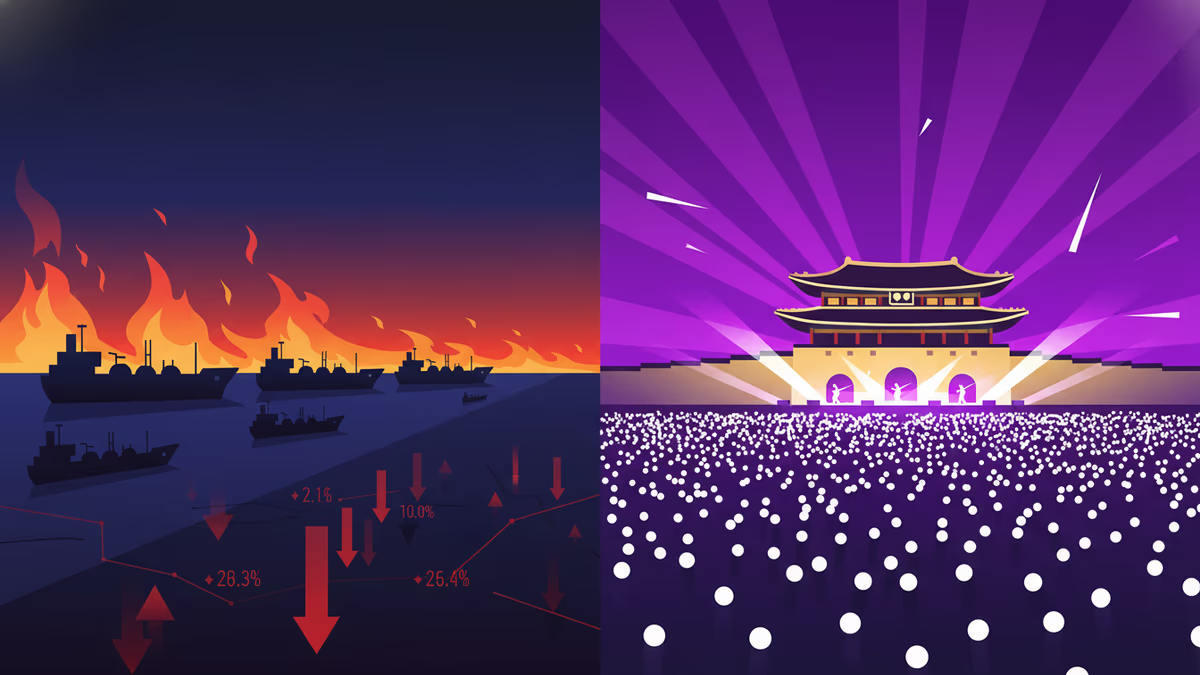
BTS came back. After four years of absence, military service, and the longest wait their fans have ever endured. At that exact moment, 150 tankers still sat at anchor outside the Strait of Hormuz. The Federal Reserve issued a stagflation warning. Anthropic unveiled what may be the most consequential AI model of the year. Week four of the war — the world was running on two entirely different clocks at once.
The Night at Gwanghwamun
At midnight on March 20, "ARIRANG" went live on streaming platforms. Fourteen tracks. Within the first 24 hours, it shattered Spotify's record for fastest album to reach 100 million streams. The lead single, "ARIRANG (Modern)," splices traditional Korean pansori technique with hype-pop production — the most daring artistic experiment since their debut, by nearly every critical account.
At 6 p.m. on March 21, the concert at Gwanghwamun Square began. All 22,000 seats had been reserved by fans who won a lottery held four years ago, when the group announced their upcoming military enlistment. Peak concurrent viewers online hit 6.2 million. Netflix's exclusive livestream went out simultaneously to 190 countries. When BTS performed "Spring Day," all 22,000 fans in the square lit up their phone flashlights at once. That clip crossed 300 million views on X within 72 hours.
The narrative weight of a fully reunited comeback after mandatory military service is larger than any chart metric can capture. If "Dynamite" in 2020 consoled a world in pandemic, "ARIRANG" in 2026 is a declaration of Korean identity spoken into a world at war. All seven members have writing credits on the album. RM said in an interview: "The question I kept asking in the military was: why do we sing? This album is the answer."
In the drama world, "Siren's Kiss" hit 7.1% ratings in its third episode — the highest single-episode rating on tvN in 2026. The chemistry between Wi Ha-joon's insurance investigator Kang Tae-joo and Park Min-young's enigmatic lead Lee Su-yeon has generated the kind of online reaction that keeps people awake on weeknights. Studio Dragon is reportedly in active negotiations with Netflix for a global simultaneous broadcast deal.
The Fed's Warning
On March 19, following the FOMC decision, Federal Reserve Chair Jerome Powell used a phrase that sent a chill through markets: "The current economic situation bears structural similarities to aspects of the 1970s." That is an explicit stagflation warning from the head of the most powerful central bank in the world.

The Fed held rates at 5.25%. The updated dot plot erased both projected 2026 rate cuts entirely. CPI came in at 4.1% year-over-year. Core CPI at 3.7% — nearly double the Fed's 2% target. Energy price increases are now feeding into second-round effects across the service economy. Airfares jumped 18% in March alone. Food prices are up 6.2%.
The labor market is holding, for now. Weekly initial jobless claims came in at 223,000, roughly stable. But the leading indicators tell a different story. Manufacturing PMI dropped to 47.3, entering contraction. Consumer confidence hit its lowest reading since the 2020 pandemic shock. The U.S. economy is approaching the worst-case scenario: inflation arrives before growth can be established, and the tools to fight one make the other worse.
The South Korean government convened an emergency macroeconomic review meeting. The won breached 1,420 per dollar. Foreign capital outflows are accelerating. The Bank of Korea is cornered — rate hikes would crush an already slowing economy, but holding steady risks currency pressure and imported inflation.
War Week Four — Blocked Waters, Moving Diplomacy
Two weeks into the Hormuz blockade. What has changed, and what hasn't.
What's changed: Qatar stepped in. Multiple diplomatic sources reported back-channel contact between Iran and the U.S. in Doha. Iran's stated conditions: U.S. military withdrawal from the Gulf region and reinstatement of the 2024 nuclear agreement. Washington officially denied any talks. But WTI fell from $98 to $94 over the week — four dollars in a market that doesn't move on rumor unless the rumor is credible.
What hasn't changed: tanker traffic remains effectively zero. The U.S. Navy's Fifth Fleet has intensified patrols but has not broken the blockade. Saudi Arabia signaled it is considering increasing output by 500,000 barrels per day to offset disruptions. The problem is that Saudi crude cannot reach markets without either transiting Hormuz or using the East-West pipeline — which is already running at capacity.
Europe is in an energy emergency. Germany activated emergency natural gas rationing. France declared maximum operation of its nuclear fleet. The EU convened an emergency energy summit for March 25. This crisis is Europe's second confrontation with energy vulnerability since the 2022 Russia-Ukraine war — and this time, there is no LNG export surge from the U.S. to fill the gap, because the U.S. is the one fighting.
AI Doesn't Pause for Wars
While geopolitical clocks slowed, the AI industry continued to move on an entirely different timeline.
On March 18, Anthropic launched Claude 4.5 — code-named "Prometheus" internally. The core capability leap is extended reasoning: multi-step logical inference, autonomous planning, and self-correction in ways that go beyond the question-answer paradigm of previous generations. Benchmark results show 12% improvement over GPT-5.4 on mathematical reasoning, 23% on coding tasks, and 91.3% accuracy on complex legal document analysis. API pricing: $3.00 per million input tokens, slightly above GPT-5.4's $2.50.
The more consequential announcement came alongside the model itself. Anthropic stated that Claude 4.5 carries explicit use restrictions for military and law enforcement applications. The terms of service list "decision-making in autonomous weapons systems" and "construction of civilian surveillance infrastructure" as prohibited uses. This is a direct and deliberate contrast with OpenAI's Pentagon contract — the same contract Anthropic turned down in February, and OpenAI signed within 48 hours of that refusal.
The Chinese AI front is moving fast. ByteDance slashed pricing on Doubao-Pro-32K to $0.11 per million input tokens — one twenty-third of OpenAI's rate. Alibaba released Qwen 3.0 as open source, targeting the title of most-downloaded model on Hugging Face. An AI price war is now officially underway. While America is fighting a shooting war, China is competing for pricing dominance in the AI market.
Authors

Combining the sharp eye of a financial auditor with the warm sensibility of a picture book editor, writing stories that read the currents of the AI era. Currently Editor-in-Chief at Liabooks.
Related Articles

Trump announced substantial progress on a US-Iran peace deal and Hormuz reopened after six weeks. Bitcoin jumped from $74,000 to $76,700 in four hours. Xi seated Putin, Iran, and India at the same desk in one week. SpaceX opened its books for the first time in 23 years with the largest IPO in U.S. history; Nvidia conceded China to Huawei. BTS held the Billboard 200 top 10 for an eighth straight week.
Trump and Xi met in Beijing for the first time in nine years. Microsoft poured $100B into OpenAI and became the supporting actor; Cerebras received $70B on day one. Hormuz entered week six. Cisco cut 4,000. ILLIT hit Billboard No. 1, CORTIS debuted at No. 3, and BTS is confirmed for the World Cup Final halftime stage.

A closed Hormuz arrives at the kitchen table, Musk vs. Altman puts a trillion dollars on trial, the Big Four bet $650 billion on AI, and Trump sends 25% tariff invoices to long-time allies. K-pop's seventeen-year slave-contract era closes with a standard-contract reform.

Tim Cook's 25-year goodbye, $40 billion poured into Anthropic, shots near the White House dinner, and TXT's first Grand Slam — a week of power handed over and crises distributed.
Trump announced substantial progress on a US-Iran peace deal and Hormuz reopened after six weeks. Bitcoin jumped from $74,000 to $76,700 in four hours. Xi seated Putin, Iran, and India at the same desk in one week. SpaceX opened its books for the first time in 23 years with the largest IPO in U.S. history; Nvidia conceded China to Huawei. BTS held the Billboard 200 top 10 for an eighth straight week.
Trump and Xi met in Beijing for the first time in nine years. Microsoft poured $100B into OpenAI and became the supporting actor; Cerebras received $70B on day one. Hormuz entered week six. Cisco cut 4,000. ILLIT hit Billboard No. 1, CORTIS debuted at No. 3, and BTS is confirmed for the World Cup Final halftime stage.
A closed Hormuz arrives at the kitchen table, Musk vs. Altman puts a trillion dollars on trial, the Big Four bet $650 billion on AI, and Trump sends 25% tariff invoices to long-time allies. K-pop's seventeen-year slave-contract era closes with a standard-contract reform.
Tim Cook's 25-year goodbye, $40 billion poured into Anthropic, shots near the White House dinner, and TXT's first Grand Slam — a week of power handed over and crises distributed.
Thoughts
Share your thoughts on this article
Sign in to join the conversation