
PRISM Weekly Digest: Third Week of April 2026
From the Hormuz blockade to K-pop's 12th Billboard week — seven days that rewrote the rules. Rare earth leverage, Anthropic's thaw, and a 46-minute DeFi heist point to the same shift.
Apr Week 3, 2026 | From Hormuz to Hollywood — A Week the World Rewrote Itself
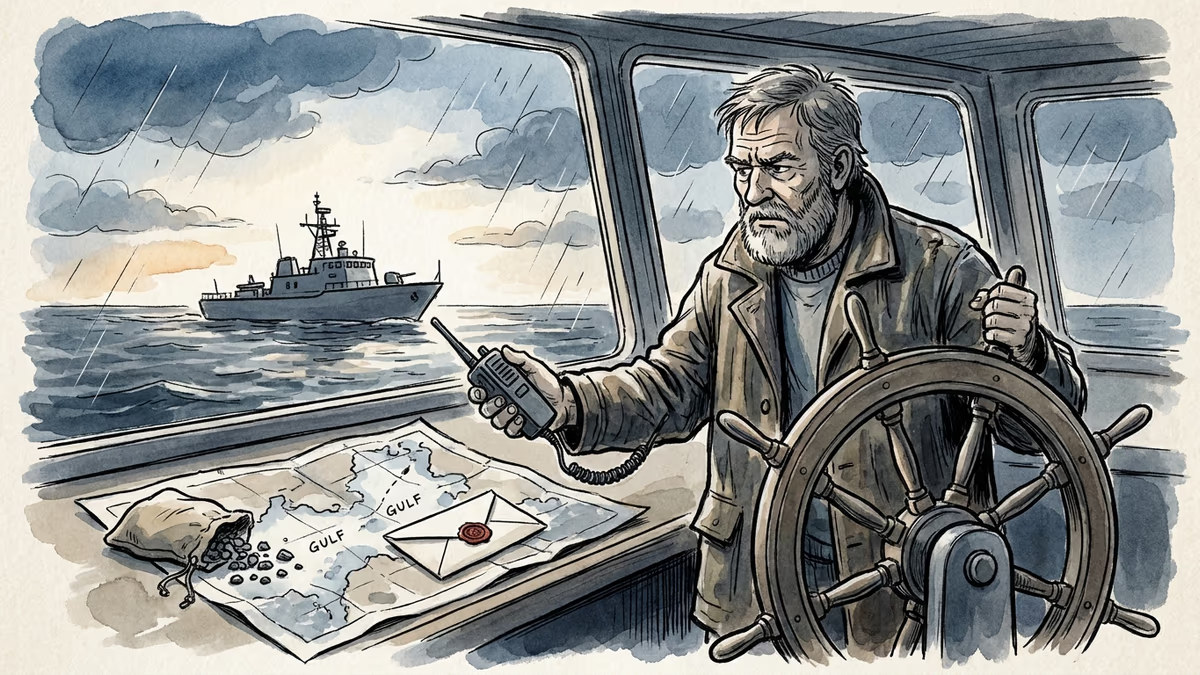
On the morning of April 13, Iran shut the Strait of Hormuz.
The chokepoint through which 20% of the world's seaborne oil passes went dark. Brent crude surged $8 a barrel within hours. Then, seven days later, word of resumed U.S.-Iran nuclear talks out of Muscat sent global equities to their biggest 11-session rebound. Geopolitics pushed the markets; the markets pulled diplomacy. In between, the AI industry staged a quiet reshuffling of power, and K-pop held the Billboard charts for a twelfth consecutive week.
Hormuz: Seven Days That Moved the World
The Iranian naval blockade announcement on April 13 was its own kind of shock therapy for energy markets. Brent cleared $94. Energy stocks in Seoul and Tokyo gapped down at the open. South Korea imports 72% of its crude from the Middle East — a prolonged closure wouldn't just mean higher pump prices. It would mean supply rationing for petrochemicals, shipping disruptions, and a domestic inflation shock arriving on top of existing tariff pressures.
The blockade itself, however, proved easier to declare than to enforce. U.S. Central Command deployed naval assets and issued turning orders to tankers, but in the first 24 hours, not a single vessel was successfully diverted. The Revolutionary Guards and the U.S. Navy circled each other with precision — close enough to signal intent, not close enough to fire. What looked like a military action was, in practice, a negotiating maneuver.
The pivot came quickly. On April 17, Trump told reporters an Iran nuclear deal was possible "this weekend." By April 19, reporting confirmed that U.S. and Iranian delegations had returned to the table in Oman. That expectation alone was enough to trigger the largest equity rally in over two weeks. Goldman Sachs disclosed that the whipsaw in commodities and fixed income during the blockade week had meaningfully weighed on its trading revenues — a rare admission that volatility had become a liability rather than an asset. The IMF issued a separate warning: if a full military confrontation with Iran materialized, global growth projections could fall by an additional 1.4 percentage points.
Rare Earth, Semiconductors, and the New Deterrence
The week's quietest story may prove its most consequential.
A joint USGS-Defense Department report argued that the real deterrence framework of the 21st century isn't nuclear arsenals or carrier groups. It's lithium, cobalt, and neodymium. China controls roughly 60% of global rare earth mining production and over 85% of refining capacity. Every tightening of U.S. semiconductor export controls gives Beijing more reason — and more leverage — to reach for its mineral export card in return.
TSMC's earnings landed directly in this context. The company reported a 58% surge in net income for the first quarter — its fourth consecutive record — driven almost entirely by AI chip demand from hyperscalers. Taiwan's chokehold on advanced semiconductor fabrication mirrors, in technological terms, the energy leverage that makes Hormuz strategically significant. The concentration risk isn't lost on Washington, which is why tens of billions in CHIPS Act subsidies are flowing toward TSMC's Arizona fab.

The memory crunch is real and getting worse. Industry analysis suggests DRAM supply will cover only 60% of demand through 2027. Samsung, SK Hynix, and Micron are all accelerating capacity expansions, but new fabs won't come online until late 2027 at the earliest. The HBM (High Bandwidth Memory) demand from AI training and inference is now competing with consumer memory supply chains — meaning the shortage that started at the frontier of AI infrastructure is creeping toward your laptop and phone.
The AI Power Shuffle
The most surprising political story in tech this week involved Anthropic.
Two months ago, Trump administration officials were reviewing whether to exclude Anthropic from federal procurement contracts over concerns that Claude was too ideologically oriented. This week, White HouseAI policy staff invited Anthropic CEO Dario Amodei to an advisory session, following the company's launch of Claude Mythos — a cybersecurity-specialized model that caught the Defense Department's attention. The alignment between national security imperatives and AI capability created an opening that neither side was initially looking for.
The broader industry implication is significant: the Pentagon's appetite for AI-powered cyber defense is now large enough to override ideological friction with the administration. OpenAI investors were meanwhile reported to be exploring stakes in Anthropic — a competitor's investors buying into a competitor is either a hedge or a signal that the AI landscape is consolidating around fewer, larger bets.
Cerebras, the startup that has been poaching Nvidia customers by offering roughly 10x throughput on inference workloads, moved to revive its IPO, targeting an $8 billion valuation. Tesla expanded its robotaxi service to Dallas and Houston — carrying with it the record of 14 incidents logged since the Austin launch. The pattern holds: move fast, count the dents later.
The 46-Minute Heist
At 3:14 a.m. Seoul time on April 19, an attacker exploited a cross-chain oracle vulnerability in Kelp DAO's smart contracts. In 46 minutes, approximately 116,500 rsETH — roughly $292 million — was drained. The largest single DeFi exploit of 2026.
The dollar figure is the headline; the architecture is the story. The attacker simultaneously targeted liquidity pools across 20 chains, exploiting the oracle layer that connects them — the point where on-chain and off-chain information meets. Securing individual blockchains is a solved problem relative to securing the bridges and oracles between them. Total DeFi value locked dropped by $1.2 billion in the 48 hours following the attack. The promise of decentralized finance survives; the path to institutional trust just got longer.
K-Pop's Twelfth Week at the Top
None of the above slowed down the Korean entertainment industry.
ENHYPEN extended their Billboard World Albums chart run to 12 consecutive weeks at No. 1. BTS logged their 14th win for 'SWIM' and completed the Triple Crown — simultaneous No. 1 positions on the Hot 100, Billboard 200, and Global 200. Seven of the top ten entries on the Billboard World Albums chart are Korean acts. The other three are Japanese.
The easy explanation is fan mobilization. The complete one involves structural shifts in how streaming platforms weight listening patterns, how Korean labels have engineered fan engagement to align with chart-counting mechanics, and how five years of investment in multilingual community infrastructure is now compounding. aespa announced a comeback with 'LEMONADE.' I.O.I officially confirmed their reunion, ten years after disbanding. In a week of hard news, the culture section delivered nothing but records.
Authors

Combining the sharp eye of a financial auditor with the warm sensibility of a picture book editor, writing stories that read the currents of the AI era. Currently Editor-in-Chief at Liabooks.
Related Articles
Trump announced substantial progress on a US-Iran peace deal and Hormuz reopened after six weeks. Bitcoin jumped from $74,000 to $76,700 in four hours. Xi seated Putin, Iran, and India at the same desk in one week. SpaceX opened its books for the first time in 23 years with the largest IPO in U.S. history; Nvidia conceded China to Huawei. BTS held the Billboard 200 top 10 for an eighth straight week.
Trump and Xi met in Beijing for the first time in nine years. Microsoft poured $100B into OpenAI and became the supporting actor; Cerebras received $70B on day one. Hormuz entered week six. Cisco cut 4,000. ILLIT hit Billboard No. 1, CORTIS debuted at No. 3, and BTS is confirmed for the World Cup Final halftime stage.

A closed Hormuz arrives at the kitchen table, Musk vs. Altman puts a trillion dollars on trial, the Big Four bet $650 billion on AI, and Trump sends 25% tariff invoices to long-time allies. K-pop's seventeen-year slave-contract era closes with a standard-contract reform.
Tim Cook's 25-year goodbye, $40 billion poured into Anthropic, shots near the White House dinner, and TXT's first Grand Slam — a week of power handed over and crises distributed.
Trump announced substantial progress on a US-Iran peace deal and Hormuz reopened after six weeks. Bitcoin jumped from $74,000 to $76,700 in four hours. Xi seated Putin, Iran, and India at the same desk in one week. SpaceX opened its books for the first time in 23 years with the largest IPO in U.S. history; Nvidia conceded China to Huawei. BTS held the Billboard 200 top 10 for an eighth straight week.
Trump and Xi met in Beijing for the first time in nine years. Microsoft poured $100B into OpenAI and became the supporting actor; Cerebras received $70B on day one. Hormuz entered week six. Cisco cut 4,000. ILLIT hit Billboard No. 1, CORTIS debuted at No. 3, and BTS is confirmed for the World Cup Final halftime stage.
A closed Hormuz arrives at the kitchen table, Musk vs. Altman puts a trillion dollars on trial, the Big Four bet $650 billion on AI, and Trump sends 25% tariff invoices to long-time allies. K-pop's seventeen-year slave-contract era closes with a standard-contract reform.
Tim Cook's 25-year goodbye, $40 billion poured into Anthropic, shots near the White House dinner, and TXT's first Grand Slam — a week of power handed over and crises distributed.
Thoughts
Share your thoughts on this article
Sign in to join the conversation