
PRISM Weekly Digest: Fourth Week of April 2026
Tim Cook's 25-year goodbye, $40 billion poured into Anthropic, shots near the White House dinner, and TXT's first Grand Slam — a week of power handed over and crises distributed.
Apr Week 4, 2026 | Succession, Alliance, and Crises That Won't Close
On the morning of Tuesday, April 21, Apple announced Tim Cook's phased retirement.
A $4 trillion company, run by one person for 25 years, is turning the page. In the same week, Amazon and Google together placed nearly $40 billion of fresh bets on Anthropic, redrawing the map of AI power. The mines in the Strait of Hormuz remain in place, and shots rang out near the White House Correspondents' Dinner. North Korean and Russian cyber operations played out across satellites, golf clubs, and emoji-laced code. And above all that noise, TXT became the first Korean boy group ever to complete a BillboardGrand Slam. Power handed over, alliances reshuffled, crises distributed — that is the keyword for the fourth week of April.
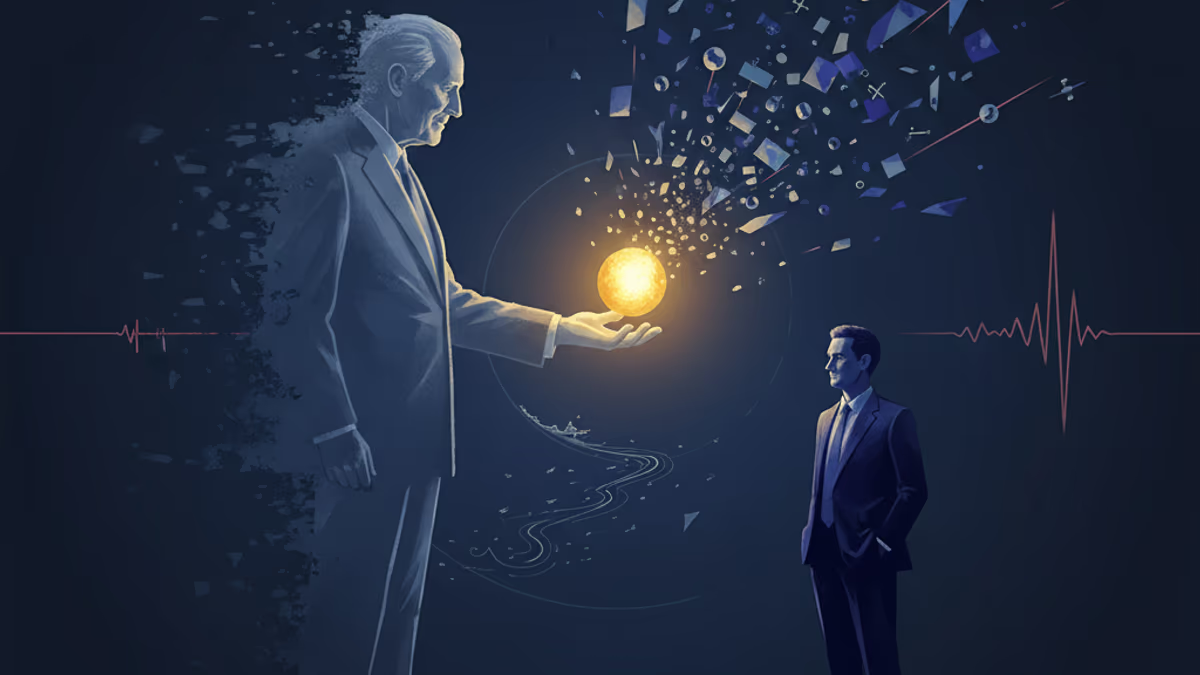
Tim Cook, 25 Years Later — Apple's Next Page
On April 21, Apple's board announced Tim Cook's phased retirement plan. Fifteen years since he took the company from Steve Jobs in 2011, and 25 years counting his earlier tenure as senior vice president — it is a long goodbye.
Cook's legacy is told in numbers. Apple's market capitalization stood at $350 billion when he became CEO in August 2011. As of the April 21, 2026 close, it is $3.8 trillion — a 1,900% increase that runs more than eight times the S&P 500 average over the same window. The story behind those numbers is bigger still. Cook translated Jobs's product genius into operational genius. The supply-chain pivot toward India and Southeast Asia, the rise of services revenue, the push into India and emerging markets — all his work.
The reported successor is John Ternus, Apple's senior vice president of hardware engineering. Inside Apple he is known as "the product person": he led the M1 chip program and was a key decision-maker on Vision Pro. The market's first reaction was muted. Apple shares fell 1.2% on announcement day and recovered the next session. Investors had been preparing for life after Cook. The harder question lies elsewhere — after the genius of operations, does Apple need a genius of products again?
$40 Billion to Anthropic — A New Map of AI Alliances
Big Tech's biggest bets this week all pointed at one company: Anthropic.
On April 21, Amazon disclosed an additional $10 billion investment in Anthropic, bringing its cumulative commitment to roughly $18 billion. On April 24, reports said Google was considering up to a $30 billion further stake — meaning two Big Tech rivals were jointly preparing roughly $40 billion of fresh capital for the same AI lab. Silicon Valley's unwritten rule against funding shared competitors did not survive the week.
The motive is hedging against OpenAI. With AWS and Google Cloud both effectively shut out of the OpenAI–Microsoft alliance, each desperately needs a Tier-1 model that runs on its own cloud. Anthropic's Claude is now beating GPT-4o in a growing number of coding and reasoning benchmarks, and just as importantly, it remains the only "independent camp" that two warring giants can both back without picking a side.

A separate $20 billionAI merger also surfaced, framed as building a "third pole" against Big Tech. Nvidia's market cap crossed $5 trillion. AI infrastructure demand shows no sign of cooling, and the gravitational centers of AI capital are now unmistakably three: OpenAI–Microsoft, Anthropic–Amazon/Google, and Nvidia.
After Hormuz — Talks Stall, Shots at the White House
Last week's Hormuz drama entered a new phase.
On April 23, the U.S. and Iran agreed to extend their ceasefire by 30 days, and global equities briefly cheered. Two days later, the Trump administration abruptly canceled the special envoy it had been preparing to send to Pakistan for Iran negotiations. No reason was given publicly. The same day, the U.S. Navy said clearance of the sea mines laid in the Strait of Hormuz would take several more weeks. Diplomacy went dark and the supply-chain clock stopped. South Korea's average gasoline price for the week reached 1,847 won per liter — its highest in two years.
Geopolitical tension was joined by a more direct shock. On the night of Saturday, April 25, shots were fired near the White House Correspondents' Dinner in Washington, D.C. President Trump was rapidly evacuated mid-dinner and the Secret Service sealed the venue. Trump was unhurt, but coming after July's attempted shooting at a Pennsylvania rally, this is the second direct security incident against the president in nine months. The White House announced two new executive orders on cybersecurity within hours. When threats reach the dinner table, politics changes too.
The Cyber Front's Next Act — Satellites, Golf Clubs, Emojis
The cyber front moved on three tracks this week.
On April 23, it emerged that a new Russian reconnaissance satellite had positioned itself in orbit near a U.S. spy satellite. Dubbed a "matryoshka satellite," it conceals a smaller craft inside the launch vehicle, then approaches and detaches near its target. It marks the first time the U.S. has formally acknowledged that space is a contested operational domain. On April 22, a security firm published an analysis of new malware attributed to a North Korea-linked group, finding that emoji characters were embedded as comments throughout the code — a fresh evasion technique, since automated detection systems treat emojis as plain text.
The most striking case was reported on April 26: a U.S. golf club chain hack that exposed roughly 500,000 member records, again attributed to North Korean operators. The reason is simple — those membership lists include large numbers of senior U.S. political and corporate figures. The week closed with another twist: the U.S. Cybersecurity and Infrastructure Security Agency (CISA) had excluded Anthropic from its newly announced AI security tooling procurement. The same government, on the same week, was nudging private capital toward Anthropic and shutting it out of national-security purchases. The dissonance is its own data point.
K-Pop's New Champion — TXT's First Grand Slam
In the shadow of geopolitics and cyber alarms, K-pop reached another summit.
After hitting No. 1 on the BillboardHot 100 with "Stick With You" on April 22, Tomorrow X Together (TXT) went on by April 26 to top all five major Billboard charts simultaneously — Hot 100, Billboard 200, Global 200, Artist 100, and Radio Songs. It is the first Grand Slam ever achieved by a Korean boy group. Reaching that summit in their seventh year offers one answer to the industry's long-standing "who comes after BTS?" question.
The same week, BLACKPINK's Jennie cracked the Billboard top 15 with a collaboration alongside Australian band Tame Impala, while BTS, edged out by "Stick With You," remained on both the Hot 100 and Global 200. RIIZE broke a seven-month silence to confirm a June comeback. On the K-drama side, projects starring Kim Hee-ae, Cha Seung-won, and Kim Seon-ho, a Park Hae-soo–Lee Hee-joon thriller, and Park Bo-young's modern return all surfaced — the second-half 2026 Hallyu lineup took shape inside a single week.
Authors

Combining the sharp eye of a financial auditor with the warm sensibility of a picture book editor, writing stories that read the currents of the AI era. Currently Editor-in-Chief at Liabooks.
Related Articles
Trump announced substantial progress on a US-Iran peace deal and Hormuz reopened after six weeks. Bitcoin jumped from $74,000 to $76,700 in four hours. Xi seated Putin, Iran, and India at the same desk in one week. SpaceX opened its books for the first time in 23 years with the largest IPO in U.S. history; Nvidia conceded China to Huawei. BTS held the Billboard 200 top 10 for an eighth straight week.
Trump and Xi met in Beijing for the first time in nine years. Microsoft poured $100B into OpenAI and became the supporting actor; Cerebras received $70B on day one. Hormuz entered week six. Cisco cut 4,000. ILLIT hit Billboard No. 1, CORTIS debuted at No. 3, and BTS is confirmed for the World Cup Final halftime stage.

A closed Hormuz arrives at the kitchen table, Musk vs. Altman puts a trillion dollars on trial, the Big Four bet $650 billion on AI, and Trump sends 25% tariff invoices to long-time allies. K-pop's seventeen-year slave-contract era closes with a standard-contract reform.
From the Hormuz blockade to K-pop's 12th Billboard week — seven days that rewrote the rules. Rare earth leverage, Anthropic's thaw, and a 46-minute DeFi heist point to the same shift.
Trump announced substantial progress on a US-Iran peace deal and Hormuz reopened after six weeks. Bitcoin jumped from $74,000 to $76,700 in four hours. Xi seated Putin, Iran, and India at the same desk in one week. SpaceX opened its books for the first time in 23 years with the largest IPO in U.S. history; Nvidia conceded China to Huawei. BTS held the Billboard 200 top 10 for an eighth straight week.
Trump and Xi met in Beijing for the first time in nine years. Microsoft poured $100B into OpenAI and became the supporting actor; Cerebras received $70B on day one. Hormuz entered week six. Cisco cut 4,000. ILLIT hit Billboard No. 1, CORTIS debuted at No. 3, and BTS is confirmed for the World Cup Final halftime stage.
A closed Hormuz arrives at the kitchen table, Musk vs. Altman puts a trillion dollars on trial, the Big Four bet $650 billion on AI, and Trump sends 25% tariff invoices to long-time allies. K-pop's seventeen-year slave-contract era closes with a standard-contract reform.
From the Hormuz blockade to K-pop's 12th Billboard week — seven days that rewrote the rules. Rare earth leverage, Anthropic's thaw, and a 46-minute DeFi heist point to the same shift.
Thoughts
Share your thoughts on this article
Sign in to join the conversation