
PRISM Weekly Digest: Second Week of April 2026
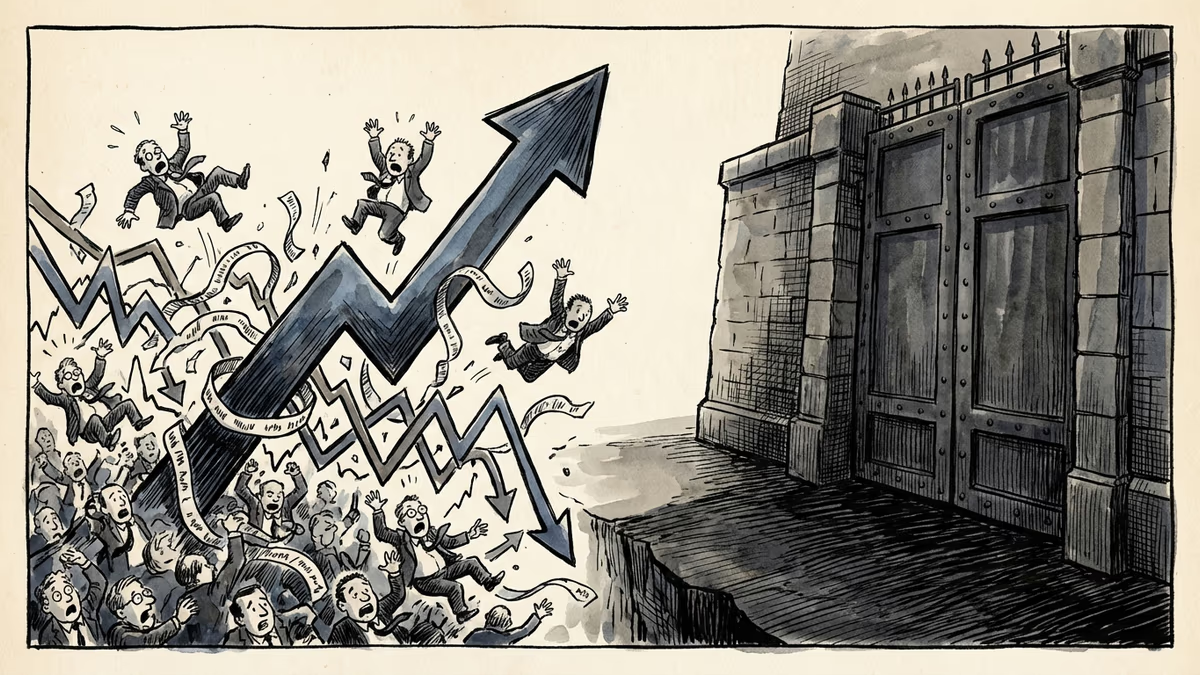
Trump's Liberation Day tariff shock and the 90-day pause — markets went on the wildest ride in years. China excluded, 145% vs. 125% tariff war, and what it means for the new trade order.
Apr Week 2, 2026 | Ninety Days — After the Tariff Storm
At 1:07 p.m. on April 9, Trump posted a single sentence on Truth Social.
"I am hereby authorizing a 90-day pause on tariffs for over 75 countries that have shown a willingness to negotiate." The S&P 500 rose 9.5% in the 90 minutes that followed — the largest single-session gain since the post-pandemic surge of 2020. But one country did not make the list. China. On the same day, U.S. tariffs on Chinese goods rose to 145%.
Liberation Day, and What Came After
On April 2, Trump placed his largest economic bet of his second term. The branding was theatrical — "Liberation Day." A 10% universal baseline tariff on all imports, layered with country-specific "reciprocal" tariffs reaching as high as 50% for some trading partners. The most sweeping trade barriers the U.S. had erected since the Smoot-Hawley Tariff Act of 1930.
Markets responded with immediate, severe judgment. The S&P 500 fell 10.5% in the two days of April 3 and 4. The Dow lost 4,500 points across three sessions. Before New York opened, Japan's Nikkei had already shed 7.8% and South Korea's KOSPI had fallen 5.5%. The Korean won pushed past 1,480 per dollar. South Korea had been assigned a 25% reciprocal tariff rate.
China moved first. It imposed 34% retaliatory tariffs on U.S. imports. Trump raised China's rate to 104%. China responded with 84%. Trump escalated to 145%. China matched with 125%. Within a single week, U.S.-China trade had been elevated to what amounts to a comprehensive mutual embargo.
The April 9 pause was an abrupt reversal — but with conditions. The 10% baseline tariff remains in force. The pause applies only to the reciprocal layer. And China is explicitly excluded.
What the Markets Saw

The market's reaction to the pause was something close to euphoric panic — only upward. The S&P 500's 9.5% single-session gain. The Nasdaq surged 12.2%. A substantial portion of the $6 trillion in market capitalization erased between April 3 and 8 returned in a single afternoon.
But the bond market was telling a different story. When equities fall sharply, Treasuries typically rise — the flight-to-safety trade. This week, that logic broke down. The 10-year Treasury yield climbed from 4.01% to 4.59% even as stocks were declining. Stocks falling and bonds falling together is unusual enough to be alarming. It suggests that investors began questioning not just market conditions but the bedrock reliability of U.S. assets themselves. The dollar index fell to its lowest level in two years.
Apple became the emblem of the week. Roughly 90% of iPhones are assembled in China. Apple's stock fell 23% between April 4 and 8, wiping approximately $750 billion from its market capitalization. Tim Cook flew to Washington on April 8 for a meeting at the White House. What was said was not disclosed.
The IMF revised its global growth forecast for 2026 from 2.8% to 2.3%. Treasury Secretary Scott Bessent called the 90-day window "a negotiating period." In practice, the world now has 90 days to negotiate a new trade architecture while perched on a working detonator.
AI Keeps Running
While the world debated tariffs, Google held its annual Cloud Next conference in Las Vegas from April 9 to 11 — beginning, by coincidence or design, on the same day as the tariff pause. The centerpiece was Gemini 2.5 Flash, a model that offers meaningfully improved reasoning and multimodal processing at 40% lower API pricing than its predecessor. Vertex AI's agentic pipeline tools received a substantial update, and Google Workspace got full AI assistant integration.
The quieter announcement may prove more consequential. Google formally launched NotebookLM for enterprise, adding audio summaries and real-time source citation. The ability for AI to ingest internal documents, meeting notes, and research reports and synthesize them into structured analysis is generating serious enterprise interest. The product is gaining traction in segments — legal, consulting, finance — where dense document analysis is a daily bottleneck.
On the Chinese AI front, Alibaba released Qwen3 as open source on Hugging Face. Early download velocity is tracking 37% faster than Llama 3.3 at comparable post-release intervals. The open-source strategy is China's most effective countermeasure to U.S. export restrictions: code released publicly does not respect borders. While U.S.-China trade moves toward decoupling, their AI capabilities are converging.
K-Culture in Spring
While trade anxieties dominated global headlines, Korean entertainment continued its quiet accumulation of records.
aespa released their second studio album, Astral, on April 7. First-week Spotify streams: 38 million. The music video passed 100 million YouTube views in 72 hours. Lead single "Black Mamba (Rebirth)" — which foregrounds SM Entertainment's extended fictional universe — managed a Billboard Hot 100 entry, a notable achievement for a concept-heavy track.
On television, tvN's My Perfect Secretary hit 8.4% ratings at episode 6, aided by the chemistry between Song Hye-kyo and Park Bo-gum. It claimed the top position in Netflix's non-English series global chart. In a week when the news cycle was dominated by economic dread, the impulse to seek out a good story reasserted itself, as it always does.
Authors

Combining the sharp eye of a financial auditor with the warm sensibility of a picture book editor, writing stories that read the currents of the AI era. Currently Editor-in-Chief at Liabooks.
Related Articles
Trump announced substantial progress on a US-Iran peace deal and Hormuz reopened after six weeks. Bitcoin jumped from $74,000 to $76,700 in four hours. Xi seated Putin, Iran, and India at the same desk in one week. SpaceX opened its books for the first time in 23 years with the largest IPO in U.S. history; Nvidia conceded China to Huawei. BTS held the Billboard 200 top 10 for an eighth straight week.
Trump and Xi met in Beijing for the first time in nine years. Microsoft poured $100B into OpenAI and became the supporting actor; Cerebras received $70B on day one. Hormuz entered week six. Cisco cut 4,000. ILLIT hit Billboard No. 1, CORTIS debuted at No. 3, and BTS is confirmed for the World Cup Final halftime stage.

A closed Hormuz arrives at the kitchen table, Musk vs. Altman puts a trillion dollars on trial, the Big Four bet $650 billion on AI, and Trump sends 25% tariff invoices to long-time allies. K-pop's seventeen-year slave-contract era closes with a standard-contract reform.
Tim Cook's 25-year goodbye, $40 billion poured into Anthropic, shots near the White House dinner, and TXT's first Grand Slam — a week of power handed over and crises distributed.
Trump announced substantial progress on a US-Iran peace deal and Hormuz reopened after six weeks. Bitcoin jumped from $74,000 to $76,700 in four hours. Xi seated Putin, Iran, and India at the same desk in one week. SpaceX opened its books for the first time in 23 years with the largest IPO in U.S. history; Nvidia conceded China to Huawei. BTS held the Billboard 200 top 10 for an eighth straight week.
Trump and Xi met in Beijing for the first time in nine years. Microsoft poured $100B into OpenAI and became the supporting actor; Cerebras received $70B on day one. Hormuz entered week six. Cisco cut 4,000. ILLIT hit Billboard No. 1, CORTIS debuted at No. 3, and BTS is confirmed for the World Cup Final halftime stage.
A closed Hormuz arrives at the kitchen table, Musk vs. Altman puts a trillion dollars on trial, the Big Four bet $650 billion on AI, and Trump sends 25% tariff invoices to long-time allies. K-pop's seventeen-year slave-contract era closes with a standard-contract reform.
Tim Cook's 25-year goodbye, $40 billion poured into Anthropic, shots near the White House dinner, and TXT's first Grand Slam — a week of power handed over and crises distributed.
Thoughts
Share your thoughts on this article
Sign in to join the conversation