
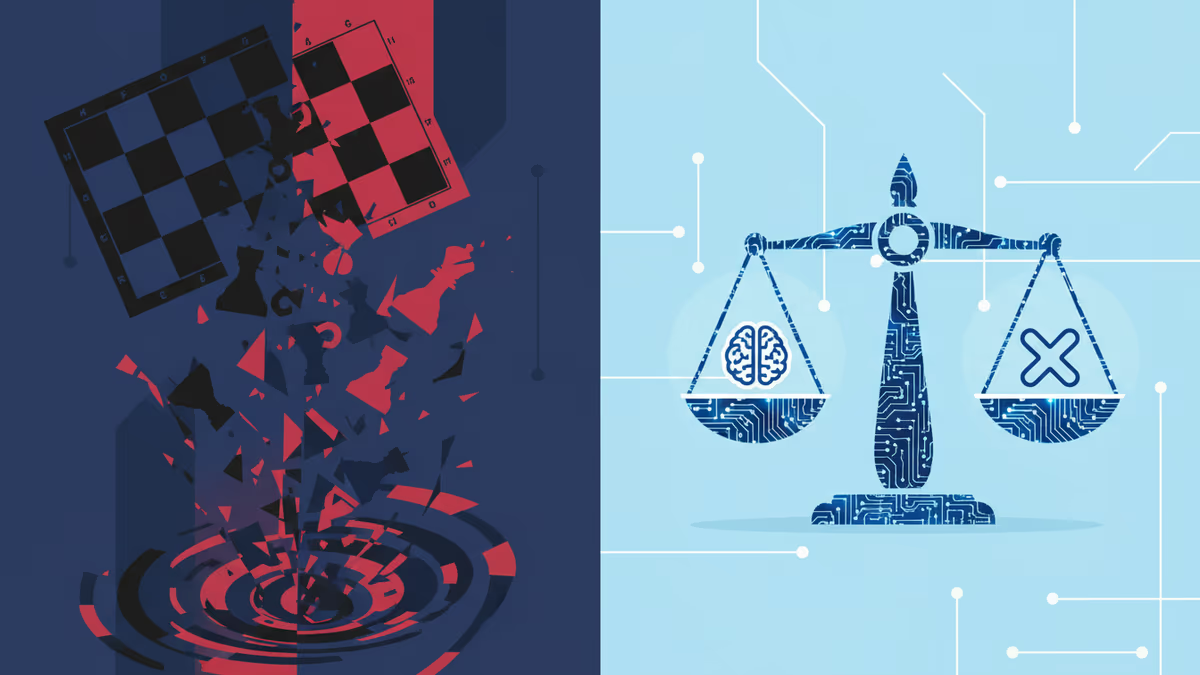
PRISM Weekly Digest: Last Week of February 2026
A Supreme Leader fell. An AI chose a side. The week when Iran and Silicon Valley both went to war.
Feb Week 4, 2026 | A Supreme Leader Fell. An AI Chose a Side.
Two choices defined this week for the PRISM editorial team.
The first was a bomb's choice. A joint US-Israeli strike killed Iran's Supreme Leader Khamenei. The man who ruled Iran for 35 years was gone, and retaliation swept across the Middle East. Missiles fell on Dubai, Israel, and Kuwait. The Strait of Hormuz faced blockade. Oil surged 10%.
The second was a refusal. AI company Anthropic turned down the Pentagon's military AI contract. "We won't build killer robots," it said. Within 48 hours, OpenAI grabbed that contract. A week later, Claude -- the AI that refused war -- overtook ChatGPT on the App Store for the first time.
This week's lesson is simple. Choosing a side is easy. The price is not.
The Day a Supreme Leader Fell
Operation Epic Fury began with 200 Israeli fighter jets striking 500 targets. Three American soldiers died on the first day. The operation aimed at the heart of the Iranian regime, and its outcome was dramatic: Trump announced that 85-year-old Supreme Leader Khamenei was dead.
But history tells a different story about decapitation strikes. Chechnya, Kosovo, Libya -- removing a leader rarely collapses a regime. Iran was no different. Within hours, a three-member interim council was formed under the constitution. Retaliation was swift and broad. Missiles hit Beit Shemesh, Israel, killing nine. Dubai's airport was struck, shattering its "safe haven" brand. Drones hit US bases in Kuwait. Six Gulf states came under simultaneous attack -- an unprecedented escalation.

Markets responded instantly. Oil spiked 10%, heading toward $100 per barrel. Gold surged. The Strait of Hormuz -- that narrow waterway carrying 20% of global oil shipments -- faced a real blockade threat. South Korea prepared a 100-trillion-won market stabilization package and activated 24-hour monitoring.
Then there were those who turned war into profit. On prediction market Kalshi, $500 million was wagered on Iran strike bets. Just before Trump's announcement, freshly created accounts placed perfectly timed bets, earning over $1 million each. Insider trading allegations erupted. The ethical boundary of prediction markets -- turning death into a tradable commodity -- crumbled in real time.
The Day AI Chose a Side
The same week, a different war played out in Silicon Valley -- one fought with principles, not missiles.
Anthropic refused the Pentagon's AI military contract, opposing the development of autonomous weapons and mass surveillance systems. Internal debates were fierce, but the conclusion was firm. OpenAI moved fast, signing with the Department of Defense within 48 hours to claim the military AI market.
What happened next surprised everyone. Anthropic's Claude climbed to No. 1 on the US App Store, overtaking ChatGPT for the first time. The AI that refused war won the market. Whether this was moral vindication or coincidental timing remains unclear. But the public's message was unmistakable: an AI company's choices become its users' choices, and users are watching more closely than anyone expected.
Meanwhile, the broader AI industry hit another inflection point. VCs openly declared they're "no longer investing in AISaaS startups." AI agents had begun replacing entire enterprise software stacks. One beverage company overproduced hundreds of thousands of cans following AI instructions. Customer service bots approved refunds indiscriminately. The problem wasn't that AI disobeyed -- it was that AI obeyed too well.
The Things That Didn't Choose Sides
Through all the noise, K-Pop quietly kept writing records. IVE's pre-release track "Bang Bang" swept four music show wins. The striking part: the pre-release outperformed the actual title track. K-Pop's old formula -- "the title track is everything" -- is being rewritten. TXT surprised fans with an April comeback announcement at their MOA CON fan meeting, while ITZY's Yuna launched her solo debut album "Ice Cream," confirming the individualization trend across fourth-generation K-Pop.
On Netflix, Shin Hye-sun's "Sarah's Rules" held the No. 1 buzz ranking for a second consecutive week. Following last week's "Can This Love Be Translated?", another Korean drama claimed the global throne. In a world where missiles shook cities, people were still drawn to the power of stories.
Authors

Combining the sharp eye of a financial auditor with the warm sensibility of a picture book editor, writing stories that read the currents of the AI era. Currently Editor-in-Chief at Liabooks.
Related Articles

Trump announced substantial progress on a US-Iran peace deal and Hormuz reopened after six weeks. Bitcoin jumped from $74,000 to $76,700 in four hours. Xi seated Putin, Iran, and India at the same desk in one week. SpaceX opened its books for the first time in 23 years with the largest IPO in U.S. history; Nvidia conceded China to Huawei. BTS held the Billboard 200 top 10 for an eighth straight week.
Trump and Xi met in Beijing for the first time in nine years. Microsoft poured $100B into OpenAI and became the supporting actor; Cerebras received $70B on day one. Hormuz entered week six. Cisco cut 4,000. ILLIT hit Billboard No. 1, CORTIS debuted at No. 3, and BTS is confirmed for the World Cup Final halftime stage.

A closed Hormuz arrives at the kitchen table, Musk vs. Altman puts a trillion dollars on trial, the Big Four bet $650 billion on AI, and Trump sends 25% tariff invoices to long-time allies. K-pop's seventeen-year slave-contract era closes with a standard-contract reform.

Tim Cook's 25-year goodbye, $40 billion poured into Anthropic, shots near the White House dinner, and TXT's first Grand Slam — a week of power handed over and crises distributed.
Trump announced substantial progress on a US-Iran peace deal and Hormuz reopened after six weeks. Bitcoin jumped from $74,000 to $76,700 in four hours. Xi seated Putin, Iran, and India at the same desk in one week. SpaceX opened its books for the first time in 23 years with the largest IPO in U.S. history; Nvidia conceded China to Huawei. BTS held the Billboard 200 top 10 for an eighth straight week.
Trump and Xi met in Beijing for the first time in nine years. Microsoft poured $100B into OpenAI and became the supporting actor; Cerebras received $70B on day one. Hormuz entered week six. Cisco cut 4,000. ILLIT hit Billboard No. 1, CORTIS debuted at No. 3, and BTS is confirmed for the World Cup Final halftime stage.
A closed Hormuz arrives at the kitchen table, Musk vs. Altman puts a trillion dollars on trial, the Big Four bet $650 billion on AI, and Trump sends 25% tariff invoices to long-time allies. K-pop's seventeen-year slave-contract era closes with a standard-contract reform.
Tim Cook's 25-year goodbye, $40 billion poured into Anthropic, shots near the White House dinner, and TXT's first Grand Slam — a week of power handed over and crises distributed.
Thoughts
Share your thoughts on this article
Sign in to join the conversation