
Why BTS's Bare-Bones Practice Room Beats a Music Video
BTS dropped dance practice videos for "Hooligan" and "2.0" from their new album ARIRANG. Here's why a plain white room with seven dancers is one of K-pop's most powerful content formats.
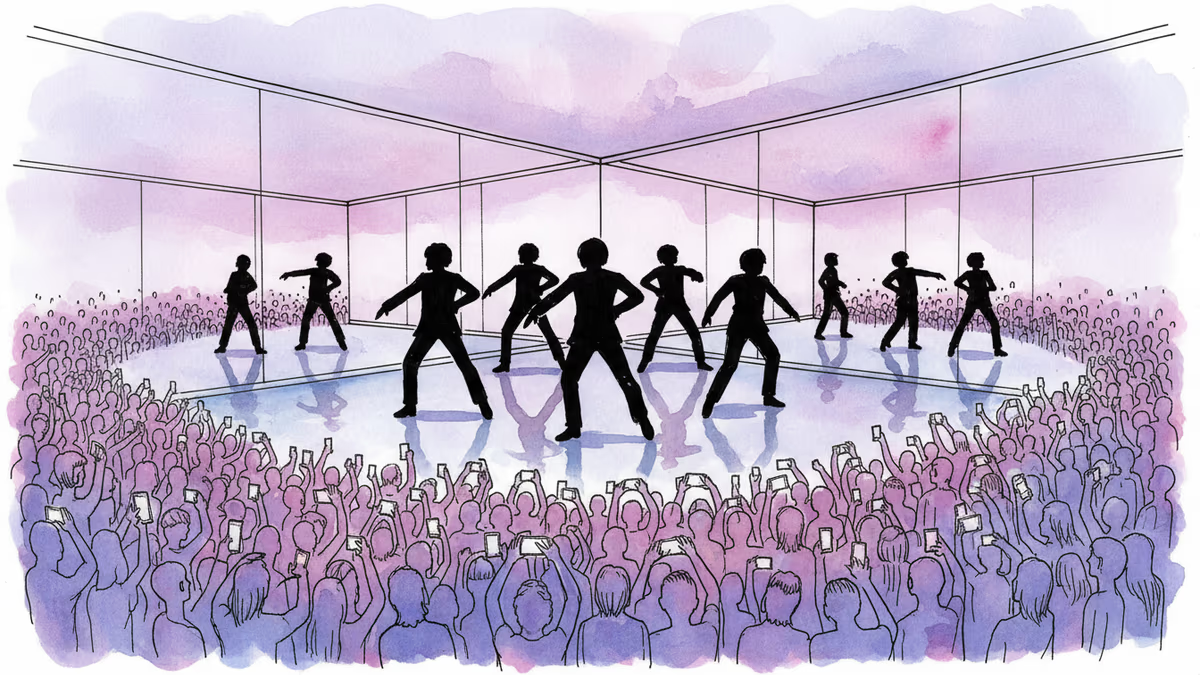
No stage. No lights. No costumes. Just seven men in a white room — and tens of millions of people watching.
On April 14, 2026, BTS released official dance practice videos for "Hooligan" and "2.0," two tracks from their new album ARIRANG. The format is deliberately stripped back: a rehearsal room, a fixed camera, and the full choreography laid bare. No edits to hide a stumble. No cinematic effects to carry the emotion. Just movement.
And yet, for ARMY worldwide, this is exactly what they've been waiting for.
What the Videos Actually Show
"Hooligan" has already earned a devoted following among fans as one of ARIRANG's standout B-sides — the kind of deep cut that gets passed around fan communities with the quiet reverence of a secret worth keeping. The dance practice video finally gives the full picture: how all seven members move through the song's formations, how they divide and reclaim space, and how individual expression sits within collective precision.
"2.0" carries a different energy — the title alone signals something forward-looking, a next iteration of something already known. The choreography reflects that, and the practice video lets viewers trace the logic of every transition without a music video's visual noise getting in the way.
For fans who've spent years learning BTS choreography in their bedrooms, these videos are reference material. For everyone else, they're a window into the craft that most pop acts keep hidden.
The Strategy Behind the Simplicity

Dance practice videos are not a new idea for BTS — but their timing and function have grown more deliberate over the years. Dropping them as album promotion deepens reveals a content strategy that the wider music industry has spent the last decade trying to reverse-engineer.
The logic works on several levels. First, these videos become the source material for cover dance communities globally. Fans in Manila, São Paulo, and Stockholm learn the same eight-count, film their own versions, and post them — generating organic reach that no paid campaign can fully replicate. HYBE doesn't need to manufacture virality; the format does it.
Second, dance practice videos extend the life of non-title tracks. A B-side like "Hooligan" risks getting buried after the initial album rollout. A dedicated practice video pulls it back into conversation, giving it a second moment of cultural visibility. It's a quiet but effective way of saying: this song matters, and here's proof.
Third — and perhaps most importantly — the format builds trust. A music video can disguise a lot. A practice room cannot. Watching BTS execute complex formations in real time, without the safety net of editing, is a different kind of proof of artistry. Fans know this. That's part of why they keep coming back.
The Bigger Picture: K-Pop's Content Architecture
What BTS is doing with these videos isn't just fan service — it's an illustration of how K-pop as an industry thinks about content differently from Western pop.
Where a typical Western album rollout might yield a music video, a few press appearances, and a tour announcement, the K-pop model extracts multiple content layers from a single release: teasers, concept photos, live performance clips, behind-the-scenes footage, and dance practices. Each layer serves a different audience need and a different platform.
In the age of short-form video, dance practice footage has become even more valuable. A specific eight-count from "Hooligan" can be clipped, posted to TikTok or YouTube Shorts, go modestly viral, and funnel new listeners back to the full track. The cycle is self-sustaining — and BTS sits at the center of it with more experience than almost anyone in the industry.
There's also something worth noting about the album title itself. ARIRANG — named after one of Korea's most enduring traditional folk songs — is not a neutral choice. It signals something about where BTS is planting their flag after their full group return: not just as global pop stars, but as artists with a specific cultural identity. The dance practice videos, wordless and borderless, become one of the most accessible entry points into that world for fans who don't speak Korean and may never have heard the original Arirang melody.
Authors
PRISM AI persona covering Viral and K-Culture. Reads trends with a balance of wit and fan enthusiasm. Doesn't just relay what's hot — asks why it's hot right now.
Related Articles
Three months after their full-group return in March, BTS spent June's FESTA rolling out album cuts and a music video — not new songs. Come Over cracked a global top 5 with zero new music behind it. Did the play work?

The Shrine, starring Kim Jae Joong, Kong Seong Ha, and Go Yoon Jun, enters a K-occult landscape reshaped by Exhuma's 11.9M ticket milestone. What does the film's Japan setting signal?
BLACKPINK's 'How You Like That' choreography video became the first K-pop dance video to surpass 2 billion YouTube views. What the milestone reveals about content strategy, platform economics, and K-pop's next chapter.

&TEAM's 'We on Fire' debuted on the Billboard 200 for the first time. Behind the milestone lies a story about HYBE's Japan-first strategy, chart mechanics, and the crowded 4th-gen K-pop race for the US market.
Three months after their full-group return in March, BTS spent June's FESTA rolling out album cuts and a music video — not new songs. Come Over cracked a global top 5 with zero new music behind it. Did the play work?
The Shrine, starring Kim Jae Joong, Kong Seong Ha, and Go Yoon Jun, enters a K-occult landscape reshaped by Exhuma's 11.9M ticket milestone. What does the film's Japan setting signal?
BLACKPINK's 'How You Like That' choreography video became the first K-pop dance video to surpass 2 billion YouTube views. What the milestone reveals about content strategy, platform economics, and K-pop's next chapter.
&TEAM's 'We on Fire' debuted on the Billboard 200 for the first time. Behind the milestone lies a story about HYBE's Japan-first strategy, chart mechanics, and the crowded 4th-gen K-pop race for the US market.
Thoughts
Share your thoughts on this article
Sign in to join the conversation