
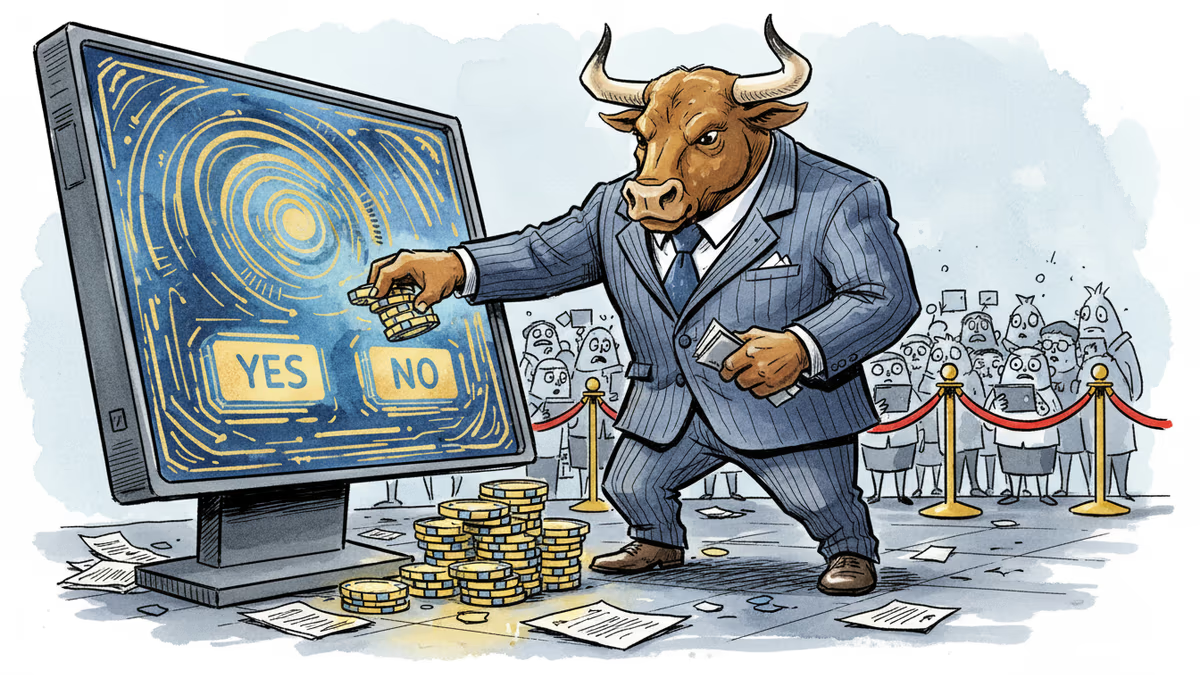
Wall Street Is Betting on Prediction Markets. Should You?
From NYSE's parent company to Nasdaq, institutional money is flooding into prediction markets. But as Wall Street moves in, is the 'wisdom of crowds' at risk of becoming another professional trading arena?
"People told us we were crazy." That was six months ago. Today, Troy Dixon's phone won't stop ringing.
Dixon, co-head of global markets at Tradeweb, proposed integrating prediction markets into the platform's electronic trading infrastructure and was met with disbelief. Then Tradeweb announced a partnership with Kalshi in February 2026. The calls haven't stopped since. "We have never had this kind of feedback from clients on any other announcement," he says.
From Super Bowl Bets to Derivatives Desks
Prediction markets work on a simple premise: you buy a contract that pays out if an event happens, and loses if it doesn't. Yes or no. Will the Fed cut rates? Will a specific hurricane make landfall? Who wins the next election?
For most of their existence, these platforms were associated with political junkies and sports bettors. The majority of activity on Kalshi and its biggest rival Polymarket is still retail — ordinary people wagering on football games and election outcomes. But the institutional layer building underneath is now impossible to ignore.
In October 2025, Intercontinental Exchange — the parent company of the New York Stock Exchange — invested $2 billion in Polymarket. Jump Trading, a high-frequency trading firm, took equity stakes in both Kalshi and Polymarket in exchange for providing market-making services. Susquehanna International Group, one of the largest market-makers on the planet, is Kalshi's lead market-maker and is recruiting staff specifically to trade prediction markets. SIG also plans to launch its own prediction market product in partnership with Robinhood.
This week, Kalshi announced a deal with XP International, a Brazilian financial services firm, letting Brazilian clients trade financial and political prediction market contracts through XP's platform. Lucas Rabechini, XP Inc.'s director of financial products, called prediction market contracts "a new asset class." Meanwhile, Tradeweb — majority-owned by the London Stock Exchange Group and serving pension funds, hedge funds, banks, and insurers — has opened its institutional client base directly to Kalshi's markets.
Why Professionals Are Paying Attention
The institutional interest isn't about picking Super Bowl winners. It comes down to two things: information and hedging.

On the information side, prediction markets aggregate real-money opinions on outcomes that directly affect financial portfolios — interest rate decisions, geopolitical events, commodity prices. For a hedge fund with exposure to energy markets, a liquid market pricing in the probability of a Middle East conflict isn't just interesting. It's actionable intelligence.
On the hedging side, the use cases are just beginning to emerge. Interactive Brokers founder Thomas Peterffy says his platform has already seen hedging on weather-related event contracts. "Extreme temperatures correlate with higher electricity use resulting in higher electricity prices and eventually greater natural gas consumption," he explains. "Utilities and pipelines are typical users." Former CFTC attorney Jake Preiserowicz confirms the trend: "We're seeing it in contracts related to economic indicators, like GDP growth rate, whether interest rates are going up or down."
The missing piece holding back wider adoption is margin trading. Most professional derivatives trading involves posting a fraction of the contract's value as collateral — not paying the full amount upfront. Prediction markets don't yet offer this. As Preiserowicz puts it: "Imagine you think oil prices are going up, so you want to buy 10,000 barrels. That's a lot of cash to put up for commodities that generally only move a few pennies. It's not a feasible way to hedge." Until margin becomes available, large-scale institutional positioning remains constrained.
Nasdaq Filed. ETFs Are Queued Up.
The structural integration of prediction markets into mainstream finance is already in motion at the regulatory level. Nasdaq recently filed a proposal with the SEC to offer prediction-market-style yes/no event contracts. Several investment firms have submitted proposals for prediction market ETFs — bundled investment products built around event outcomes.
Roundhill Financial's proposed "Democrat President ETF" is the most illustrative example. Investors deposit money; the fund puts it into prediction market contracts tied to a Democratic presidential win. If the Democrat wins, there's a payout. If not, the ETF goes to zero. It's a prediction market with a brokerage wrapper.
Whether the SEC approves these products is genuinely uncertain. Prediction markets currently sit under CFTC jurisdiction as derivatives. But there's a growing bipartisan push in Congress to reclassify them as gambling — which would fundamentally change the regulatory landscape. Kalshi is simultaneously navigating multiple lawsuits over its sports markets while trying to cement its identity as a financial infrastructure company. Edward Ridgeley, CEO of prediction market software startup Stand, puts the industry's current moment plainly: "It's where crypto was around 2017." Some firms are watching. Others are moving.
The Retail Question Nobody's Answering Cleanly
Here's the tension at the center of this story. Prediction markets built their appeal on a democratic premise: anyone can participate, prices reflect genuine crowd wisdom, no gatekeepers. The absence of intermediaries was a feature, not a bug.
But as institutional capital flows in — with professional market-makers, algorithmic traders, and high-frequency firms — the information and capital asymmetry grows. Cory Klippsten, CEO of Swan Bitcoin, is blunt: "Trading firms and crypto funds that have gotten into prediction markets are making the majority of the profits. Retail is really just getting their face ripped off every day."
This isn't unique to prediction markets. It's the story of every financial market that has ever professionalized. Options markets, futures markets, crypto — the pattern is consistent. Retail participation provides liquidity. Professional traders extract most of the value. The question is whether prediction markets, with their promise of democratized forecasting, will follow the same trajectory.
The ETF proposals add another wrinkle. One of the stated appeals of prediction markets is the removal of intermediaries. If Roundhill or Nasdaq inserts a fee-charging wrapper between the retail investor and the market, the original value proposition starts to erode — even as access technically broadens.
Authors
Related Articles
Venmo's biggest redesign since 2021 adds social features, personalized offers, and a revamped feed. But the timing — amid PayPal's restructuring and Stripe's reported interest — raises a harder question about who this update is really for.
E-commerce fintech Parker filed for Chapter 7 bankruptcy on May 7, despite raising over $200M. The YC-backed startup's abrupt shutdown left small business customers scrambling—and exposed the fragility of vertical fintech models.

Tesla expanded its driverless robotaxi to Dallas and Houston, even after reporting 14 crashes in Austin. What does this tell us about how autonomous vehicles actually get built?
OpenAI acquired Hiro Finance, an AI-powered personal finance startup. Is this just a talent grab, or is the ChatGPT maker quietly building a financial services empire?
Venmo's biggest redesign since 2021 adds social features, personalized offers, and a revamped feed. But the timing — amid PayPal's restructuring and Stripe's reported interest — raises a harder question about who this update is really for.
E-commerce fintech Parker filed for Chapter 7 bankruptcy on May 7, despite raising over $200M. The YC-backed startup's abrupt shutdown left small business customers scrambling—and exposed the fragility of vertical fintech models.
Tesla expanded its driverless robotaxi to Dallas and Houston, even after reporting 14 crashes in Austin. What does this tell us about how autonomous vehicles actually get built?
OpenAI acquired Hiro Finance, an AI-powered personal finance startup. Is this just a talent grab, or is the ChatGPT maker quietly building a financial services empire?
Thoughts
Share your thoughts on this article
Sign in to join the conversation