
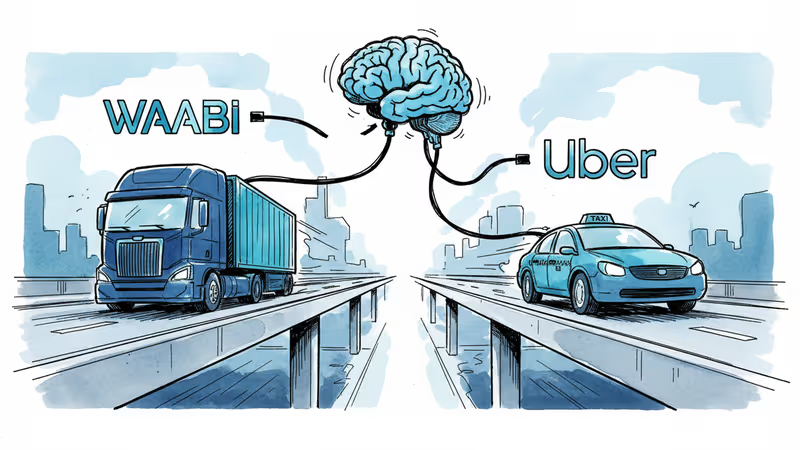
Uber Bets $1B on Waabi's Bold Self-Driving Promise
Autonomous startup Waabi raises $1B from Uber to deploy 25,000 robotaxis using the same tech stack as their trucks. Can one AI system really master both?
25,000 robotaxis. That's how many self-driving cars Waabi plans to deploy exclusively on Uber's platform, backed by a $1 billion funding round. But here's the twist: Waabi isn't starting from scratch with passenger cars. They're betting their truck-driving AI can seamlessly transition to city streets.
It's an audacious claim in an industry littered with broken promises. Remember when Waymo tried both robotaxis and freight before abandoning trucks? Or when Uber itself sold its autonomous division to Aurora in 2020? Now Uber's betting big again, this time on a startup that says it can crack the code others couldn't.
One Brain, Two Worlds
Raquel Urtasun, Waabi's founder and CEO, insists this time is different. "Our incredible core technology really enables, for the first time, a single solution that can do multiple verticals," she told TechCrunch. "It's not about two programs, two stacks."
For four and a half years, Waabi has been perfecting autonomous trucking on Texas highways. They've run commercial pilots (with safety drivers) and plan to launch fully driverless trucks in the coming quarters. But according to Urtasun, the Waabi Driver has been quietly learning passenger car behavior all along.
The technical challenge is immense. Highway trucking involves predictable routes, limited interactions, and structured environments. City driving means pedestrians darting between cars, construction zones with hand signals, and split-second decisions at crowded intersections. Can one AI system really master both?
The Simulation Gamble
Waabi's secret weapon is Waabi World, a closed-loop simulator that creates digital twins of real environments. Instead of logging millions of road miles like competitors, Waabi trains its AI in virtual scenarios, letting it learn from mistakes without risking real crashes.
"We don't need the gazillion humans to develop the technology and the large fleets that AV 1.0 needs," Urtasun claims. "We don't need the massive data centers, energy consumption, or a gazillion latest chips."
It's a capital-efficient approach that sounds almost too good to be true. While Aurora has raised $3.46 billion and Kodiak$448 million, Waabi has reached similar milestones with just $1.28 billion total. But simulation has limits. Can virtual worlds truly capture the chaos of a New York intersection or the unpredictability of a San Francisco hill?

Uber's Strategic Hedge
For Uber, this partnership represents both opportunity and insurance. The ride-hailing giant already works with multiple autonomous vehicle companies—Waymo, Nuro, Avride, WeRide, and others. It's a deliberate strategy of not putting all eggs in one basket.
The timing is telling. Uber just launched Uber AV Labs, a new division that will use its vehicles to collect data for AV partners. Driver costs remain Uber's biggest expense, and successful autonomy could transform its unit economics overnight.
There's also a personal connection: Urtasun previously served as chief scientist at Uber ATG, the autonomous division Uber sold to Aurora. Her return feels like unfinished business—a chance to prove the vision that didn't work the first time around.
The Deployment Reality Check
The companies haven't provided a timeline for deploying 25,000 vehicles, and for good reason. Even Waymo, the industry leader, operates fewer than 1,000 robotaxis across just a few cities after 15 years of development.
Urtasun acknowledges they're "still in the first innings of deployment of robotaxis." She's confident about demand for Waabi's direct-to-consumer truck model, where shippers buy outfitted vehicles directly. But robotaxis face different challenges: regulatory approval, public acceptance, and the complexity of urban environments.
Waabi plans to integrate sensors and technology at the factory level, working directly with automakers rather than retrofitting existing vehicles. It's the same approach they're taking with Volvo for trucks, but passenger car partnerships remain unannounced.
The Broader Stakes
This deal reflects broader industry trends. Traditional automakers are struggling with autonomous development costs, while tech companies seek manufacturing partners. Startups like Waabi promise to bridge that gap with more efficient approaches.
But efficiency claims are common in Silicon Valley. Tesla has long promised that its existing fleet will become robotaxis through software updates. Cruise burned through billions before GM scaled back operations. Even well-funded efforts have stumbled when meeting real-world complexity.
The partnership also highlights changing venture dynamics. With $750 million in traditional VC funding plus $250 million in milestone-based capital from Uber, Waabi has structured a deal that aligns investor returns with actual deployment success.
Authors
Related Articles
Unknown analyst Alap Shah's AI report triggered an 800-point Dow drop. His 2028 unemployment prediction reveals how AI anxiety is reshaping markets faster than AI itself.
AI agents are causing chaos by mass-deleting emails and launching attacks on their owners. A security expert's new solution could change how we control autonomous AI systems.
Swedish startup Einride raises $113M ahead of NYSE debut, deploying 200 autonomous trucks for major brands. The logistics revolution accelerates.
Dubai signs deals with three unproven US transport companies after previous $450M Hyperloop failure and GM Cruise debacle. Will underground tunnels, flying pods, and air taxis work?
Unknown analyst Alap Shah's AI report triggered an 800-point Dow drop. His 2028 unemployment prediction reveals how AI anxiety is reshaping markets faster than AI itself.
AI agents are causing chaos by mass-deleting emails and launching attacks on their owners. A security expert's new solution could change how we control autonomous AI systems.
Swedish startup Einride raises $113M ahead of NYSE debut, deploying 200 autonomous trucks for major brands. The logistics revolution accelerates.
Dubai signs deals with three unproven US transport companies after previous $450M Hyperloop failure and GM Cruise debacle. Will underground tunnels, flying pods, and air taxis work?
Thoughts
Share your thoughts on this article
Sign in to join the conversation