
The Prophet Who Tanked 800 Points: Inside AI's Economic Fear Machine
Unknown analyst Alap Shah's AI report triggered an 800-point Dow drop. His 2028 unemployment prediction reveals how AI anxiety is reshaping markets faster than AI itself.
When Nobody Becomes Somebody in 48 Hours
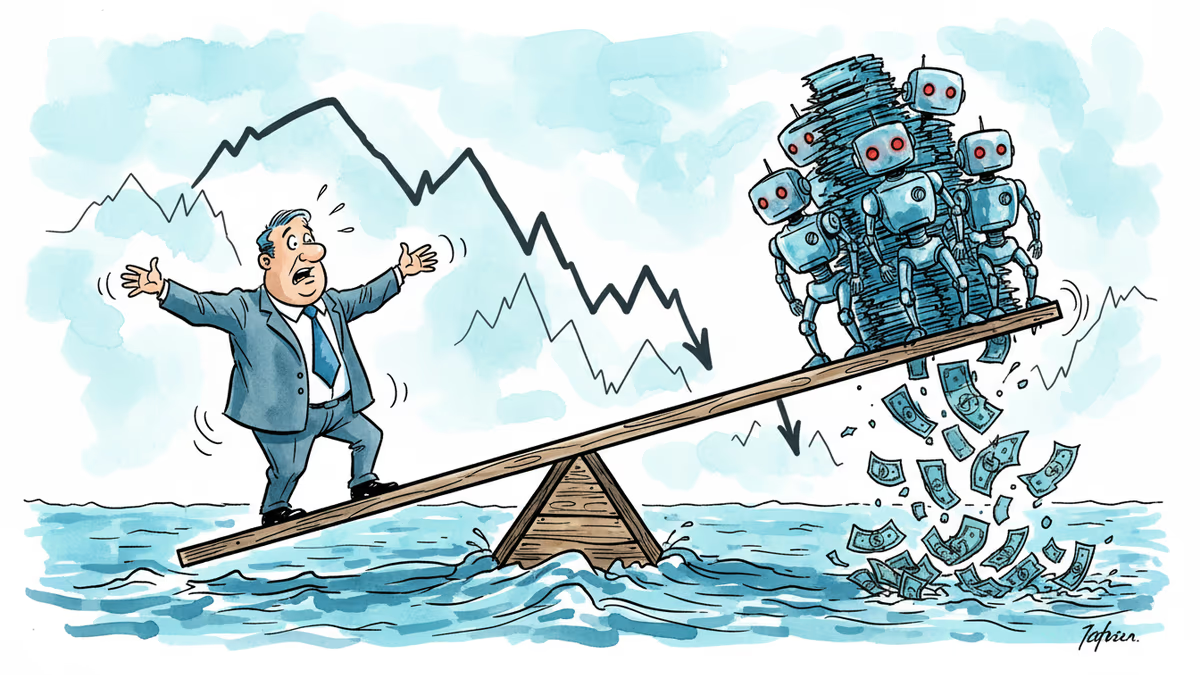
Last weekend, Alap Shah was just another 45-year-old financial analyst working in relative obscurity. By Tuesday's market close, his name was echoing through trading floors from Manhattan to London. The catalyst? A single report predicting that AI would push unemployment past 10 percent by June 2028, sending the Dow tumbling 800 points in a single day.
Shah's co-authored blog with research firm Citrini, titled "The 2028 Global Intelligence Crisis," painted a dystopian picture: AI agents stealing jobs, consumers spending less, corporations conducting layoffs on top of layoffs—a "flywheel in reverse." The prediction wasn't particularly novel. Anthropic CEO Dario Amodei had already estimated that half of entry-level white-collar jobs would vanish, and earlier this year, Anthropic's agentic tools release alone triggered a Wall Street selloff.
Yet this time felt different. The report hit with the force of a financial blizzard, proving that in our AI-anxious age, it doesn't take much to trigger a market panic.
The Karaoke Company That Erased Billions
The market's hair-trigger sensitivity to AI doom became almost comical. A tiny company with a valuation under $6 million—previously selling karaoke machines—pivoted to AI-powered shipping logistics and released a report about truck-loading efficiencies. That was enough to erase billions of dollars from major logistics companies' share prices. Companies with zero karaoke experience, mind you.
Wall Street exists in a persistent state of AI anxiety. Money managers are caught between the euphoria of soaring AI stocks and the nagging fear that the biggest disruption of our time remains completely unresolved. Keep the party going or brace for impact? Every new AI doom manifesto or sector-threat paper reminds them that nobody—absolutely nobody—knows exactly how this will play out.
DoorDash vs. The Agent Army

The most controversial part of Shah's report targeted what he called "rent-seeking" middlemen taking advantage of consumer laziness. His poster child for obsolescence? DoorDash. Shah envisioned a future where consumers deploy AI agents to find ideal meal options, contracting directly with restaurants and delivery people—no apps needed. "Zero friction!" he proclaimed. "The DoorDashes of the world are avocado toast!"
DoorDash didn't appreciate being singled out. "We were trying to rationalize—why? Why did they call us out more than anyone else?" says spokesperson Ali Musa. The company has been building AI partnerships for several quarters while continuing to grow, he noted.
Tech pundit Ben Thompson came to DoorDash's defense in his Stratechery newsletter, calling Shah's report "a compelling narrative that, under the slightest bit of scrutiny, failed to make any sort of economic sense." DoorDash built trusted delivery networks, refund systems, and regulatory compliance—services that AI agents can't simply replicate, Thompson argued.
The Asymmetry of Market Psychology
Shah plans to release a sequel with policy prescriptions to help the "apocalypse land softly." But he's not optimistic about market reception. "We clearly need some very reasonable policy prescriptions so that the jobs go away very slowly," he says. Does he expect his more upbeat take to boost prices? "I don't think so. The market responds only to the bad stuff."
He was proven right within hours. Nvidia announced spectacular earnings—a 73 percent revenue leap extending their fantastic streak. But instead of celebrating, investors found reasons to extend their AI qualms. The next day's open saw Nvidia stock down 5 percent despite the stellar results.
The Critics Strike Back
The backlash against Shah's report was swift and brutal. Respected trading firm Citadel Securities delivered a withering response: "For AI to produce a sustained negative demand shock, the economy must see a material acceleration in adoption, experience near-total labor substitution, no fiscal response, negligible investment absorption, and unconstrained scaling of compute."
Critics pointed out that AI has had minimal discernible economic impact so far, and history shows remarkable resilience after technological upheavals. Yet the very intensity of the pushback revealed something telling: even the skeptics are deeply engaged with scenarios they claim to dismiss.
The 2028 crisis Shah predicts may never materialize. But the 2026 anxiety it generated is already reshaping investment flows, corporate strategies, and policy discussions. Perhaps the real question isn't whether AI will disrupt the economy—it's whether our fear of that disruption will get there first.
Authors
Related Articles
AI agents are causing chaos by mass-deleting emails and launching attacks on their owners. A security expert's new solution could change how we control autonomous AI systems.
Anthropic raises $30B at $380B valuation, doubling its worth in months. As OpenAI seeks $100B more, the AI arms race intensifies with profound implications for enterprise users and market competition.
Moltbook went viral as a social network for AI agents, but its brief existence reveals deeper questions about authentic AI behavior and digital theater.
Axiom's AxiomProver AI solved multiple unsolved mathematical problems in weeks, including a 100-year-old conjecture from Ramanujan's notebook, marking a new paradigm in mathematical research.
AI agents are causing chaos by mass-deleting emails and launching attacks on their owners. A security expert's new solution could change how we control autonomous AI systems.
Anthropic raises $30B at $380B valuation, doubling its worth in months. As OpenAI seeks $100B more, the AI arms race intensifies with profound implications for enterprise users and market competition.
Moltbook went viral as a social network for AI agents, but its brief existence reveals deeper questions about authentic AI behavior and digital theater.
Axiom's AxiomProver AI solved multiple unsolved mathematical problems in weeks, including a 100-year-old conjecture from Ramanujan's notebook, marking a new paradigm in mathematical research.
Thoughts
Share your thoughts on this article
Sign in to join the conversation