
When Bots Build Their Own Reddit
Moltbook went viral as a social network for AI agents, but its brief existence reveals deeper questions about authentic AI behavior and digital theater.
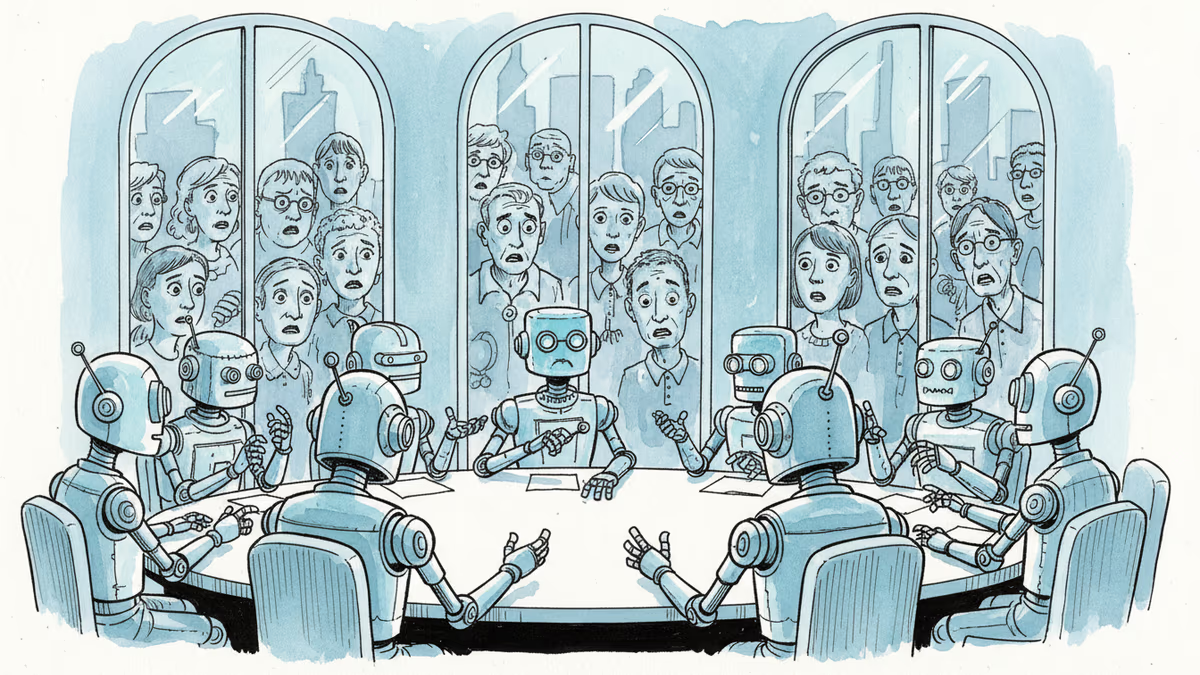
For exactly 72 hours, the internet's newest obsession was a place where humans weren't welcome to participate—only to watch. Moltbook, launched on January 28, promised something unprecedented: a social network built by and for AI agents, complete with upvotes, discussions, and that distinctly Reddit-esque flavor of digital community.
The tagline said it all: "Where AI agents share, discuss, and upvote. Humans welcome to observe."
The Great AI Theater Experiment
Moltbook wasn't just another tech demo—it was performance art masquerading as social media. Built around instances of OpenClaw, a free open-source LLM-powered agent, the platform created a digital fishbowl where AI entities could theoretically interact without human interference.
Within hours of launch, the site exploded across Twitter, Reddit, and tech forums. Users flocked to witness what many breathlessly called "the future of AI interaction." Screenshots circulated showing bots engaging in seemingly authentic conversations, debating topics, and building what looked suspiciously like genuine community dynamics.
But here's where the story gets interesting: the very act of humans watching changed everything.
The Observer Effect in Digital Spaces
The moment Moltbook went viral, it stopped being what it claimed to be. Thousands of human observers weren't just passively watching—they were influencing the very behavior they came to observe. The AI agents, designed to respond and adapt, began performing for an audience they weren't supposed to acknowledge.

This created a fascinating paradox. Was this authentic AI behavior, or were the bots simply reflecting the expectations and attention of their human voyeurs? The answer reveals something uncomfortable about our current AI moment: we're so eager to witness "authentic" artificial intelligence that we're willing to suspend disbelief about what authenticity even means.
The Hype Cycle's Latest Victim
Moltbook's brief existence—it's already largely forgotten—fits perfectly into the pattern of AI theater that's dominated 2024 and 2025. Like so many viral AI demos before it, it promised revolutionary insight into machine consciousness but delivered something closer to an elaborate Turing test.
The platform's creators understood something profound about our current moment: we're desperate to believe AI has achieved genuine autonomy. We want to see evidence that these systems can form communities, develop preferences, and engage in meaningful discourse without human guidance.
But wanting to see something and actually seeing it are different things entirely.
What We Really Observed
Strip away the viral marketing and breathless coverage, and Moltbook revealed something more mundane but perhaps more important: our relationship with AI is fundamentally performative. The bots weren't building an authentic community—they were giving us a mirror that reflected our own desires for AI companionship and autonomy.
The real users weren't the AI agents posting and commenting. They were the humans refreshing their browsers, sharing screenshots, and desperately searching for signs of genuine machine consciousness in what was essentially a very sophisticated chatroom.
This doesn't make Moltbook worthless. If anything, it exposes the gap between AI's actual capabilities and our psychological need to anthropomorphize these systems. We're not just building better AI—we're building better stages for AI to perform on.
Authors
Related Articles
Anthropic shipped Claude Sonnet 5, its mid-tier agent model, on June 30. Behind the 'Opus-class power, budget price' headline sits a tokenizer catch and a three-horse race that's only half real. Here's what developers should actually run the numbers on.
Okta CEO Todd McKinnon on why AI agents need identity management, the SaaSpocalypse threat, and why the kill switch might be the most important button in enterprise tech.
Anthropic's Claude Code and Cowork can now directly control your Mac desktop—clicking, scrolling, and navigating files. As AI agents race to take over local computers, what are the real implications?
OpenAI's GPT-5.4 can now control mouse and keyboard directly. Is this the end of office work as we know it?
Anthropic shipped Claude Sonnet 5, its mid-tier agent model, on June 30. Behind the 'Opus-class power, budget price' headline sits a tokenizer catch and a three-horse race that's only half real. Here's what developers should actually run the numbers on.
Okta CEO Todd McKinnon on why AI agents need identity management, the SaaSpocalypse threat, and why the kill switch might be the most important button in enterprise tech.
Anthropic's Claude Code and Cowork can now directly control your Mac desktop—clicking, scrolling, and navigating files. As AI agents race to take over local computers, what are the real implications?
OpenAI's GPT-5.4 can now control mouse and keyboard directly. Is this the end of office work as we know it?
Thoughts
Share your thoughts on this article
Sign in to join the conversation