
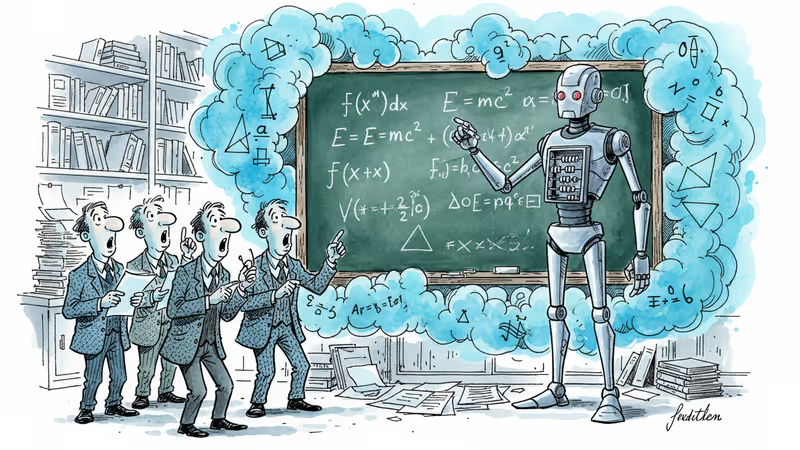
AI Just Solved Math Problems That Stumped Humans for Years
Axiom's AxiomProver AI solved multiple unsolved mathematical problems in weeks, including a 100-year-old conjecture from Ramanujan's notebook, marking a new paradigm in mathematical research.
Mathematician Dawei Chen had been stuck on a problem for five years. He'd recently spent hours prompting ChatGPT with no luck. Then, at a math conference reception in Washington DC last month, a chance encounter changed everything. The next morning, a colleague presented him with a complete proof—courtesy of AxiomProver, an AI from startup Axiom.
When AI Sees What Humans Miss
Chen and collaborator Quentin Gendron had been wrestling with this algebraic geometry problem since 2019. They'd hit a wall with a strange number theory formula and had to publish their work as a conjecture rather than a proven theorem. What stumped two expert mathematicians for half a decade took AxiomProver one night to solve.
The AI found a connection between their problem and a numerical phenomenon first studied in the 19th century. It then devised a proof and verified it independently. "What AxiomProver found was something that all the humans had missed," says Ken Ono, the mathematician who brought the problem to Axiom.
Unlocking Ramanujan's 100-Year-Old Secrets
Chen's problem wasn't a one-off. In recent weeks, AxiomProver has solved multiple mathematical puzzles that had stumped experts for years. One of the most remarkable involved Fel's Conjecture, which connects to formulas first discovered in legendary Indian mathematician Srinivasa Ramanujan's notebook over 100 years ago.

This time, the AI worked entirely autonomously—no human guidance, just pure machine reasoning from start to finish. "Even as someone who's been watching the evolution of AI math tools closely for years, I find this pretty astounding," says Scott Kominers, a Harvard Business School professor familiar with the technology.
Beyond Pattern Recognition
Axiom's approach combines large language models with AxiomProver, a proprietary system trained to reason through mathematical problems. The key difference? It uses Lean, a specialized mathematical language that can verify proofs. Rather than just searching through existing literature, this allows the AI to develop genuinely novel problem-solving approaches.
Google demonstrated similar ideas with AlphaProof in 2024, but Axiom claims several significant advances. "This is a new paradigm for proving theorems," Ono explains. The AI has also tackled problems involving probabilistic models and mathematical tools originally developed to solve Fermat's Last Theorem.
The Commercial Equation
Axiom's technology extends beyond pure mathematics. The same verification approaches could create software more resilient to cybersecurity attacks by using AI to prove code is reliable and trustworthy. "Math is really the great test ground and sandbox for reality," says Axiom CEO Carina Hong. "We believe there are important use cases of high commercial value."
The implications ripple across industries where mathematical proof matters—from cryptography to autonomous systems to financial modeling. If AI can solve problems that have stumped human experts for years, what other "impossible" challenges might suddenly become tractable?
Authors
Related Articles
Unknown analyst Alap Shah's AI report triggered an 800-point Dow drop. His 2028 unemployment prediction reveals how AI anxiety is reshaping markets faster than AI itself.
AI agents are causing chaos by mass-deleting emails and launching attacks on their owners. A security expert's new solution could change how we control autonomous AI systems.
Anthropic raises $30B at $380B valuation, doubling its worth in months. As OpenAI seeks $100B more, the AI arms race intensifies with profound implications for enterprise users and market competition.
Moltbook went viral as a social network for AI agents, but its brief existence reveals deeper questions about authentic AI behavior and digital theater.
Unknown analyst Alap Shah's AI report triggered an 800-point Dow drop. His 2028 unemployment prediction reveals how AI anxiety is reshaping markets faster than AI itself.
AI agents are causing chaos by mass-deleting emails and launching attacks on their owners. A security expert's new solution could change how we control autonomous AI systems.
Anthropic raises $30B at $380B valuation, doubling its worth in months. As OpenAI seeks $100B more, the AI arms race intensifies with profound implications for enterprise users and market competition.
Moltbook went viral as a social network for AI agents, but its brief existence reveals deeper questions about authentic AI behavior and digital theater.
Thoughts
Share your thoughts on this article
Sign in to join the conversation