
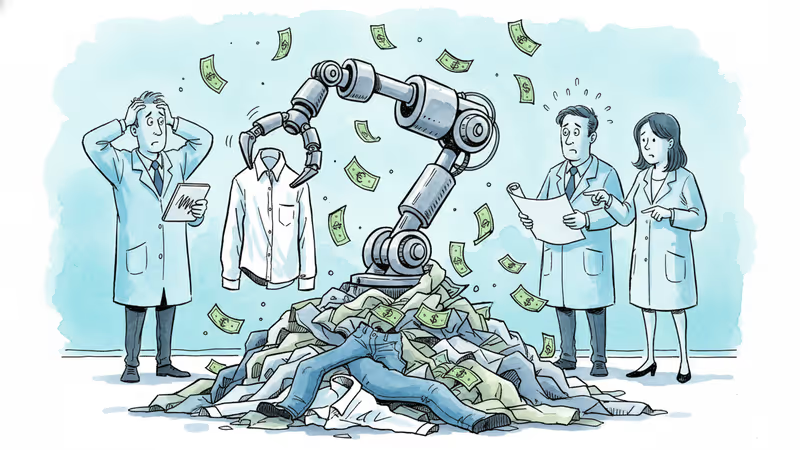
The $1 Billion Bet on Robots That Can't Fold Pants (Yet)
Physical Intelligence raised over $1 billion to build ChatGPT for robots, but won't tell investors when it'll make money. Inside the race to create general-purpose robotic intelligence.
A robot arm is trying to fold black pants. It's failing spectacularly. Next to it, another robot attempts to turn a shirt inside out with the determination of someone who'll eventually succeed—just not today. Meanwhile, a third robot peels a zucchini with surprising competence, depositing shavings into a container with mechanical precision.
This awkward ballet is unfolding inside Physical Intelligence's San Francisco headquarters, where $1 billion in funding is backing an audacious bet: building "ChatGPT for robots."
The Unglamorous Hardware Revolution
The scene looks more like a college robotics lab than a $5.6 billion startup. Blonde-wood tables are scattered with Girl Scout cookies, Vegemite jars, and tangled black wires. The robots themselves are deliberately unremarkable—each arm costs about $3,500 retail, though co-founder Sergey Levine notes they could manufacture them for under $1,000.
"A few years ago, a roboticist would've been shocked these things could do anything at all," Levine explains, gesturing toward the mechanical chaos. "But good intelligence compensates for bad hardware."
That's the core insight driving this company: the future of robotics isn't about building better arms or more precise sensors. It's about creating general-purpose intelligence that can inhabit any hardware platform, much like how software transformed smartphones from expensive gadgets into ubiquitous tools.
The CEO Who Won't Promise Profits
What makes Physical Intelligence particularly unusual isn't just its technology—it's what CEO Lachy Groom refuses to tell his investors. "I don't give investors answers on commercialization," he says of backers including Khosla Ventures, Sequoia Capital, and Thrive Capital. "That's sort of a weird thing, that people tolerate that."
Groom, who sold his first company at 13 in Australia and later became an early Stripe employee, spent five years as an angel investor backing companies like Figma, Notion, and Ramp before finding what he calls "the one." His philosophy is simple: "Good ideas at a good time with a good team—that's extremely rare."

The company's strategy revolves around what co-founder Quan Vuong calls "cross-embodiment learning." If someone builds new hardware tomorrow, they won't need to start data collection from scratch—they can transfer all the knowledge the model already has. "The marginal cost of onboarding autonomy to a new robot platform is just a lot lower," he explains.
The Commercial Reality Check
But Physical Intelligence isn't alone in this race. Pittsburgh-based Skild AI, founded in 2023, just raised $1.4 billion at a $14 billion valuation—and it's taking a notably different approach. While Physical Intelligence remains focused on pure research, Skild AI has already deployed commercially, generating $30 million in revenue across security, warehouses, and manufacturing in just a few months last year.
Skild AI has even taken public shots at competitors, arguing on its blog that most "robotics foundation models" are just vision-language models "in disguise" that lack "true physical common sense." The philosophical divide is sharp: Skild AI bets that commercial deployment creates a data flywheel that improves the model with each real-world use case. Physical Intelligence bets that resisting near-term commercialization will enable superior general intelligence.
The Automation Paradox
The pants-folding robot reveals something deeper about our relationship with automation. We expect robots to master human tasks, but we've designed human tasks around human limitations. Folding clothes requires spatial reasoning, fine motor control, and adaptation to different fabrics—skills that took humans millions of years to develop.
Yet Physical Intelligence is already working with companies across logistics, grocery, and manufacturing to test whether their systems are ready for real-world deployment. Vuong claims that in some cases, they already are. The "any platform, any task" approach creates enough surface area that some automation challenges are ready to be solved today.
The Platform Wars Begin
What's really at stake here isn't just better robots—it's who controls the operating system for the automated future. Just as Microsoft and Apple shaped how we interact with computers, and Google and Meta defined social media, the winner of the robotics foundation model race will influence how machines integrate into human society.
The implications extend far beyond manufacturing floors. These systems will determine how robots behave in homes, hospitals, and schools. They'll encode assumptions about privacy, safety, and human-robot interaction that could persist for decades.
Authors
Related Articles

Cluely CEO admits to fabricating $7M revenue figure, exposing how startup "fake it till you make it" culture has gone too far. What this means for the ecosystem.

Unknown analyst Alap Shah's AI report triggered an 800-point Dow drop. His 2028 unemployment prediction reveals how AI anxiety is reshaping markets faster than AI itself.
Phantom Space acquired assets from bankrupt Vector Launch, showing how failed space companies' technologies are finding new life. Is this becoming the new normal in aerospace?
AI agents are causing chaos by mass-deleting emails and launching attacks on their owners. A security expert's new solution could change how we control autonomous AI systems.
Cluely CEO admits to fabricating $7M revenue figure, exposing how startup "fake it till you make it" culture has gone too far. What this means for the ecosystem.
Unknown analyst Alap Shah's AI report triggered an 800-point Dow drop. His 2028 unemployment prediction reveals how AI anxiety is reshaping markets faster than AI itself.
Phantom Space acquired assets from bankrupt Vector Launch, showing how failed space companies' technologies are finding new life. Is this becoming the new normal in aerospace?
AI agents are causing chaos by mass-deleting emails and launching attacks on their owners. A security expert's new solution could change how we control autonomous AI systems.
Thoughts
Share your thoughts on this article
Sign in to join the conversation