

The AI Lab Ambition Scale: Who's Really Trying to Make Money?
A new framework reveals the true commercial ambitions of AI foundation model companies, from OpenAI's billions to research labs that prioritize science over profit.
The AI gold rush has created an unusual problem: it's becoming impossible to tell which companies actually want to strike it rich.
With $3 billion seed rounds becoming commonplace and legendary researchers launching labs with ambiguous commercial goals, the foundation model space has evolved into something unprecedented. Veterans from OpenAI, Google, and Anthropic are going solo, while academic stars are raising massive war chests without clear monetization plans. The result? A landscape where genuine research projects sit alongside future unicorns, often indistinguishable from the outside.
The Five Levels of AI Ambition
To make sense of this complexity, consider a simple framework: a five-level scale measuring not success, but ambition. It doesn't matter if you're profitable—only if you're trying to be.
Level 5: Already generating millions daily (OpenAI, Anthropic, Google) Level 4: Detailed roadmap to world domination Level 3: Multiple promising product concepts, timeline TBD Level 2: Rough outlines of potential plans Level 1: True wealth comes from loving yourself
The established players clearly occupy Level 5, but the new generation of labs launching in 2025-2026 presents a fascinating puzzle. With AI funding at historic highs, founders can essentially choose their ambition level without investor scrutiny. Even pure research projects attract eager capital.
Decoding the New Generation
Humans& exemplifies this ambiguity perfectly. The startup made headlines this week with its vision for next-generation AI models focused on communication and coordination rather than pure scaling. Their pitch promises to revolutionize workplace software—replacing Slack, Jira, and Google Docs while "redefining how these tools work at a fundamental level."
Yet for all the compelling rhetoric about post-software workplaces, Humans& remains deliberately vague about actual products. They want to build something; they just won't commit to specifics. This calculated ambiguity places them squarely at Level 3.

Thinking Machines Lab presents a more complex case. With former ChatGPT project lead Mira Murati raising a $2 billion seed round, you'd expect a Level 4 operation with military precision. But recent departures tell a different story. CTO Barret Zoph and at least five other employees left within the past two weeks, with nearly half the founding team no longer at the company after just one year.
The exodus suggests they aimed for Level 4 but discovered they were operating at Level 2 or 3. The plan wasn't as solid as it appeared.
The Spectrum of Scientific Ambition
World Labs offers a counternarrative to the chaos. Fei-Fei Li, the Stanford professor who established the ImageNet challenge that kickstarted modern deep learning, could easily coast on her legendary reputation. Instead, she raised $230 million for spatial AI and has since shipped both a world-generating model and commercial products targeting the gaming and special effects industries.
What looked like a Level 2 academic project has evolved into something approaching Level 4, potentially graduating to Level 5 soon.
At the opposite extreme sits Safe Superintelligence (SSI). Ilya Sutskever's post-OpenAI venture raised $3 billion while explicitly rejecting commercial pressures—even turning down a Meta acquisition attempt. With no product cycles and no products beyond their superintelligent foundation model in development, SSI embodies Level 1 thinking.
Yet Sutskever recently hinted at potential pivots if research timelines prove longer than expected or if breakthrough discoveries demand wider deployment. In AI's fast-moving landscape, even the most science-focused labs might jump levels rapidly.
The Money Problem
This ambiguity creates real industry drama. Much of the anxiety surrounding OpenAI's nonprofit-to-profit conversion stemmed from their overnight leap from Level 1 to Level 5. Similarly, Meta's early AI research operated at Level 2 when the company clearly wanted Level 4 results.
The fundamental issue isn't the money itself—there's plenty of that. It's the mixed signals about intentions. Investors, employees, and competitors struggle to predict behavior when commercial motivations remain opaque.
For founders, this flexibility offers unprecedented freedom. If you're not particularly motivated to become a billionaire, operating at Level 2 might deliver more satisfaction than the pressure-cooker environment of Level 5. The AI boom has created space for genuine scientific exploration alongside ruthless commercialization.
Authors
Related Articles
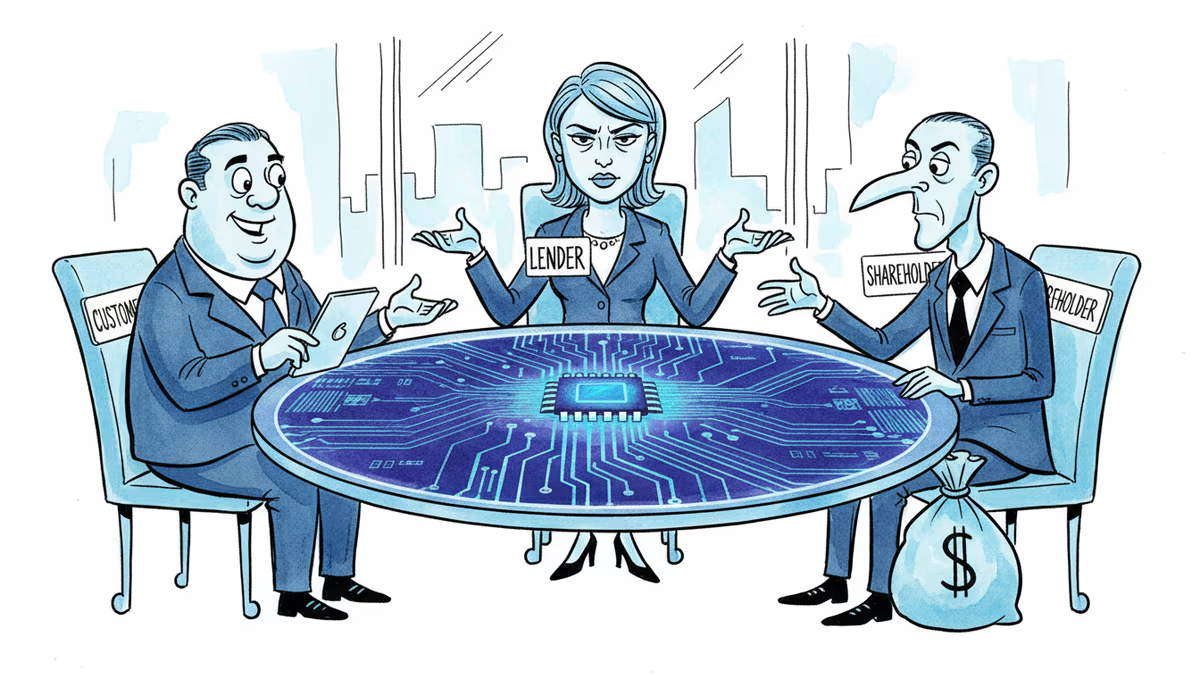
Cerebras Systems is targeting a $26.6B valuation in what could be 2026's largest tech IPO. But the real story is how deeply OpenAI is embedded in its capital structure—as customer, lender, and potential shareholder.
All 11 of xAI's original co-founders have now left Elon Musk's AI startup. With the company absorbed into SpaceX and declared 'rebuilt from foundations,' what does this mean for Grok—and for Musk's AI ambitions?

Despite fierce competition, the CEOs of Polymarket and Kalshi have co-invested in 5(c) Capital, a $35M VC fund targeting prediction market infrastructure. What this signals for the industry.
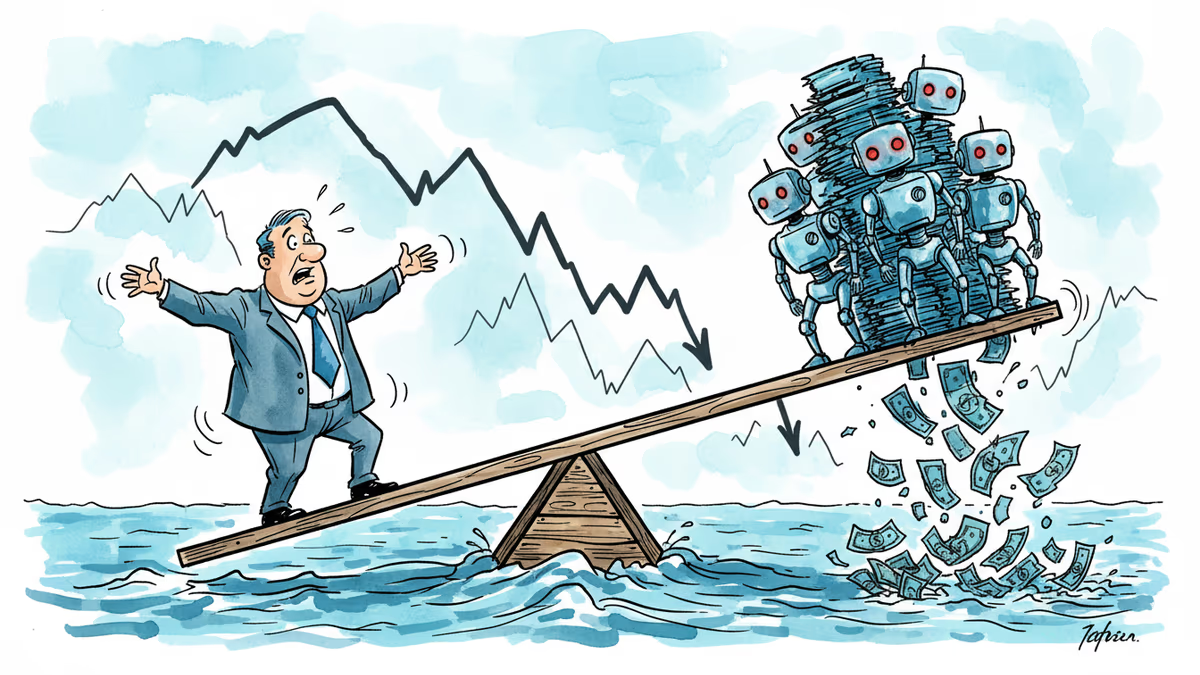
Unknown analyst Alap Shah's AI report triggered an 800-point Dow drop. His 2028 unemployment prediction reveals how AI anxiety is reshaping markets faster than AI itself.
Cerebras Systems is targeting a $26.6B valuation in what could be 2026's largest tech IPO. But the real story is how deeply OpenAI is embedded in its capital structure—as customer, lender, and potential shareholder.
All 11 of xAI's original co-founders have now left Elon Musk's AI startup. With the company absorbed into SpaceX and declared 'rebuilt from foundations,' what does this mean for Grok—and for Musk's AI ambitions?
Despite fierce competition, the CEOs of Polymarket and Kalshi have co-invested in 5(c) Capital, a $35M VC fund targeting prediction market infrastructure. What this signals for the industry.
Unknown analyst Alap Shah's AI report triggered an 800-point Dow drop. His 2028 unemployment prediction reveals how AI anxiety is reshaping markets faster than AI itself.
Thoughts
Share your thoughts on this article
Sign in to join the conversation