
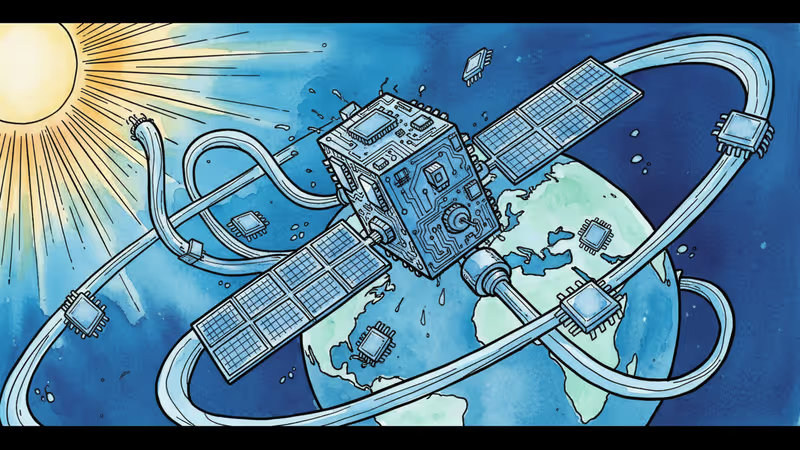
Why Musk Really Wants to Run AI in Space
SpaceX acquires xAI to build space-based data centers, creating a $1.25 trillion entity. Is Musk's vision of cosmic AI infrastructure realistic or just another grandiose promise?
Global electricity demand for AI is spiraling out of control. Elon Musk's solution? Move the whole operation to space.
SpaceX announced Monday it's acquiring Musk's AI startup xAI, creating a $1.25 trillion behemoth that becomes the world's most valuable private company. But the real story isn't the price tag—it's Musk's audacious claim that Silicon Valley will soon need to build data centers in space to fuel its AI ambitions.
The Logic Behind Cosmic Computing
"Global electricity demand for AI cannot be met with terrestrial solutions," Musk wrote in his blog post. His reasoning is straightforward: transport "resource-intensive efforts to a location with vast power and space." As he quipped, "Space is called 'space' for a reason."
The numbers back up the urgency. Training a single large language model like ChatGPT consumes millions of dollars in electricity. Tech giants Google, Microsoft, and Meta are already exploring nuclear power options to meet their AI energy needs. Some estimates suggest AI could consume as much electricity as entire countries within the next decade.
Space offers tantalizing advantages: solar panels operate 7x more efficiently without atmospheric interference, and the vacuum provides natural cooling. But the challenges are equally daunting. Launch costs, maintenance complexity, and radiation damage to hardware present massive hurdles that current technology hasn't solved.
The Musk Empire Consolidates
This acquisition continues Musk's pattern of weaving his companies together. Last year, xAI acquired his social media platform X (formerly Twitter) in a deal valuing the combined entity at over $110 billion. A decade ago, he used Tesla shares to purchase SolarCity, his cousin's renewable energy firm.

Bloomberg reports that SpaceX will proceed with its planned IPO later this year. In December, SpaceX valued itself at $800 billion through an employee share buyback, while xAI raised $20 billion last month, reaching a $230 billion valuation.
For investors, this consolidation presents a double-edged sword. While cross-company synergies could unlock value, it also concentrates enormous risk under Musk's increasingly unpredictable leadership.
The Regulatory Reality Check
Musk's space-based AI vision faces a regulatory minefield. The Federal Communications Commission already struggles to manage satellite internet constellations. Adding AI data centers to the mix would require unprecedented international cooperation on space governance.
Then there's the question of jurisdiction. Which country's laws apply to an AI system processing data in orbit? How do you enforce privacy regulations or content moderation policies in space? These aren't just technical challenges—they're fundamental questions about digital sovereignty in the space age.
What This Means for Everyone Else
If Musk's vision materializes, it could reshape the entire AI landscape. Traditional cloud providers like Amazon Web Services and Microsoft Azure would face competition from literal sky-high infrastructure. The cost advantages of space-based computing could create new winners and losers in the AI race.
For consumers, the implications are murky. Space-based AI might enable more powerful applications, but it could also create new dependencies on infrastructure that's literally out of reach. What happens when your AI assistant relies on satellites that malfunction millions of miles away?
The announcement also raises questions about Musk's other ventures. Will Tesla's Full Self-Driving technology eventually rely on space-based processing? Could Neuralink brain interfaces connect directly to orbital AI systems?
Authors
Related Articles
American Airlines just signed Starlink for 500+ aircraft. It's not just about faster inflight internet — it's a calculated move in the run-up to what could be the largest IPO in history.
SpaceX's upgraded Starship V3 completed its first test flight, deploying 20 Starlink simulators but losing the Super Heavy booster. With an IPO weeks away, the stakes just got higher.
SpaceX's IPO filing puts AI at the center, claiming a $26.5 trillion market opportunity. But can Grok compete with OpenAI and Anthropic for enterprise customers?
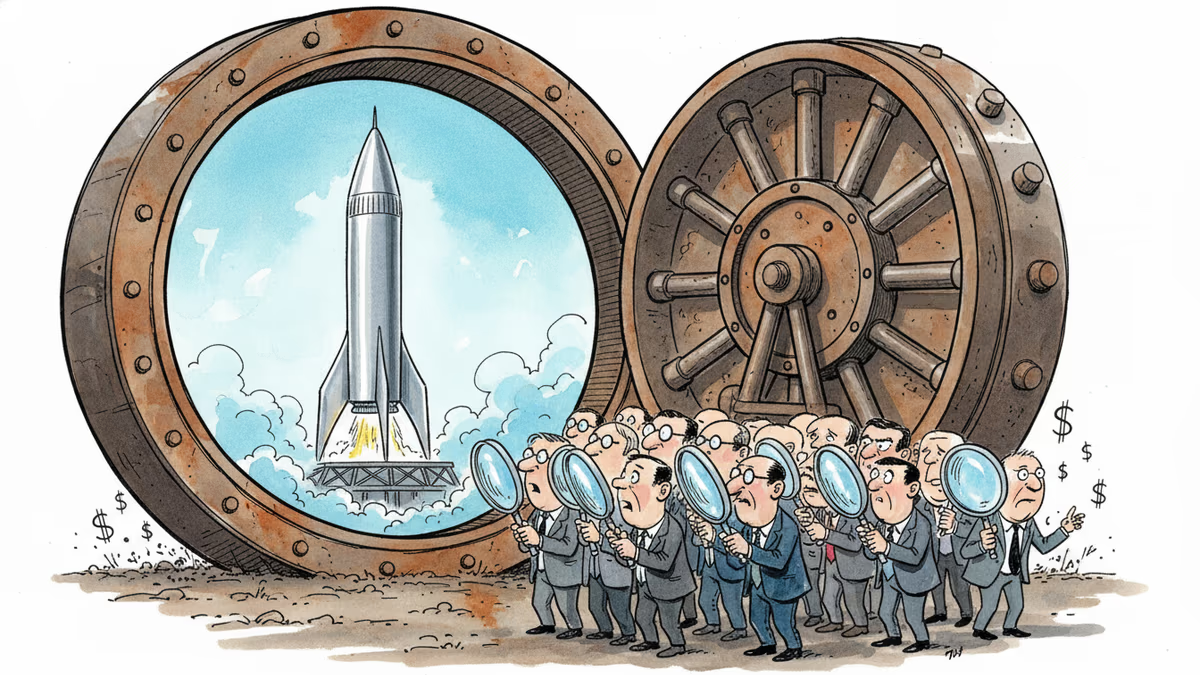
SpaceX filed a nearly 400-page S-1 with the SEC, targeting an IPO as early as June 12. Here's what the filing reveals—and what it doesn't.
American Airlines just signed Starlink for 500+ aircraft. It's not just about faster inflight internet — it's a calculated move in the run-up to what could be the largest IPO in history.
SpaceX's upgraded Starship V3 completed its first test flight, deploying 20 Starlink simulators but losing the Super Heavy booster. With an IPO weeks away, the stakes just got higher.
SpaceX's IPO filing puts AI at the center, claiming a $26.5 trillion market opportunity. But can Grok compete with OpenAI and Anthropic for enterprise customers?
SpaceX filed a nearly 400-page S-1 with the SEC, targeting an IPO as early as June 12. Here's what the filing reveals—and what it doesn't.
Thoughts
Share your thoughts on this article
Sign in to join the conversation