
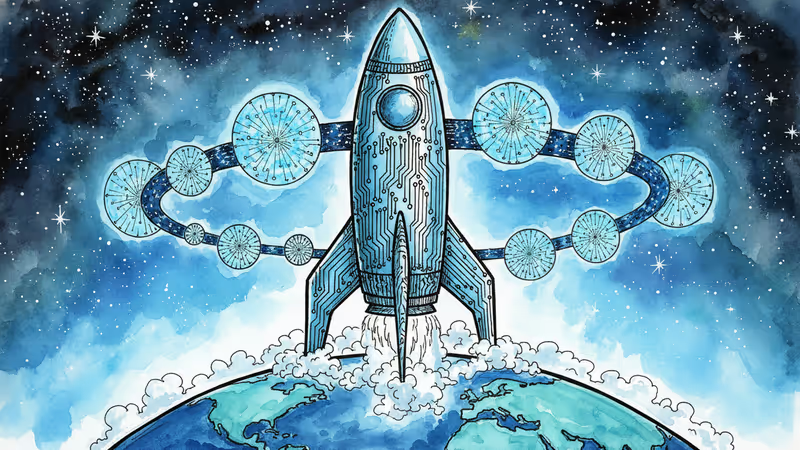
Musk Merges SpaceX and xAI Into Cosmic AI Empire
Elon Musk combines SpaceX and xAI to create an integrated tech giant spanning rockets, AI, and satellite internet. What this mega-merger means for the future of technology.
Elon Musk just announced he's merging two of his biggest companies, SpaceX and xAI, into what he calls "the most ambitious, vertically-integrated innovation engine on (and off) Earth." The combined entity will control rockets, AI, space-based internet, mobile communications, and the X platform—essentially creating a tech empire that spans from Earth's surface to the stars.
What's Actually Merging
SpaceX brings its proven rocket technology, the Starlink satellite constellation with over 6,000 active satellites, and direct-to-mobile communication capabilities. xAI contributes its artificial intelligence systems, while X provides the "world's foremost real-time information and free speech platform," according to Musk's announcement.
The timing isn't coincidental. Current AI advances depend heavily on massive computing power, and traditional data centers are hitting physical and energy limits. By combining space infrastructure with AI capabilities, Musk could potentially run AI computations in orbit—bypassing earthbound constraints entirely.
This isn't just about putting servers in space. Starlink already provides internet to remote areas, disaster zones, and conflict regions. Adding AI processing power to that network could deliver sophisticated AI services anywhere on Earth, regardless of local infrastructure.
The Strategic Play
While OpenAI, Google, and Microsoft battle for AI dominance on Earth, Musk is essentially changing the game board. His integrated approach could solve multiple problems simultaneously: AI needs massive computing power, space missions need intelligent systems, and global communications need both.
Consider the possibilities: AI-powered satellites that can adapt their coverage based on real-time needs, space missions guided by AI that learns from each flight, or global internet service enhanced by orbital AI processing. The synergies are compelling, at least on paper.

Market Implications
This merger could reshape several industries. Traditional cloud providers like Amazon Web Services and Microsoft Azure might face competition from space-based computing. Telecom companies could see their infrastructure advantages eroded by direct satellite-to-phone services enhanced with AI.
For investors, this creates both opportunities and uncertainties. SpaceX was already valued at over $200 billion, while xAI raised $6 billion in its latest funding round. The combined entity could become one of the world's most valuable private companies—if it delivers on its promises.
The Concentration Question
But here's where things get complicated. Musk would control critical infrastructure spanning space access, global communications, AI development, and social media discourse. That's an unprecedented concentration of technological power in one person's hands.
Regulators are already scrutinizing big tech companies for monopolistic practices. A Musk-controlled entity managing everything from satellite internet to AI systems to social media platforms could face intense regulatory pressure, especially given Musk's increasingly political public persona.
Technical Reality Check
Running AI systems in space isn't trivial. Satellites face radiation, extreme temperatures, and limited power. Current space-based computing is basic compared to terrestrial data centers. Scaling this to handle advanced AI workloads would require significant technological breakthroughs.
Musk has a track record of ambitious promises that arrive years late—if at all. Remember when Tesla was supposed to have 1 million robotaxis by 2020? Or when Hyperloop was going to revolutionize transportation? The gap between Musk's vision and execution timelines is often measured in years.
Authors
Related Articles
American Airlines just signed Starlink for 500+ aircraft. It's not just about faster inflight internet — it's a calculated move in the run-up to what could be the largest IPO in history.
SpaceX's upgraded Starship V3 completed its first test flight, deploying 20 Starlink simulators but losing the Super Heavy booster. With an IPO weeks away, the stakes just got higher.
SpaceX's IPO filing puts AI at the center, claiming a $26.5 trillion market opportunity. But can Grok compete with OpenAI and Anthropic for enterprise customers?
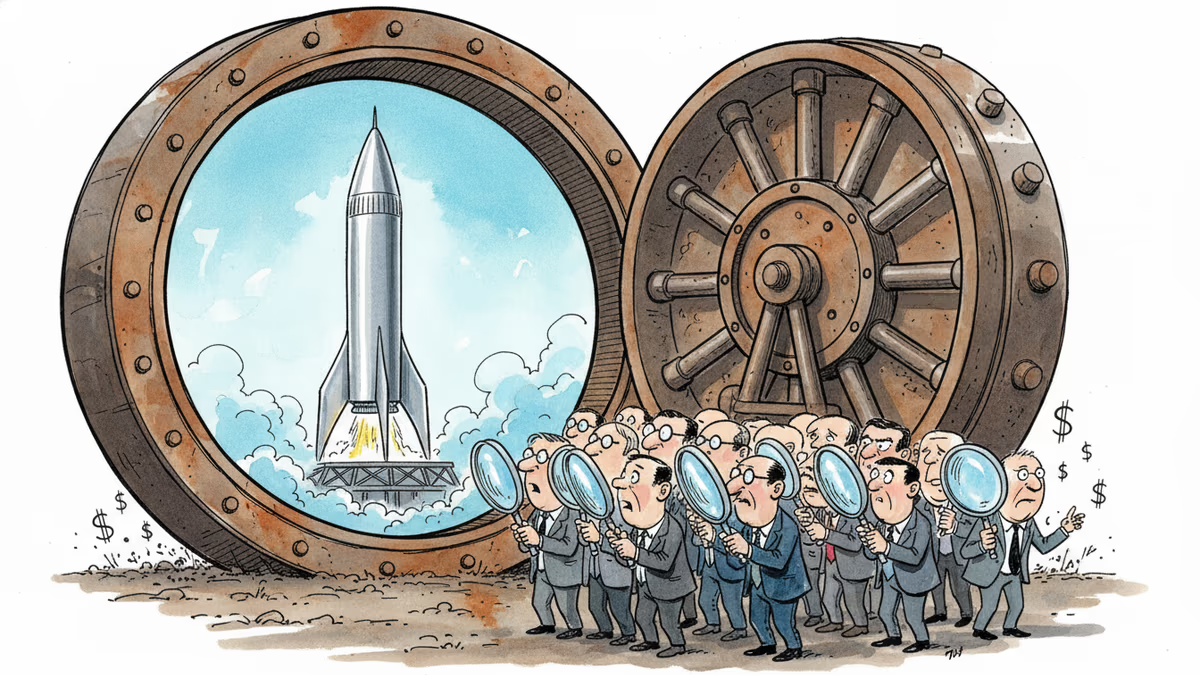
SpaceX filed a nearly 400-page S-1 with the SEC, targeting an IPO as early as June 12. Here's what the filing reveals—and what it doesn't.
American Airlines just signed Starlink for 500+ aircraft. It's not just about faster inflight internet — it's a calculated move in the run-up to what could be the largest IPO in history.
SpaceX's upgraded Starship V3 completed its first test flight, deploying 20 Starlink simulators but losing the Super Heavy booster. With an IPO weeks away, the stakes just got higher.
SpaceX's IPO filing puts AI at the center, claiming a $26.5 trillion market opportunity. But can Grok compete with OpenAI and Anthropic for enterprise customers?
SpaceX filed a nearly 400-page S-1 with the SEC, targeting an IPO as early as June 12. Here's what the filing reveals—and what it doesn't.
Thoughts
Share your thoughts on this article
Sign in to join the conversation