
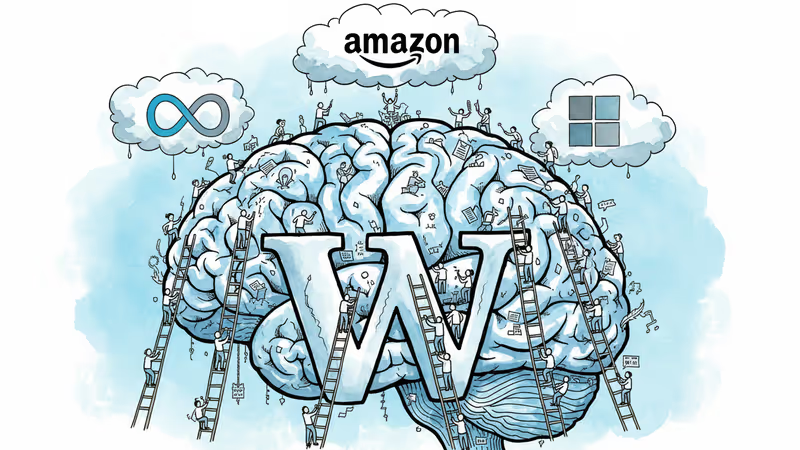
Wikipedia Becomes AI's Brain – But Who Guards the Guards?
As Wikipedia partners with major AI companies, a small army of volunteer editors worldwide now shoulders the massive responsibility of curating knowledge that will shape billions of AI interactions.
When you ask ChatGPT or Gemini a question today, there's a good chance the answer traces back to Wikipedia. On January 15, the Wikimedia Foundation announced partnerships with Amazon, Meta, Microsoft, Mistral AI, and Perplexity, effectively making Wikipedia the unofficial brain of AI.
Through these deals, AI models gain access to encyclopedias in 350 languages, Wikibooks in 75 languages, and dictionaries in over 190 languages. But here's the catch: this vast repository of human knowledge is maintained by surprisingly few people.
The Few Who Shape Knowledge for Many
English Wikipedia boasts 284,000 monthly editors, with 30,000 making at least five edits per month. Major European languages like French and Spanish also have tens of thousands of editors. But Telugu, spoken by 96 million people in southern India, has only a few hundred active editors.
Pranayraj Vangari, a film director who has contributed 10,700 articles to Telugu Wikipedia over 13 years, puts it bluntly: "Local contributors understand linguistic subtleties and cultural context that AI simply cannot replicate. Without strong human involvement, AI could actually widen the gap between English and regional-language Wikipedias instead of narrowing it."
The math is stark. Regional language editors face the same challenges as their English counterparts but with a fraction of the resources. When AI struggles to answer basic questions in these languages, the ripple effects reach millions of speakers worldwide.
Fighting AI with AI
Ironically, Wikipedia editors are now using AI tools to combat AI-generated content. Marshall Miller, senior director of product at the Wikimedia Foundation, describes it as an evolving "immune system" that volunteers have built over years to identify content that doesn't belong.

Since 2024, volunteers have flagged over 4,800 articles with suspected AI-generated content. A Princeton University study found that 5% of newly created English Wikipedia pages contained some AI-generated text. But catching AI slop in English is easier when you have hundreds of thousands of eyes watching. Regional language communities don't have that luxury.
Netha Hussain, a physician-researcher who has contributed over 400 articles across English and Malayalam Wikipedia, says the role has fundamentally changed: "As an editor, it's now time for me to not only write articles but also focus more on finding and fixing knowledge gaps, strengthening verifications, and maintaining neutrality."
The Double-Edged Sword
Ravi Chandra Enaganti, who started publishing Telugu articles in 2007 when the language barely existed online, sees opportunity in the chaos. "Since Wikipedia is built on verified, reliable sources, it's actually a good thing that AI tools scrape our data rather than non-credible sources. I want to ensure the 'brain' of the internet is trained on quality content."
But there's a dangerous feedback loop emerging. As AI-generated content proliferates across the web, some of it inevitably gets cited as "reliable sources" on Wikipedia. The platform that's training AI could end up being trained by AI – a recipe for what researchers call "model collapse."
The stakes couldn't be higher. Wikipedia's partnerships mean that regional language editors aren't just preserving their linguistic heritage – they're shaping how AI understands and represents their cultures to the world.
The Responsibility Nobody Asked For
These volunteer editors never signed up to be the guardians of AI's knowledge base. Vangari describes encountering "AI-generated articles filled with generic language, unreliable or fake citations, and confident-sounding claims without proper evidence." Each piece of misinformation they miss could be amplified billions of times through AI systems.
Every language community is developing its own defenses. Some leverage AI and machine translation tools to grow content in regional languages. Others focus on early detection and flagging of AI-generated content. But they're all racing against the same clock: the exponential growth of AI-generated content flooding the internet.
Authors
Related Articles
SpaceX's IPO filing puts AI at the center, claiming a $26.5 trillion market opportunity. But can Grok compete with OpenAI and Anthropic for enterprise customers?
AI is everywhere now—but is it helping or hurting? MIT Technology Review diagnoses a new mood: not excitement, not panic, just a creeping, uncomfortable uncertainty.
Machine-translated junk is flooding minority-language Wikipedia pages. AI learns from that junk. The result could accelerate the extinction of thousands of languages.
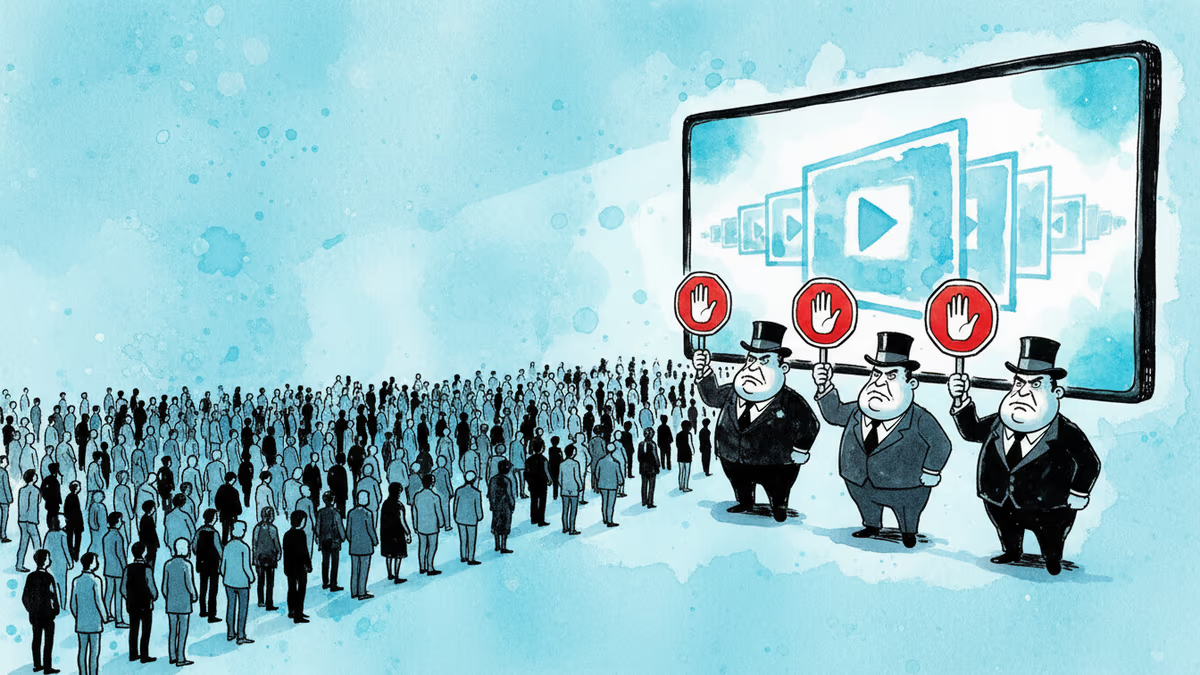
ByteDance's Seedance 2.0 is shocking China's creative industry, but Hollywood studios are fighting back with cease-and-desist letters. What's driving this cultural divide?
SpaceX's IPO filing puts AI at the center, claiming a $26.5 trillion market opportunity. But can Grok compete with OpenAI and Anthropic for enterprise customers?
AI is everywhere now—but is it helping or hurting? MIT Technology Review diagnoses a new mood: not excitement, not panic, just a creeping, uncomfortable uncertainty.
Machine-translated junk is flooding minority-language Wikipedia pages. AI learns from that junk. The result could accelerate the extinction of thousands of languages.
ByteDance's Seedance 2.0 is shocking China's creative industry, but Hollywood studios are fighting back with cease-and-desist letters. What's driving this cultural divide?
Thoughts
Share your thoughts on this article
Sign in to join the conversation