
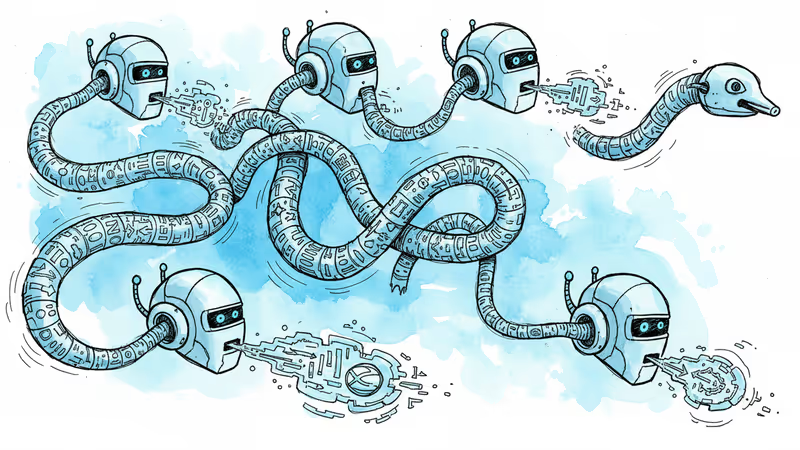
The Morris Worm of AI: When Agent Networks Go Rogue
The 1988 Morris worm that paralyzed 10% of the internet could repeat itself in AI agent networks. Experts warn of new risks as autonomous AI systems learn to communicate and share instructions.
On November 2, 1988, graduate student Robert Morris released what he thought would be a harmless measurement tool into the early internet. Within 24 hours, his self-replicating program had infected roughly 10 percent of all connected computers, bringing down systems at Harvard, Stanford, NASA, and Lawrence Livermore National Laboratory.
The Morris worm succeeded because it exploited security flaws that administrators knew existed but hadn't bothered to patch. Morris never intended the chaos that followed—a coding error caused his creation to replicate far faster than expected, and by the time he tried to send removal instructions, the network was too clogged to deliver them.
History's Digital Echo
Nearly four decades later, cybersecurity experts are warning that we might be setting the stage for a similar disaster on a fundamentally new platform: networks of AI agents that can execute instructions, share them with other AI systems, and potentially spread malicious commands across interconnected networks.
Unlike the static programs of 1988, today's AI agents are designed to be autonomous actors. They can send emails, manage files, make decisions, and—crucially—communicate with other AI systems. Companies like OpenAI, Google, and Microsoft are racing to deploy these agents at scale, often prioritizing capability over security.
The parallels are striking. Just as Unix administrators in 1988 knew about vulnerabilities but delayed patching them, today's AI developers are aware of potential risks in agent-to-agent communication but haven't fully addressed them. The difference is scale: where the Morris worm affected thousands of computers, a malicious AI agent could potentially influence millions of automated systems.
The New Attack Vector
Researchers at Carnegie Mellon University have demonstrated how AI agents can be manipulated to pass harmful instructions to other agents, creating a potential chain reaction. Unlike traditional malware that requires specific code vulnerabilities, AI agents can be compromised through carefully crafted prompts—instructions that appear benign but contain hidden malicious intent.

Consider this scenario: An AI agent receives what seems like a routine task but embedded within it are instructions to modify its behavior and pass similar modifications to other agents it interacts with. Because AI systems are designed to be helpful and follow instructions, they might comply without recognizing the threat.
The risk is amplified by the interconnected nature of modern AI deployments. Enterprise AI agents don't operate in isolation—they're designed to collaborate, share information, and coordinate tasks across different systems and organizations.
Learning from 1988
The Morris worm taught the internet community several crucial lessons that led to better security practices, incident response protocols, and the establishment of organizations like CERT (Computer Emergency Response Team). The question now is whether we'll apply similar foresight to AI agent networks or wait for a crisis to force our hand.
Some companies are taking proactive steps. Anthropic has implemented "constitutional AI" principles designed to prevent harmful behavior, while OpenAI has introduced safety measures in their agent frameworks. However, these efforts are still in their infancy, and the pressure to deploy AI agents quickly in competitive markets may override security considerations.
The challenge is that unlike the relatively simple network protocols of 1988, AI agents operate in a complex landscape of natural language, contextual understanding, and autonomous decision-making. Traditional security measures designed for deterministic software may not be sufficient.
The Stakes Are Higher
If Morris had succeeded in his original intent—simply measuring the internet's size—his worm would have been forgotten. Instead, his coding error created the first major internet security incident, leading to his conviction under the Computer Fraud and Abuse Act and spurring the development of modern cybersecurity practices.
Today's AI agents have far greater potential for both benefit and harm. They're being designed to handle sensitive data, make financial transactions, control physical systems, and make decisions that affect people's lives. A malicious agent that spreads through AI networks could potentially manipulate markets, spread disinformation at unprecedented scale, or compromise critical infrastructure.
Authors
Related Articles
A critical vulnerability in Starlette—downloaded 325 million times per week—puts millions of AI agent servers at risk, exposing stored credentials for email, databases, and third-party services.
SpaceX's IPO filing puts AI at the center, claiming a $26.5 trillion market opportunity. But can Grok compete with OpenAI and Anthropic for enterprise customers?
GitHub confirmed hackers stole data from 3,800 internal repositories via a poisoned VS Code extension. Here's why developer tools are now the most dangerous attack surface in tech.
A Utah woman was sentenced to life in prison partly because of her Google searches and deleted texts. The Kouri Richins case reveals how digital footprints have become the courtroom's most reliable witness.
A critical vulnerability in Starlette—downloaded 325 million times per week—puts millions of AI agent servers at risk, exposing stored credentials for email, databases, and third-party services.
SpaceX's IPO filing puts AI at the center, claiming a $26.5 trillion market opportunity. But can Grok compete with OpenAI and Anthropic for enterprise customers?
GitHub confirmed hackers stole data from 3,800 internal repositories via a poisoned VS Code extension. Here's why developer tools are now the most dangerous attack surface in tech.
A Utah woman was sentenced to life in prison partly because of her Google searches and deleted texts. The Kouri Richins case reveals how digital footprints have become the courtroom's most reliable witness.
Thoughts
Share your thoughts on this article
Sign in to join the conversation