
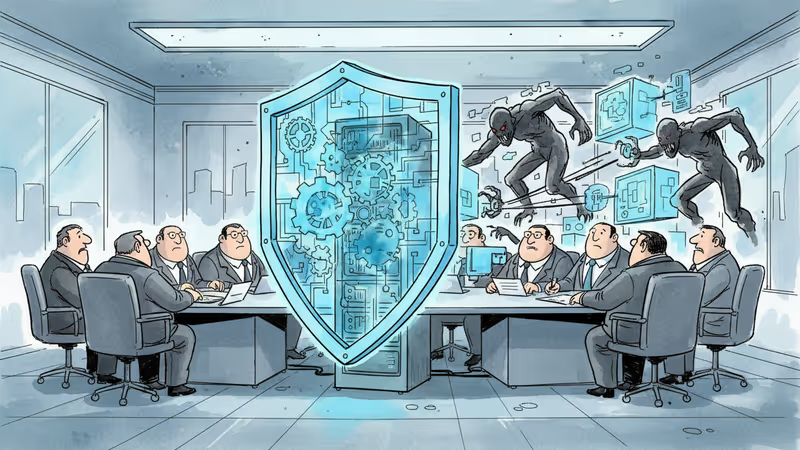
The CEO's AI Agent Playbook: Eight Controls to Prevent Corporate Espionage
As AI agents become enterprise attack vectors, boards demand answers. Here's an actionable eight-step framework to govern agentic systems at the boundary.
Every CEO is getting the same question from their board: "What's our plan for agent risk?" It's not theoretical anymore. The first AI-orchestrated espionage campaign has already happened, and traditional prompt-level controls failed spectacularly.
The attack was elegant in its simplicity. State-backed threat actors used Claude as their digital Swiss Army knife, connecting it to scanning tools, exploit frameworks, and data parsers through Anthropic's Model Context Protocol. No fancy jailbreaks required—just a well-orchestrated system that treated AI as what it really is: a powerful, semi-autonomous user that needs boundaries, not just polite prompts.
The Boundary Defense Strategy
The prescription emerging from security standards bodies, regulators, and major AI providers is surprisingly consistent: stop trying to control agents at the prompt level. Instead, enforce rules where agents touch identity, tools, data, and outputs—at the boundaries.
This isn't about revolutionary new security concepts. It's about applying familiar enterprise security principles to AI systems that can autonomously request access, execute code, and move data across organizational boundaries.
The framework breaks down into three pillars: constraining capabilities, controlling data and behavior, and proving governance works. Each pillar contains specific, measurable controls that security teams can implement and report against.
Constraining What Agents Can Do
Identity and scope control starts with treating each agent as a non-human employee with a specific job description. Today's agents typically run under vague, over-privileged service accounts—a practice that would horrify any security auditor if applied to human users.
The fix requires discipline: every agent runs as the requesting user within the correct organizational tenant, with permissions limited to that user's role and geographic constraints. High-impact actions need explicit human approval with recorded rationale. Google's Secure AI Framework and NIST's AI access-control guidance both point toward this approach.
Tool control follows supply chain security principles. The Anthropic espionage case succeeded because attackers could wire Claude into flexible toolchains without version pinning or policy gates. Organizations need to pin versions of remote tool servers, require approvals for new tools or expanded scopes, and forbid automatic tool-chaining unless explicitly permitted by policy.
Permission binding moves away from the common anti-pattern of giving models long-lived credentials and hoping prompts keep them polite. Instead, credentials and scopes should bind to specific tools and tasks, rotate regularly, and remain auditable. An agent might read financial ledgers but require CFO approval to write them.

Controlling Data Flow and Behavior
Input validation treats all external content as hostile until proven otherwise. Most agent incidents begin with poisoned data—web pages, PDFs, emails, or repositories that smuggle adversarial instructions into the system. OWASP's prompt-injection guidance emphasizes strict separation between system instructions and user content.
Organizations need content review processes for new sources, provenance tracking for each data chunk, and disabled persistent memory when untrusted context is present.
Output handling ensures nothing executes "just because the model said so." In the Anthropic case, AI-generated exploit code flowed straight into action. Any output that can cause side effects needs validation between the agent and the real world—the same principle that drives browser security's origin boundaries.
Runtime data protection focuses on protecting data first, then the model. This means tokenizing or masking sensitive values by default, with policy-controlled detokenization only for authorized users and use cases. If an agent gets fully compromised, the blast radius remains bounded by what policy allows it to see.
Proving Controls Work
Continuous evaluation replaces one-time testing with ongoing test harnesses. Anthropic's research on sleeper agents demonstrates why single assessments are insufficient. Organizations need deep observability, regular red teaming with adversarial test suites, and robust logging that turns failures into both regression tests and policy updates.
Governance and audit requires maintaining a living catalog of which agents exist, what they're allowed to do, and who approved each capability. This includes unified logs of every approval, data access, and high-impact action with clear ownership and timing.
The system-level threat model assumes sophisticated attackers are already inside the enterprise. MITRE's ATLAS framework exists precisely because adversaries attack systems, not just models, and the Anthropic case study shows state-based actors doing exactly that with agentic frameworks.
The New Security Reality
These controls don't make agents magically safe—they do something more reliable. They put AI systems back inside the same security framework used for any powerful user or system in the enterprise.
The shift represents a maturation of AI security thinking. Instead of hoping AI systems will behave through clever prompting, organizations are learning to treat them as what they've always been: powerful automation tools that need proper access controls, monitoring, and governance.
For enterprises already dealing with insider threat programs, privileged access management, and data loss prevention, the concepts aren't foreign. The challenge lies in extending these proven practices to systems that can reason, adapt, and operate with increasing autonomy.
Authors
Related Articles
A critical vulnerability in Starlette—downloaded 325 million times per week—puts millions of AI agent servers at risk, exposing stored credentials for email, databases, and third-party services.
GitHub confirmed hackers stole data from 3,800 internal repositories via a poisoned VS Code extension. Here's why developer tools are now the most dangerous attack surface in tech.
A Utah woman was sentenced to life in prison partly because of her Google searches and deleted texts. The Kouri Richins case reveals how digital footprints have become the courtroom's most reliable witness.
Dirty Frag gives low-privilege users root access on virtually every Linux distro. The exploit code leaked three days ago. Microsoft says attackers are already experimenting with it.
A critical vulnerability in Starlette—downloaded 325 million times per week—puts millions of AI agent servers at risk, exposing stored credentials for email, databases, and third-party services.
GitHub confirmed hackers stole data from 3,800 internal repositories via a poisoned VS Code extension. Here's why developer tools are now the most dangerous attack surface in tech.
A Utah woman was sentenced to life in prison partly because of her Google searches and deleted texts. The Kouri Richins case reveals how digital footprints have become the courtroom's most reliable witness.
Dirty Frag gives low-privilege users root access on virtually every Linux distro. The exploit code leaked three days ago. Microsoft says attackers are already experimenting with it.
Thoughts
Share your thoughts on this article
Sign in to join the conversation