

VMware Customers Still Trapped in Broadcom's Price Squeeze
Two years post-acquisition, 88% of VMware customers still call Broadcom's changes 'disruptive.' Price hikes and uncertainty continue to plague enterprise users.
$69 Billion Later, Customers Still Feel the Pinch
Two years after Broadcom completed its $69 billion VMware acquisition, enterprise customers aren't getting relief—they're getting squeezed harder. A new report from CloudBolt Software surveyed 302 IT decision-makers at large North American companies, and the results paint a picture of ongoing disruption: 88% still describe Broadcom's changes as disruptive.
The numbers tell the story. Price increases top the list of grievances, cited by 89% of respondents. Close behind: uncertainty about Broadcom's plans (85%), support quality concerns (78%), and the shift from perpetual licenses to subscriptions (72%).
The Lock-In Dilemma
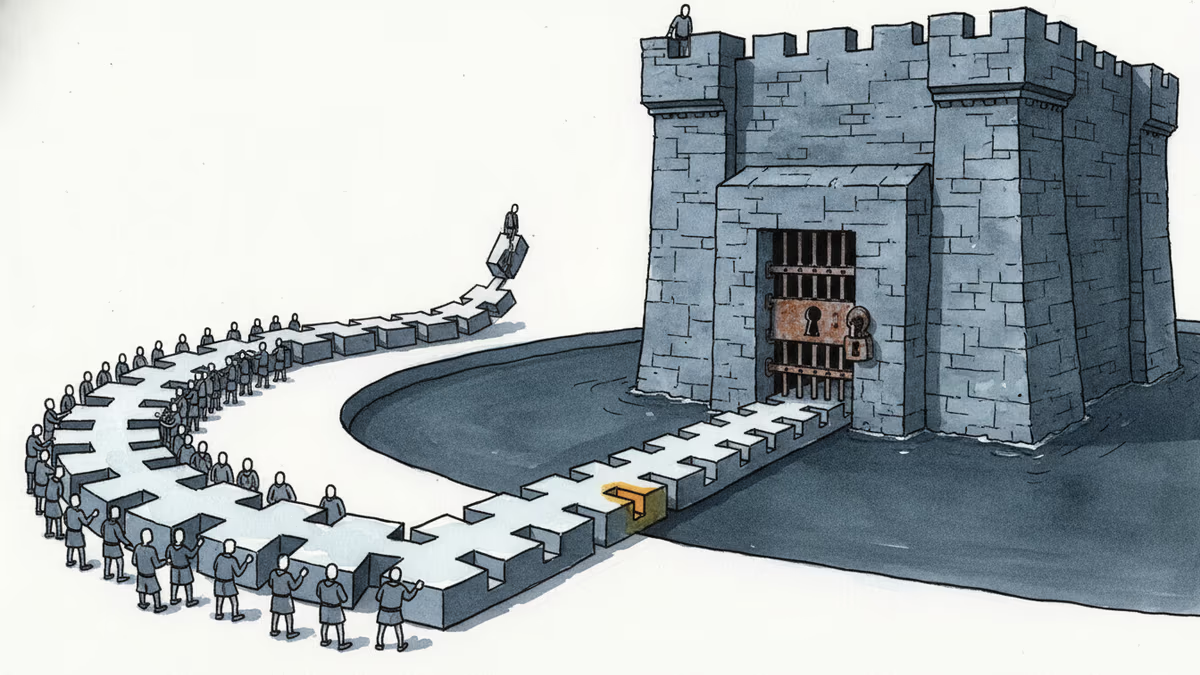
Here's what makes this situation particularly thorny: customers aren't just unhappy—they're trapped. The report's title, "The Mass Exodus That Never Was," hints at the reality many predicted but few experienced. Despite widespread dissatisfaction, most VMware customers haven't fled to alternatives.
Why? Vendor lock-in is real and expensive. Companies that have built their infrastructure around VMware for decades face migration costs that can reach millions of dollars. Add the time needed for staff retraining, system stabilization, and potential downtime, and suddenly paying Broadcom's higher prices seems like the lesser evil.

This creates a feedback loop: Broadcom knows customers are stuck, so it can continue raising prices with limited fear of customer defection.
The Subscription Trap
One of the most cited pain points—mentioned by 72% of respondents—is Broadcom's shift away from perpetual licenses toward subscription models. This isn't just a billing change; it's a fundamental shift in how enterprises budget for and think about their virtualization infrastructure.
Under the old model, companies could buy VMware licenses once and use them indefinitely. Now, they're locked into recurring payments that can increase year over year. For enterprises that previously enjoyed predictable, one-time costs, this represents a significant shift in total cost of ownership.
Partners Feel the Squeeze Too
Broadcom's changes to VMware's partner program, cited by 68% of respondents, have created ripple effects throughout the ecosystem. Many smaller partners have been cut from the program entirely, while others face new requirements that make it harder to serve customers effectively.
This consolidation might make sense from Broadcom's perspective—focusing on larger, more profitable partners—but it leaves customers with fewer options for support and customization.
Authors
Related Articles

A cloud provider trade group has filed an EU antitrust complaint against Broadcom after it slashed VMware's CSP partner count from 4,000+ to just 19 in the US. Here's what's really at stake.

China has banned cybersecurity software from Palo Alto Networks and CrowdStrike in retaliation for U.S. chip curbs. Discover the financial impact and stock outlook.

Samsung Electronics' union branch revealed that 84% of survey respondents oppose the government's roughly $290 billion (₩400 trillion) semiconductor megaproject in Gwangju. Government, management, the union and shareholders are all reading the same national project in sharply different ways.
Nvidia shipped roughly a billion RISC-V cores in 2024, then announced it would run CUDA on the open standard. We break down how royalty-free instruction sets and open software stacks are trying to route around CUDA's lock-in. Part 2 of the Semiconductor Sovereignty series.
A cloud provider trade group has filed an EU antitrust complaint against Broadcom after it slashed VMware's CSP partner count from 4,000+ to just 19 in the US. Here's what's really at stake.
China has banned cybersecurity software from Palo Alto Networks and CrowdStrike in retaliation for U.S. chip curbs. Discover the financial impact and stock outlook.
Samsung Electronics' union branch revealed that 84% of survey respondents oppose the government's roughly $290 billion (₩400 trillion) semiconductor megaproject in Gwangju. Government, management, the union and shareholders are all reading the same national project in sharply different ways.
Nvidia shipped roughly a billion RISC-V cores in 2024, then announced it would run CUDA on the open standard. We break down how royalty-free instruction sets and open software stacks are trying to route around CUDA's lock-in. Part 2 of the Semiconductor Sovereignty series.
Thoughts
Share your thoughts on this article
Sign in to join the conversation