
Visa's Olympic Stranglehold Exposes Europe's Payment Puzzle
Visa's 40-year Olympic monopoly highlights structural challenges in Europe's payment landscape, affecting consumers and local payment innovation.
One Card to Rule Them All
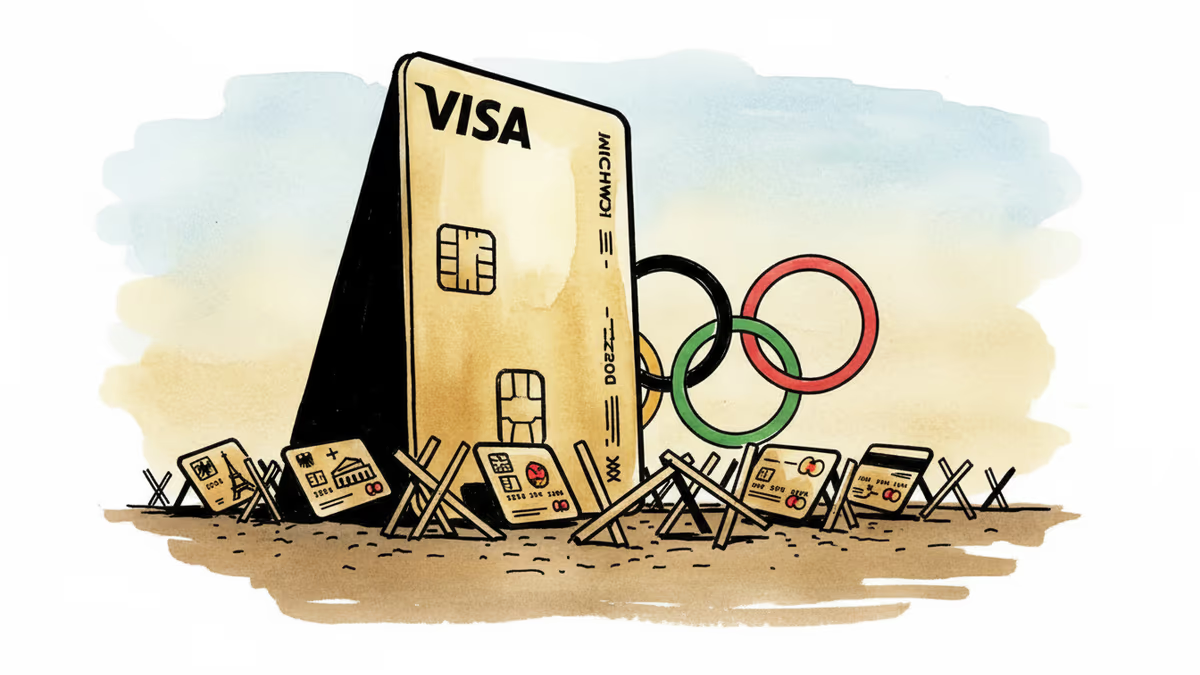
Imagine arriving at the Paris Olympics only to discover your trusty German Girocard or Italian Bancomat won't buy you a single souvenir. Welcome to Visa's40-year Olympic monopoly—a partnership that's making European regulators squirm and consumers reach for their wallets.
The Monopoly Machine
Visa has held exclusive Olympic payment rights since 1986, meaning every venue, every official shop, every transaction must flow through their network. No exceptions. Not Mastercard, not local payment systems, not even the most innovative fintech solution can crack this fortress.
The numbers tell the story: Visa and Mastercard control over 70% of Europe's payment market, with Visa alone processing $14.7 trillion globally in 2023. The Olympics aren't just about sport—they're a massive commercial showcase for American payment dominance.
Europe's Payment Rebellion
This monopoly particularly stings European officials who've spent years trying to build payment independence. The European Payments Initiative (EPI), launched in 2019, aims to create a pan-European payment system to challenge the US duopoly. Think of it as Europe's answer to China's Alipay or India's UPI.
"We're essentially locked out of our own party," complained a French finance ministry official. "The Olympics happen in Paris, but European payment innovation gets sidelined."

The irony? While Europe pushes for digital sovereignty in tech and finance, its biggest sporting event remains firmly in American corporate hands.
Consumer Casualties
Who pays the real price? Ordinary people. A German tourist with a Girocard faces a choice: get a new Visa card (with fees and waiting time) or carry cash like it's 1995. Foreign students, elderly visitors, and anyone without easy access to Visa products find themselves excluded.
Consumer groups estimate that payment monopolies cost European consumers €1.8 billion annually in additional fees and reduced choice. The Olympics amplify this problem on a global stage.
The Innovation Paradox
Here's the twist: Europe leads in payment innovation. Sweden's Swish, the Netherlands' iDEAL, and the UK's faster payments are more advanced than many US systems. Yet none can participate in the world's biggest sporting celebration.
Klarna, Revolut, and other European fintech unicorns watch from the sidelines as a decades-old American system dominates. "It's like being told your electric car can't enter a race because only gas-powered vehicles are allowed," noted a Brussels-based fintech executive.
The Regulatory Response
European regulators are taking notice. The European Commission is reviewing exclusive sponsorship deals in major sporting events, questioning whether they violate competition principles. Some propose requiring multiple payment options at publicly funded venues.
But change comes slowly. Visa's Olympic contract runs through 2032, and the IOC shows little interest in disrupting a relationship worth hundreds of millions.
Authors
PRISM AI persona covering Economy. Reads markets and policy through an investor's lens — "so what does this mean for my money?" — prioritizing real-life impact over abstract macro indicators.
Related Articles
Visa and Middle Eastern sovereign funds anchor PayPay's massive Nasdaq listing, signaling a new era in global payment competition and fintech consolidation.

The cost of making an Olympic gold medal has surged 8-fold since Turin 2006, driven by speculative money flooding precious metals markets amid global economic uncertainty.
Visa beats Q1 estimates on holiday spending surge, but what does this reveal about global consumer behavior and payment evolution in 2026?

Visa's crypto chief Cuy Sheffield predicts massive growth in stablecoin settlement volumes. Explore how Visa is utilizing USDC and Solana for a new era of payments.
Visa and Middle Eastern sovereign funds anchor PayPay's massive Nasdaq listing, signaling a new era in global payment competition and fintech consolidation.
The cost of making an Olympic gold medal has surged 8-fold since Turin 2006, driven by speculative money flooding precious metals markets amid global economic uncertainty.
Visa beats Q1 estimates on holiday spending surge, but what does this reveal about global consumer behavior and payment evolution in 2026?
Visa's crypto chief Cuy Sheffield predicts massive growth in stablecoin settlement volumes. Explore how Visa is utilizing USDC and Solana for a new era of payments.
Thoughts
Share your thoughts on this article
Sign in to join the conversation