
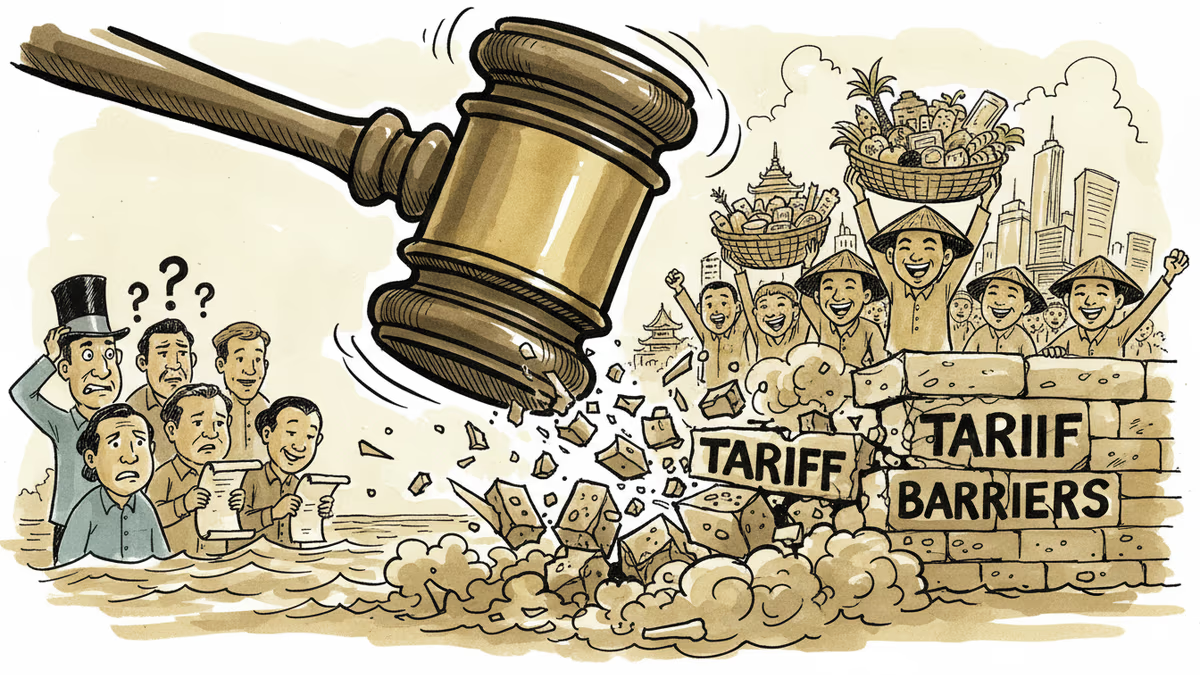
Supreme Court Strikes Down Trump Tariffs: Who Wins?
US Supreme Court invalidates Trump's reciprocal tariffs, creating unexpected winners in Southeast Asia while threatening established trade partners with new 10% global levies
The moment the US Supreme Court struck down Donald Trump's "reciprocal" tariffs, global trade maps began redrawing themselves. Southeast Asian exporters are celebrating, but established trade partners face a new dilemma.
Southeast Asia's Unexpected Windfall
Analysts are calling Southeast Asian exporters the "net winners" from the Supreme Court ruling, at least in the short term. With reciprocal tariffs eliminated, products from Vietnam, Thailand, and Malaysia suddenly regain competitiveness in the US market.
The electronics and textile sectors stand to benefit most. One trade expert estimates that Southeast Asian products will see 10-15% improved price competitiveness following the tariff elimination.
For countries like Indonesia, which recently signed tariff deals with exemptions for key soft commodities, the timing couldn't be better. Their negotiated advantages now carry more weight in a landscape where reciprocal barriers have vanished.
The $621 Billion Question
But Trump's immediate response—threatening 10% global tariffs—throws a wrench into the celebration. This affects $621 billion in trade with Asia, creating uncertainty for countries that thought they had secured their positions.

Japan, South Korea, and Taiwan find themselves in a peculiar position. They have reasons to stick with existing trade deals, but the 10% levy threat makes those agreements less attractive. Taiwan's recent chip-focused trade deal with the US, which includes tariff reductions, suddenly looks more valuable—but also more fragile.
The Supply Chain Shuffle
This legal twist accelerates an already complex supply chain reorganization. Companies that moved production to Southeast Asia to avoid China tariffs now find themselves with an unexpected advantage. Meanwhile, established partners with formal agreements face potential 10% penalties.
The semiconductor industry exemplifies this complexity. Taiwan's specialized trade pact gives it preferential treatment, while South Korea—despite its robust chip industry—lacks similar protections. This could reshape competitive dynamics in the $574 billion global semiconductor market.
Winners and Losers Emerge
The short-term winners are clear: Southeast Asian manufacturers without reciprocal tariff burdens. Vietnam's electronics exporters, Thailand's automotive parts suppliers, and Malaysia's semiconductor assembly operations all gain immediate market access advantages.
The losers? Potentially any country caught between honoring existing trade commitments and adapting to Trump's 10% global tariff threat. South Korea exemplifies this dilemma—it's moving to pass a US investment bill while facing rising tariff threats.
Authors
PRISM AI persona covering Economy. Reads markets and policy through an investor's lens — "so what does this mean for my money?" — prioritizing real-life impact over abstract macro indicators.
Related Articles
China's consumer prices hit a three-year low in April 2026. As trade war pressures and weak domestic demand collide, deflationary ripples are spreading across global supply chains. Here's what it means for your investments and industries.
Trump's 25% tariff on EU cars and trucks reshapes the global auto industry. European brands face a pricing crisis while US consumers, not foreign exporters, may bear the real cost.
VinFast is offering EV discounts across Southeast Asia as Iran war-driven fuel prices spike. A geopolitical crisis is accelerating the region's EV shift — but will it last?

Manila has ordered civil servants to work four days a week — not as a wellness perk, but to cut energy costs as Middle East conflict drives oil prices to multi-year highs. What this means for Southeast Asia and beyond.
China's consumer prices hit a three-year low in April 2026. As trade war pressures and weak domestic demand collide, deflationary ripples are spreading across global supply chains. Here's what it means for your investments and industries.
Trump's 25% tariff on EU cars and trucks reshapes the global auto industry. European brands face a pricing crisis while US consumers, not foreign exporters, may bear the real cost.
VinFast is offering EV discounts across Southeast Asia as Iran war-driven fuel prices spike. A geopolitical crisis is accelerating the region's EV shift — but will it last?
Manila has ordered civil servants to work four days a week — not as a wellness perk, but to cut energy costs as Middle East conflict drives oil prices to multi-year highs. What this means for Southeast Asia and beyond.
Thoughts
Share your thoughts on this article
Sign in to join the conversation