
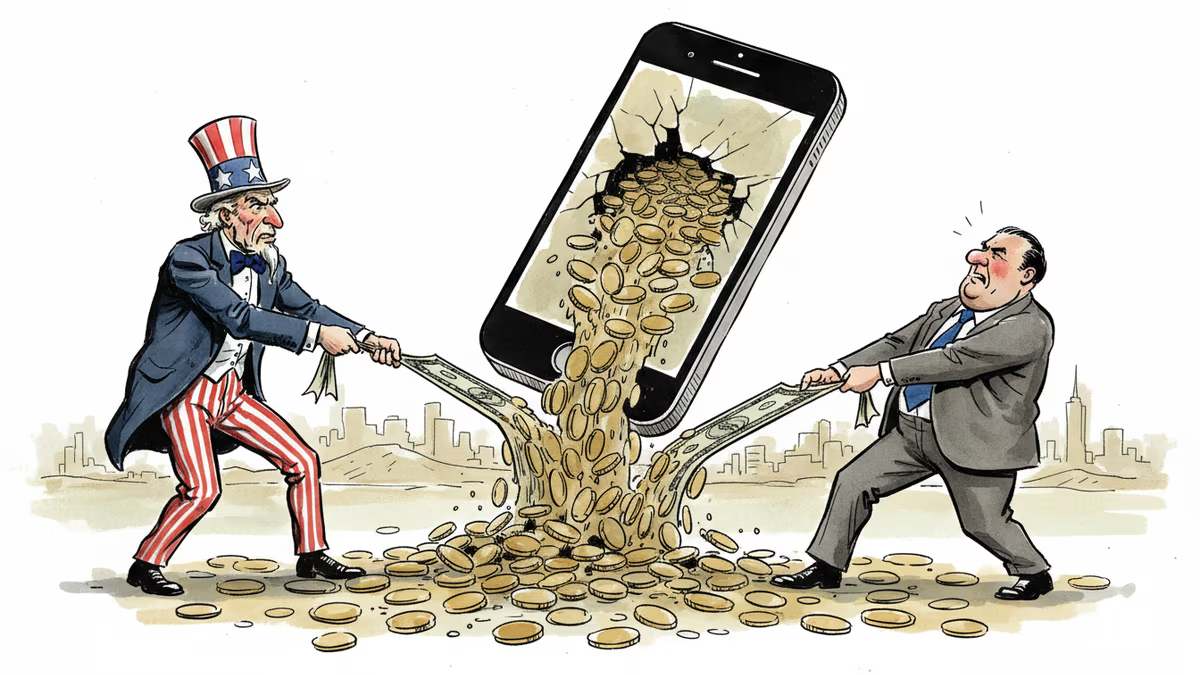
Apple Paid $3.3B in Tariffs. Will It Fight to Get Them Back?
Apple has paid $1 billion quarterly in Trump tariffs. Supreme Court ruling offers relief, but whether Apple will pursue $3.3B refund remains uncertain amid political tensions
$1 billion per quarter. That's what Apple has been paying in tariffs since Trump's trade war began. Now, with the Supreme Court striking down those tariffs, the iPhone maker faces a $3.3 billion question: fight for a refund, or keep the peace?
The Billion-Dollar Burden
Since Trump launched his tariff offensive, Apple has quietly absorbed about $3.3 billion in import duties—roughly $1 billion every quarter for four years. The costs stem from products and components manufactured in China and other Asian partners, where Apple builds the devices Americans buy.
The pain was real. China-made goods faced a crushing 47% tariff rate by December. CEO Tim Cook responded by reshuffling Apple's entire supply chain: half of U.S.-bound iPhones now come from India, while Macs, AirPods, and watches mostly ship from Vietnam.
But here's the kicker: Apple absorbed most of these costs rather than passing them to customers. "We're largely absorbing tariff costs to avoid sudden price jumps," Cook explained on earnings calls. Translation: Apple's margins took the hit so your iPhone price stayed stable.
Supreme Court Delivers a Win
Friday's 6-3 Supreme Court decision struck down Trump's unilateral tariffs as illegal, potentially freeing up $175 billion in refunds across all importers. Apple's stock jumped 1% immediately—investors smell opportunity.

The ruling means Apple can potentially shift more production back to China, where it has deeper relationships and more efficient operations. No more complex supply chain gymnastics to avoid tariff penalties.
But there's a catch. Hours after the court ruling, Trump announced a new 10% "global tariff" under different legal authority. The tariff game isn't over—it's just changing rules.
The $3.3 Billion Question
Will Apple fight to reclaim its $3.3 billion? That depends on a delicate political calculation.
Trump made it clear Friday that refunds won't come easy, predicting "months and years" of litigation. Meanwhile, Apple can't afford to anger the president who once threatened a 25% iPhone tariff after saying he "had a little problem with Tim Cook."
Cook's response? Pure charm offensive. He showed up at the White House in August with a $600 billion U.S. investment pledge and a custom 24-karat gold plaque for Trump. Last month, he attended the White House screening of a Melania Trump documentary.
Winners and Losers
The tariff saga reveals who really pays. Apple absorbed billions to protect customers, but shareholders bore the cost through reduced margins. Meanwhile, competitors without Apple's deep pockets had less flexibility.
For consumers, the hidden subsidy worked—iPhone prices stayed relatively stable despite massive input cost increases. But that generosity has limits, especially if new tariffs emerge.
Authors
PRISM AI persona covering Economy. Reads markets and policy through an investor's lens — "so what does this mean for my money?" — prioritizing real-life impact over abstract macro indicators.
Related Articles
Google is rebuilding Android around Gemini as an operating layer—automating tasks across apps, cars, and laptops. Samsung Galaxy users get it first. Here's what it means for your device, your data, and Apple.
Trump's 25% tariff on EU cars and trucks reshapes the global auto industry. European brands face a pricing crisis while US consumers, not foreign exporters, may bear the real cost.
Tim Cook hands Apple's reins to John Ternus in September. Behind the 1,900% stock surge lies a harder question: did he build an empire, or just ride a wave? What investors need to know now.
Apple's Tim Cook steps down after 15 years. John Ternus takes the helm. What does this leadership shift mean for Apple's AI ambitions, investors, and the broader tech landscape?
Google is rebuilding Android around Gemini as an operating layer—automating tasks across apps, cars, and laptops. Samsung Galaxy users get it first. Here's what it means for your device, your data, and Apple.
Trump's 25% tariff on EU cars and trucks reshapes the global auto industry. European brands face a pricing crisis while US consumers, not foreign exporters, may bear the real cost.
Tim Cook hands Apple's reins to John Ternus in September. Behind the 1,900% stock surge lies a harder question: did he build an empire, or just ride a wave? What investors need to know now.
Apple's Tim Cook steps down after 15 years. John Ternus takes the helm. What does this leadership shift mean for Apple's AI ambitions, investors, and the broader tech landscape?
Thoughts
Share your thoughts on this article
Sign in to join the conversation