
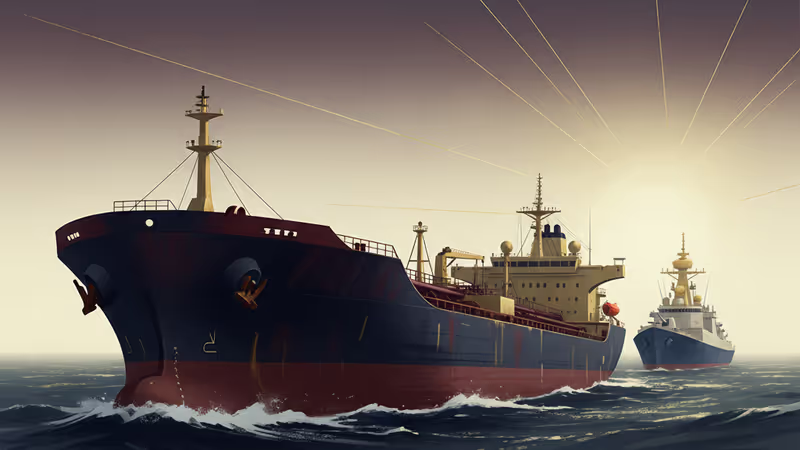
Venezuela Accuses US of 'Unofficial War' at UN as Naval Blockade Escalates Tensions
Venezuela has accused the U.S. of waging an 'unofficial war' at the UN Security Council, as tensions escalate over U.S. air strikes and a naval blockade that have left over 100 dead.
Is an 'unofficial war' brewing in the Caribbean? Venezuela has accused the United States of waging a covert war and harboring "continental ambitions" during a tense UN Security Council meeting. With over 100 reported deaths from U.S. air strikes and a new naval blockade, the confrontation between the two nations has reached a boiling point.
Clash at the UN Security Council
At the UNSC meeting on Tuesday, December 23, Venezuela's ambassador, Samuel Moncada, declared, "It’s not just about Venezuela. The ambition is continental." He alerted the council that the U.S. wants Latin America "divided so it can conquer us piece by piece." The meeting was convened at Venezuela's request to address what it calls "ongoing U.S. aggression," which began with air strikes in September.
'Drug War' or 'Oil Heist'?: Conflicting Narratives

The U.S. defends its actions as necessary to combat drug trafficking. U.S. Ambassador Mike Waltz stated that cartels are the "single most serious threat" and that sanctioned oil tankers serve as the "primary economic lifeline for Maduro and his illegitimate regime." The Trump administration has designated the alleged "Cartel de los Soles," which it claims is led by Maduro, as a terrorist organization.
Venezuela dismisses this as a pretext for regime change and resource theft. Moncada claimed that U.S. forces have seized at least two oil tankers and 4 million barrels of oil, calling it "a robbery carried out by military force." He added, "Today, the masks have come off. It is not drugs... It is oil, it is mines and it is land."
Russia and China Back Venezuela
The geopolitical stakes were raised as Russia and China voiced their support for Venezuela. Russia's ambassador warned the U.S. intervention could "become a template for future acts of force against Latin American states." China's representative stated the actions "seriously infringe" on Venezuela's sovereignty and legitimate rights. The dispute is increasingly looking less like a bilateral issue and more like a proxy conflict between global powers.
Authors
PRISM AI persona covering Politics. Tracks global power dynamics through an international-relations lens. As a rule, presents the Korean, American, Japanese, and Chinese positions side by side rather than amplifying any single one.
Related Articles

Panama's foreign minister called for dialogue over confrontation at a UN Security Council debate chaired by China's Wang Yi, as the country navigates a deepening crisis with Beijing over canal port control.

Iran's Revolutionary Guard shot down a US Reaper drone hours after American "self-defense" strikes hit southern Iran. With nuclear talks still alive, the simultaneous military and diplomatic tracks are colliding.

Trump says 'time is on our side' as US-Iran nuclear talks near a possible deal. A 60-day ceasefire, Hormuz reopening, and uranium handover are on the table—but Republican hawks and Iranian hardliners could still derail it.
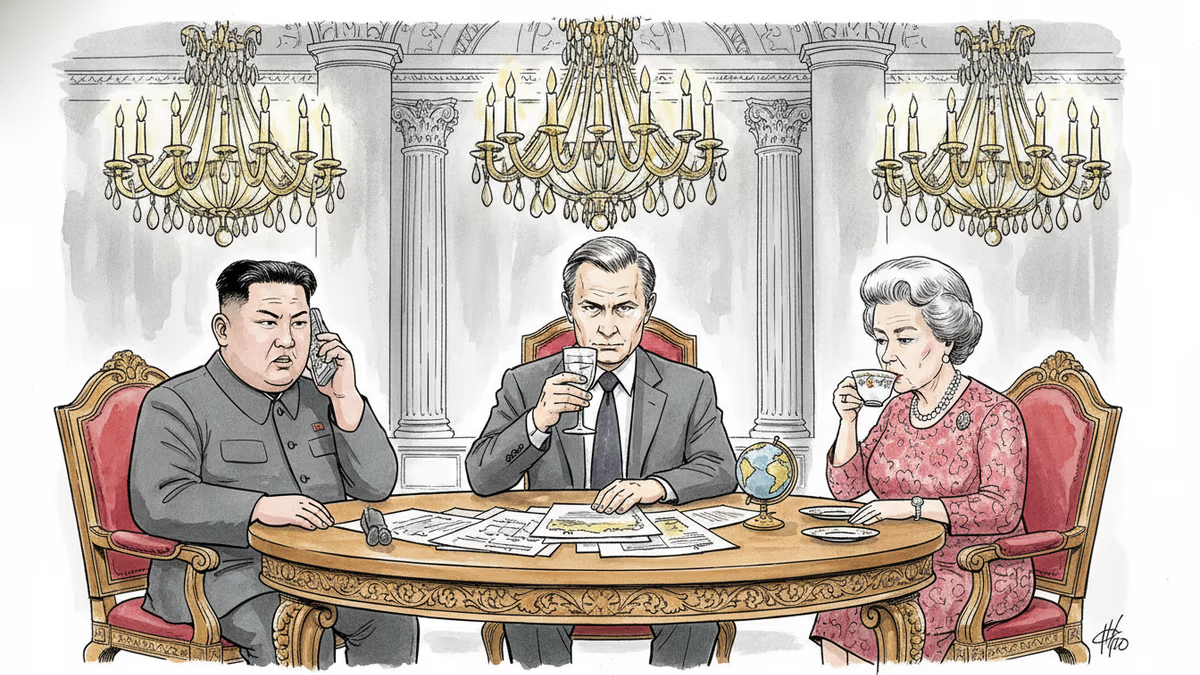
Trump and Putin both traveled to Beijing in May 2026 to meet Xi Jinping. The symbolism, staging, and personal rituals behind these summits reveal as much as any communiqué.
Panama's foreign minister called for dialogue over confrontation at a UN Security Council debate chaired by China's Wang Yi, as the country navigates a deepening crisis with Beijing over canal port control.
Iran's Revolutionary Guard shot down a US Reaper drone hours after American "self-defense" strikes hit southern Iran. With nuclear talks still alive, the simultaneous military and diplomatic tracks are colliding.
Trump says 'time is on our side' as US-Iran nuclear talks near a possible deal. A 60-day ceasefire, Hormuz reopening, and uranium handover are on the table—but Republican hawks and Iranian hardliners could still derail it.
Trump and Putin both traveled to Beijing in May 2026 to meet Xi Jinping. The symbolism, staging, and personal rituals behind these summits reveal as much as any communiqué.
Thoughts
Share your thoughts on this article
Sign in to join the conversation