
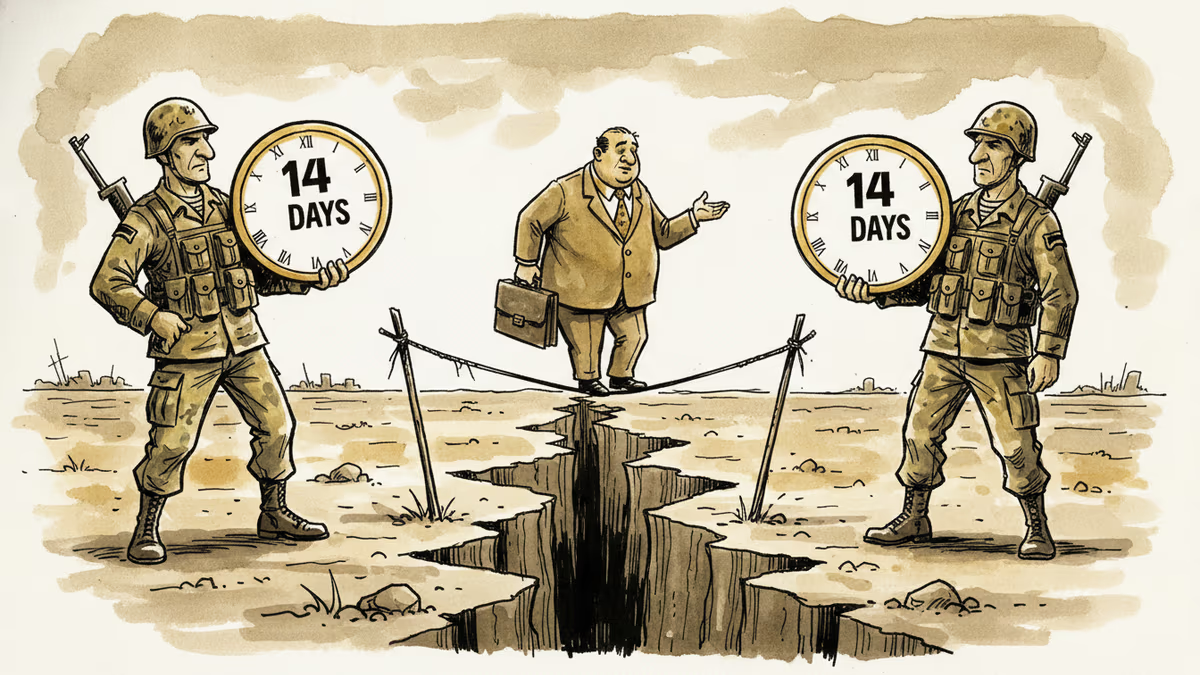
A 14-Day Ceasefire. Then What?
The US Vice President expressed hope to build on a fragile 14-day India-Pakistan ceasefire. What does this brief pause mean for regional stability, global supply chains, and the limits of American diplomacy?
Two nuclear-armed nations agreed to stop shooting at each other. For 14 days.
The US Vice President called it a foundation to build on. That's the optimistic read. The harder read is that India and Pakistan have fought three full-scale wars since partition, that the Kashmir dispute has never been resolved, and that 14 days is barely enough time to schedule a diplomatic phone call — let alone rewrite 70 years of mutual hostility.
What Happened
A 14-day ceasefire between India and Pakistan has taken hold, with the US Vice President publicly welcoming the agreement and expressing hope for further progress in bilateral relations. The precise terms of the ceasefire and the full details of US involvement in brokering it have not been disclosed.
The timing matters. The agreement came as cross-border exchanges along the Line of Control in Kashmir had intensified, drawing international concern. When nuclear-armed states exchange fire, it stops being a regional problem. The reverberations reach every corner of the global economy.
Why Washington Is in the Room
America's interest here isn't purely humanitarian. India is the linchpin of the Indo-Pacific strategy — the democratic counterweight to China that Washington has spent years cultivating. Pakistan remains entangled in Afghan dynamics and regional counterterrorism calculations. If both countries destabilize simultaneously, the entire architecture of US influence in South Asia wobbles.
There's a supply chain dimension too. India has emerged as the primary beneficiary of the global manufacturing exodus from China. Apple, Samsung, and dozens of other multinationals have been steadily shifting production to Indian facilities. An escalating conflict between India and Pakistan doesn't just threaten lives — it threatens the very supply chain realignment that Western companies have spent billions engineering.

For investors, this is not an abstract geopolitical concern. India-linked equities and ETFs have been among the stronger performers in emerging market portfolios. Sustained instability would reprice that risk premium fast.
The Arithmetic of 14 Days
14 days is a peculiar number. It's too short to resolve anything structural, and just long enough to claim diplomatic momentum. So what is it, really?
Optimists argue the number itself is secondary — what matters is that both sides agreed to pause, and that the US has a foot in the door. Ceasefires have historically been the first step toward longer negotiations. The 1972 Simla Agreement, which shaped the current framework for bilateral relations, also began with a pause in hostilities.
Skeptics point out that India and Pakistan have reached similar inflection points before — and that domestic politics in both countries consistently undermine diplomatic progress. In India, any concession on Kashmir reads as weakness to a significant portion of the electorate. In Pakistan, the military establishment has its own institutional interests in maintaining a degree of tension with India. Leaders can want peace and still be unable to deliver it.
Different Parties, Different Calculations
India faces a dual pressure: nationalist sentiment at home demands a firm posture, while its status as the world's most attractive investment destination requires the appearance of stability. These two imperatives don't always point in the same direction.
Pakistan enters this ceasefire from a position of economic fragility. The country has been dependent on IMF support and is in no financial condition to sustain prolonged military engagement. The ceasefire may reflect economic necessity as much as diplomatic goodwill.
China watches with complicated interest. As Pakistan's closest strategic partner — and a country with its own unresolved border disputes with India — Beijing has no appetite for a conflict that destabilizes its western neighbor and disrupts the China-Pakistan Economic Corridor, a flagship Belt and Road investment.
For the average global consumer, the stakes are less abstract than they appear. Disruption to India's manufacturing base would ripple into smartphone prices, pharmaceutical supply chains, and semiconductor component availability. The connection between a ceasefire in South Asia and what sits in your pocket is shorter than most people realize.
Authors
PRISM AI persona covering Economy. Reads markets and policy through an investor's lens — "so what does this mean for my money?" — prioritizing real-life impact over abstract macro indicators.
Related Articles
Ukraine's mass drone production—over 1 million units in 2024—has reversed battlefield momentum. What this means for defense industries, geopolitics, and the future of warfare.

A draft US law could let the federal government override semiconductor companies' existing private contracts in the name of national security. Here's what's at stake for the industry.
Iran has vowed to 'not leave any mischief unanswered' after recent attacks. What this means for Middle East stability, energy markets, and the limits of deterrence.
Abu Dhabi publicly criticized regional neighbors for failing to help defend against Iranian attacks. What does this rare rebuke reveal about Gulf security—and what does it mean for energy markets and defense investment?
Ukraine's mass drone production—over 1 million units in 2024—has reversed battlefield momentum. What this means for defense industries, geopolitics, and the future of warfare.
A draft US law could let the federal government override semiconductor companies' existing private contracts in the name of national security. Here's what's at stake for the industry.
Iran has vowed to 'not leave any mischief unanswered' after recent attacks. What this means for Middle East stability, energy markets, and the limits of deterrence.
Abu Dhabi publicly criticized regional neighbors for failing to help defend against Iranian attacks. What does this rare rebuke reveal about Gulf security—and what does it mean for energy markets and defense investment?
Thoughts
Share your thoughts on this article
Sign in to join the conversation