
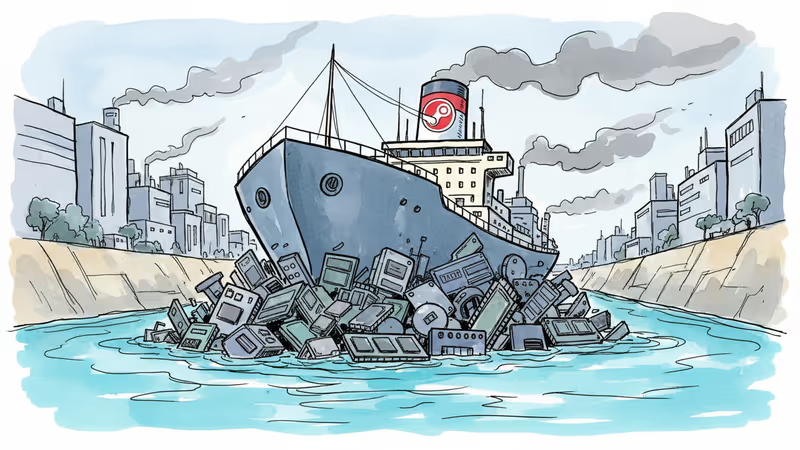
Valve's Steam Hardware Hits Memory Shortage Wall
Steam Machine, Steam Frame, and Steam Controller face delays as global memory crisis forces Valve to reset pricing expectations and launch timeline.
The gaming hardware landscape just got more complicated. Valve's highly anticipated Steam Machine, Steam Frame, and Steam Controller—first announced in November with promises of early 2026 delivery—won't make their original Q1 2026 target. The culprit? The same memory and storage shortage that's been squeezing everyone from smartphone makers to data center operators.
Valve confirmed the delay in a recent post, explaining they're now targeting the first half of this year instead. More concerning for potential buyers: the company will need to "reset expectations" for pricing "as soon as possible." Translation: these devices are about to get more expensive.
When Silicon Scarcity Meets Gaming Ambition
The timing couldn't be worse for Valve's hardware push. The company had positioned these devices as a major expansion of the Steam ecosystem beyond traditional PCs, potentially competing with console manufacturers and handheld gaming devices. The Steam Machine was expected to bring PC gaming to living rooms, while the Steam Frame promised to revolutionize game streaming, and the Steam Controller aimed to solve the age-old problem of playing PC games from the couch.
But global memory and storage shortages—driven by AI data center demand, smartphone production, and automotive electronics—have created a perfect storm. NAND flash prices have surged 40% since late 2025, while DRAM costs have climbed 25%. For gaming hardware that relies heavily on fast storage and substantial memory, these increases translate directly to higher manufacturing costs.

The delay also puts Valve in an awkward position with developers and early adopters who've been building anticipation around the original timeline. Game studios planning launch titles now face uncertainty, while enthusiasts who've been saving for early adoption must recalibrate their expectations.
The Ripple Effects Beyond Gaming
This isn't just about Valve's product roadmap—it's a window into how supply chain disruptions reshape entire industries. Gaming hardware has traditionally operated on predictable cycles, with companies announcing products months in advance and hitting firm launch dates. The current environment is forcing even established players to adopt smartphone-style flexibility, where pricing and availability shift based on component costs.
For consumers, this represents a fundamental change in how hardware launches work. The days of announced pricing holding steady until launch may be ending. Instead, buyers might need to adapt to dynamic pricing models where early estimates serve more as starting points than commitments.
The delay also highlights the interconnected nature of modern technology markets. Valve's gaming hardware competes for the same memory and storage components needed for AI servers, autonomous vehicles, and next-generation smartphones. When NVIDIA and Google are bidding up memory prices for their AI infrastructure, gaming companies inevitably feel the squeeze.
Authors
Related Articles

Taiwan's Thunder Tiger became the first Asian firm to win US military drone clearance with a China-free supply chain. As Trump meets Xi, the drone arithmetic reshapes defense strategy.
Apple quietly removed the entry-level $599 Mac Mini, raising the starting price to $799 — just one day after Tim Cook warned of chip supply constraints on the earnings call.

As the Strait of Hormuz closure traps 1,900 vessels, abandoned seafarers reveal a structural flaw at the heart of global trade—no single authority is responsible when things go wrong.
Sony halted orders for most of its CFexpress and SD card lineup on March 27, 2026 — the same day it raised PS5 prices. What does this mean for photographers, consumers, and Sony's broader strategy?
Taiwan's Thunder Tiger became the first Asian firm to win US military drone clearance with a China-free supply chain. As Trump meets Xi, the drone arithmetic reshapes defense strategy.
Apple quietly removed the entry-level $599 Mac Mini, raising the starting price to $799 — just one day after Tim Cook warned of chip supply constraints on the earnings call.
As the Strait of Hormuz closure traps 1,900 vessels, abandoned seafarers reveal a structural flaw at the heart of global trade—no single authority is responsible when things go wrong.
Sony halted orders for most of its CFexpress and SD card lineup on March 27, 2026 — the same day it raised PS5 prices. What does this mean for photographers, consumers, and Sony's broader strategy?
Thoughts
Share your thoughts on this article
Sign in to join the conversation