
Why a 24-Year-Old Wuxia Film Still Matters on Valentine's Day
Crouching Tiger, Hidden Dragon redefined martial arts cinema and cross-cultural storytelling. What makes Ang Lee's masterpiece endure in today's globalized film landscape?
When East Met West on Every Screen
$213 million worldwide. Four Academy Awards. A phenomenon that made subtitled cinema mainstream in America. Crouching Tiger, Hidden Dragon didn't just cross cultural boundaries—it obliterated them, proving that universal storytelling could transcend language barriers in ways Hollywood executives never imagined.
Twenty-four years after Ang Lee's wuxia masterpiece graced screens, it remains the highest-grossing foreign-language film in U.S. box office history. But its Valentine's Day relevance goes deeper than romantic subplot. This is a film that rewrote the rules for how Eastern stories could captivate Western audiences.
The Hidden Revolution in Plain Sight
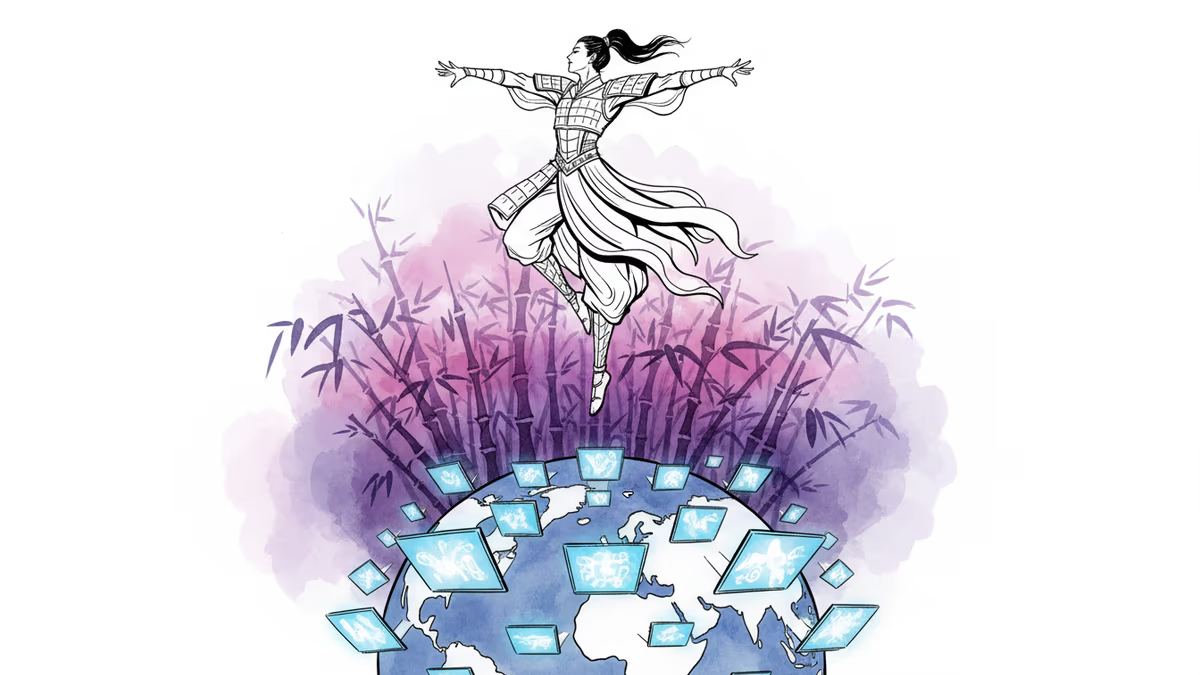
Adapted from Wang Dulu's 1940s novel, the film transported audiences to China's Qing dynasty (1644-1912), where legendary martial arts masters lived "hidden in plain sight"—the literal meaning of its poetic title. Lee's genius wasn't just in the gravity-defying fight choreography by Yuen Woo-ping, but in making the invisible visible: female warriors as complex protagonists, not sidekicks.
Michelle Yeoh's Yu Shu Lien and Zhang Ziyi's Jen Yu represented something Hollywood rarely offered—women whose martial prowess matched their emotional depth. While Western cinema was still figuring out how to write compelling female action heroes, Lee presented fully realized characters whose fights carried psychological weight.
The film's success wasn't accidental. Lee deliberately crafted a bridge between Eastern philosophy and Western narrative structure, creating what critics called "arthouse action"—intellectually satisfying yet viscerally thrilling.

The Netflix Generation's Blind Spot
Here's what's fascinating: today's streaming audiences, raised on Kingdom and Squid Game, often discover Crouching Tiger as a historical artifact rather than the groundbreaking film it was. For them, subtitled content is normal. They missed the cultural earthquake.
In 2000, American multiplexes rarely showed foreign films outside art house theaters. Crouching Tiger changed that overnight, grossing $128 million domestically—more than most Hollywood blockbusters that year. It proved audiences were hungry for stories that didn't pander to Western sensibilities.
The film's influence ripples through today's content landscape. Without Crouching Tiger's success, would Netflix have greenlit Kingdom? Would Parasite have swept the Oscars? The direct lineage is debatable, but the cultural permission it granted is undeniable.
What Got Lost in Translation
Yet something curious happened as Hollywood embraced the "Crouching Tiger formula." Studios began churning out martial arts films that captured the aesthetics but missed the soul. The wire-work became more elaborate, the budgets bigger, but few matched Lee's emotional authenticity.
The film's enduring power lies not in its technical innovations—though Yuen Woo-ping's choreography remains breathtaking—but in its commitment to character over spectacle. Every floating fight sequence served the story's emotional arc. Every sword clash reflected internal conflict.
Modern audiences, spoiled by Marvel's CGI excess, might find Crouching Tiger's practical effects quaint. But there's something irreplaceable about watching Michelle Yeoh actually perform those movements, about knowing the bamboo forest sequence required real physical poetry, not digital magic.
Authors
Related Articles

Gore Verbinski's new sci-fi film tackles humanity's relationship with screens. But can cinema cure what cinema helped create?

Five stories from late September, traced to where the paper trail stops: Korea's export record, Nvidia's Hugging Face 8-K, a US-China AI channel, the UN on AI, and rising births.

Huawei's CANN is open source under a license barring software for non-Ascend chips. Inside China's second CUDA, and the two links still outside it: pre-training compute and 5nm capacity.
Samsung Electronics' union branch revealed that 84% of survey respondents oppose the government's roughly $290 billion (₩400 trillion) semiconductor megaproject in Gwangju. Government, management, the union and shareholders are all reading the same national project in sharply different ways.
Gore Verbinski's new sci-fi film tackles humanity's relationship with screens. But can cinema cure what cinema helped create?
Five stories from late September, traced to where the paper trail stops: Korea's export record, Nvidia's Hugging Face 8-K, a US-China AI channel, the UN on AI, and rising births.
Huawei's CANN is open source under a license barring software for non-Ascend chips. Inside China's second CUDA, and the two links still outside it: pre-training compute and 5nm capacity.
Samsung Electronics' union branch revealed that 84% of survey respondents oppose the government's roughly $290 billion (₩400 trillion) semiconductor megaproject in Gwangju. Government, management, the union and shareholders are all reading the same national project in sharply different ways.
Thoughts
Share your thoughts on this article
Sign in to join the conversation