
Astronomers Find 'Ghost Galaxy' That's 99.9% Dark Matter
Scientists discover an ultra-faint galaxy where dark matter comprises nearly all its mass, offering new insights into cosmic structure and galaxy formation.
If 99.9% of something is invisible, can you really call it a galaxy?
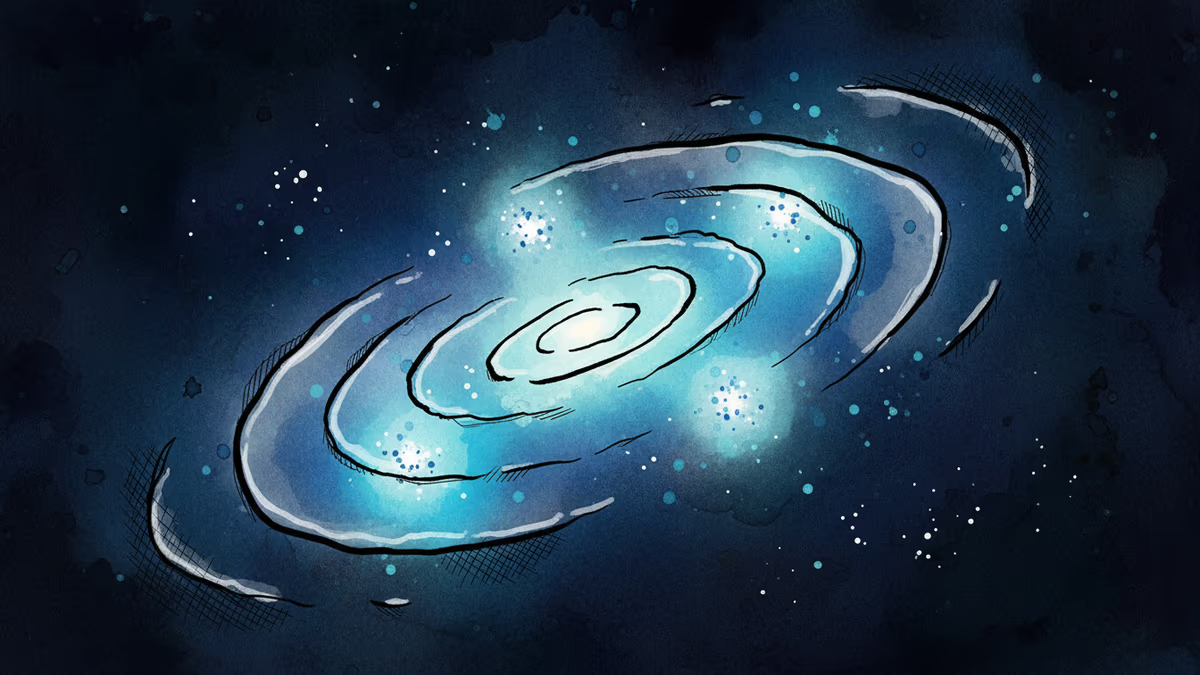
Astronomers just discovered a cosmic oddity 300 million light-years away that challenges everything we thought we knew about galaxies. At first glance, it looks like four lonely star clusters floating in empty space. But these aren't isolated objects—they're neighborhoods in a massive galaxy that's almost entirely made of dark matter.
The Invisible Giant
Meet CDG-2 (Candidate Dark Galaxy-2), a galaxy so faint it's practically a ghost. It took three of the world's most powerful telescopes—Hubble, Euclid, and Subaru—working together to even detect it. None could spot it alone.
The four globular clusters that make this galaxy visible account for just 16% of its total brightness. That's unusually high—imagine a skyscraper where you can only see the light from four windows, and the rest of the building is completely transparent.
The Universe's Hidden Skeleton
Dark matter makes up roughly 85% of all matter in the universe, yet it neither emits nor reflects light. Scientists only know it exists because of its gravitational effects. Even our own Milky Way is embedded in a halo that's about 90% dark matter.

But CDG-2 is extreme. It's essentially a dark matter halo with almost no stars—a cosmic skeleton with barely any flesh. These "dark galaxies" are becoming valuable natural laboratories for studying the mysterious substance that dominates our universe.
Formation Mysteries
Current theory suggests galaxies form when dark matter clumps together first, creating a gravitational framework that attracts regular matter to form stars. So what went wrong with CDG-2? Did star formation fail, or does this represent an entirely different evolutionary path?
Located within the Perseus cluster, CDG-2 might be a victim of its environment. Massive neighboring galaxies could have stripped away its regular matter through gravitational interactions, leaving behind this dark matter ghost.
The Search Continues
As detection methods improve, astronomers are finding more of these phantom galaxies. Each discovery refines our understanding of how dark matter behaves and how the universe's invisible architecture shapes what we can see.
The Euclid space telescope, launched in 2023, is specifically designed to map dark matter's distribution across billions of galaxies. CDG-2 might be just the beginning of a new catalog of cosmic phantoms.
Authors
Related Articles

The CHARA Array has successfully captured high-resolution direct images of nova explosions V1674 Herculis and V1405 Cassiopeiae, revealing non-spherical ejecta and common envelope phases.

Private space telescope funding is making a massive comeback in 2026. Explore how the astronomical landscape is shifting from government-led projects back to private patronage.

Samsung Electronics' union branch revealed that 84% of survey respondents oppose the government's roughly $290 billion (₩400 trillion) semiconductor megaproject in Gwangju. Government, management, the union and shareholders are all reading the same national project in sharply different ways.

Nvidia shipped roughly a billion RISC-V cores in 2024, then announced it would run CUDA on the open standard. We break down how royalty-free instruction sets and open software stacks are trying to route around CUDA's lock-in. Part 2 of the Semiconductor Sovereignty series.
The CHARA Array has successfully captured high-resolution direct images of nova explosions V1674 Herculis and V1405 Cassiopeiae, revealing non-spherical ejecta and common envelope phases.
Private space telescope funding is making a massive comeback in 2026. Explore how the astronomical landscape is shifting from government-led projects back to private patronage.
Samsung Electronics' union branch revealed that 84% of survey respondents oppose the government's roughly $290 billion (₩400 trillion) semiconductor megaproject in Gwangju. Government, management, the union and shareholders are all reading the same national project in sharply different ways.
Nvidia shipped roughly a billion RISC-V cores in 2024, then announced it would run CUDA on the open standard. We break down how royalty-free instruction sets and open software stacks are trying to route around CUDA's lock-in. Part 2 of the Semiconductor Sovereignty series.
Thoughts
Share your thoughts on this article
Sign in to join the conversation