
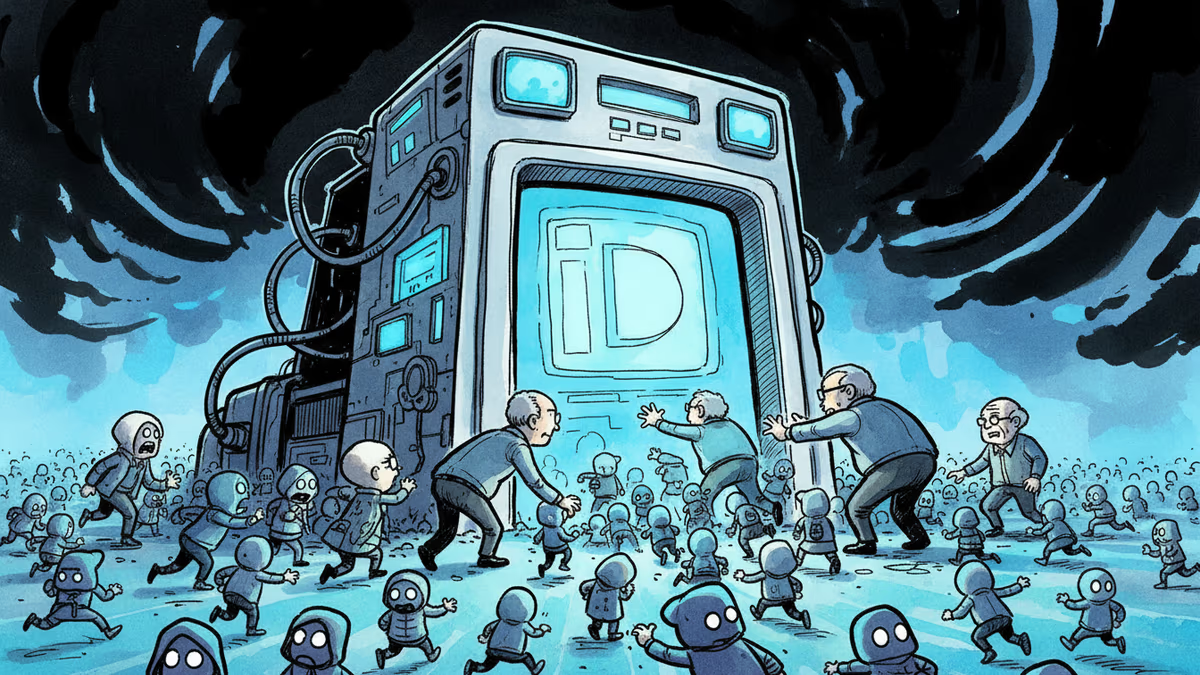
Discord's Age Verification Backlash Exposes the Privacy vs Safety Dilemma
Discord faces fierce criticism after announcing all users will default to teen mode until age verification. Privacy advocates clash with child safety concerns as 70,000 government IDs were recently breached.
70,000 Government IDs Just Got Breached. Now Discord Wants More?
Discord's announcement that all users will soon default to teen experiences until their ages are verified has triggered immediate and fierce backlash. The timing couldn't be worse—just months after a third-party breach exposed 70,000 Discord users' government IDs, the platform is doubling down on collecting even more sensitive data.
The messaging platform, used by 150 million people globally, started as a haven for gamers but has evolved into everything from study groups to professional communication. Now it's caught between regulatory pressure to protect minors and user demands for privacy—and the solution it's proposing satisfies no one.
Discord's Damage Control: "Most Won't Need ID, Just Selfies"
Facing mounting criticism, Discord quickly attempted damage control. Most users won't need to submit government IDs, the company clarified. Instead, they'll use video selfies with AI age estimation. Future behavioral signals might even override age checks entirely, Discord suggested, seemingly trying to minimize concerns about sensitive data storage.
But this explanation created new problems. Privacy advocates immediately flagged concerns about facial recognition data collection and behavioral tracking. "They're trying to solve one privacy problem by creating three new ones," said one digital rights activist. The AI age estimation technology itself remains largely unproven and potentially discriminatory.
The Great Divide: Parents vs. Power Users
The response to Discord's policy reveals a fundamental split in priorities.
Parents largely support the move. They see it as necessary protection against inappropriate content and potential predators. Many have been calling for stronger age verification on platforms their children use. "Finally, a company taking child safety seriously," one parent advocacy group stated.

Existing users are furious. Adult users resent being defaulted to restricted teen modes and forced to submit personal data to restore full functionality. Privacy-conscious communities are already planning mass migrations to alternative platforms like Matrix or Revolt.
Developers and community managers worry about the chilling effect on organic community growth. Age verification barriers could significantly reduce new user acquisition and fundamentally change Discord's open, pseudonymous culture.
The Regulatory Web Tightens
Discord's decision isn't happening in a vacuum. It's responding to a global wave of legislation demanding stronger age verification:
- The EU's Digital Services Act requires platforms to assess risks to minors
- The UK's Online Safety Act mandates age verification for certain content
- US states are passing increasingly strict child protection laws
- Australia is considering social media age limits
Each jurisdiction has different requirements, creating a compliance nightmare for global platforms. European law emphasizes data minimization, US law prioritizes free speech, and some countries require real-name verification. Platforms like Discord must somehow satisfy all these conflicting demands simultaneously.
The result? A lowest-common-denominator approach that often satisfies no one while maximizing data collection.
The Unintended Consequences
Discord's age verification push could trigger broader industry changes. If successful, expect YouTube, TikTok, and other platforms to implement similar measures. If it fails spectacularly, it might provide ammunition for those arguing against heavy-handed age verification requirements.
There's also the international competitiveness angle. While Western platforms grapple with complex verification systems, platforms from countries with different privacy norms might gain competitive advantages. Chinese apps like WeChat or emerging decentralized platforms could benefit from Discord's misstep.
Authors
Related Articles
The FTC fined Cox Media and two ad firms $930,000 — not for actually eavesdropping on users, but for falsely claiming they could. The case raises uncomfortable questions about surveillance capitalism.
A Utah woman was sentenced to life in prison partly because of her Google searches and deleted texts. The Kouri Richins case reveals how digital footprints have become the courtroom's most reliable witness.
After 15 years of fragmented mobile messaging, Apple and Google are rolling out end-to-end encrypted RCS messaging between iPhones and Android devices. Here's what changed, why it took so long, and what it means for your privacy.
New Mexico already won $375 million from Meta. Now it wants something harder to give: a court order forcing Facebook, Instagram, and WhatsApp to redesign themselves. A three-week trial starts Monday.
The FTC fined Cox Media and two ad firms $930,000 — not for actually eavesdropping on users, but for falsely claiming they could. The case raises uncomfortable questions about surveillance capitalism.
A Utah woman was sentenced to life in prison partly because of her Google searches and deleted texts. The Kouri Richins case reveals how digital footprints have become the courtroom's most reliable witness.
After 15 years of fragmented mobile messaging, Apple and Google are rolling out end-to-end encrypted RCS messaging between iPhones and Android devices. Here's what changed, why it took so long, and what it means for your privacy.
New Mexico already won $375 million from Meta. Now it wants something harder to give: a court order forcing Facebook, Instagram, and WhatsApp to redesign themselves. A three-week trial starts Monday.
Thoughts
Share your thoughts on this article
Sign in to join the conversation