
Secrets of the Stellar Blast: CHARA Array Nova Explosion Imaging Reveals Cosmic Chaos
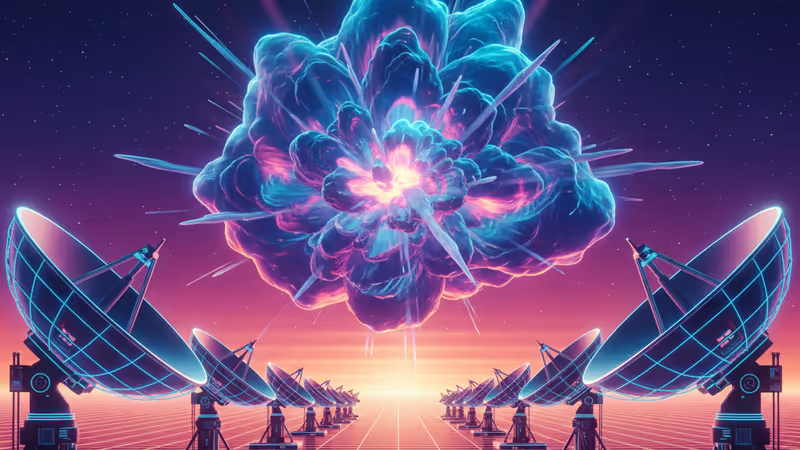
The CHARA Array has successfully captured high-resolution direct images of nova explosions V1674 Herculis and V1405 Cassiopeiae, revealing non-spherical ejecta and common envelope phases.
It's no longer just a dot in the night sky. For the first time, astronomers have captured the violent birth of a stellar explosion in unprecedented detail. The CHARA Array at Georgia State University has produced direct images of two nova explosions from 2021, fundamentally changing our understanding of how these cosmic events evolve. Using near-infrared interferometry, they've turned what were once indirect inferences into clear visual evidence.
V1674 Herculis: The Blazing Speed of Non-Spherical Ejecta
One of the subjects, V1674 Herculis, shattered records by reaching peak brightness in less than 16 hours after discovery. Images taken just 2.2 days post-explosion revealed that the blast wasn't a perfect sphere. Instead, it featured a distinct elliptical structure with two ejecta flows shooting toward the northwest and southeast.
This asymmetry is more than just a visual curiosity. According to the research team, these flows collided to form a powerful shock wave. This physical interaction perfectly timed with the detection of high-energy gamma rays by NASA's Fermi Telescope, proving that novae act as massive particle accelerators in space.

V1405 Cassiopeiae: The Mystery of the Common Envelope
The second subject, V1405 Cassiopeiae, followed a much slower path, taking 53 days to peak. Surprisingly, the expansion radius was measured at only 0.85 au—a far cry from the expected 23-46 au if the gas had been ejected immediately.
This massive discrepancy suggests a "common envelope" phase, where the expanded outer layers swallow the entire binary star system for weeks. Gail Schaefer, director of the CHARA Array, noted that catching these transient events requires extreme flexibility. Such observations provide a rare look into how closely orbiting stars interact—a phenomenon believed to occur in over 10% of the stars in our universe.
Authors
Related Articles
Scientists discover an ultra-faint galaxy where dark matter comprises nearly all its mass, offering new insights into cosmic structure and galaxy formation.

Private space telescope funding is making a massive comeback in 2026. Explore how the astronomical landscape is shifting from government-led projects back to private patronage.

Samsung Electronics' union branch revealed that 84% of survey respondents oppose the government's roughly $290 billion (₩400 trillion) semiconductor megaproject in Gwangju. Government, management, the union and shareholders are all reading the same national project in sharply different ways.

Nvidia shipped roughly a billion RISC-V cores in 2024, then announced it would run CUDA on the open standard. We break down how royalty-free instruction sets and open software stacks are trying to route around CUDA's lock-in. Part 2 of the Semiconductor Sovereignty series.
Scientists discover an ultra-faint galaxy where dark matter comprises nearly all its mass, offering new insights into cosmic structure and galaxy formation.
Private space telescope funding is making a massive comeback in 2026. Explore how the astronomical landscape is shifting from government-led projects back to private patronage.
Samsung Electronics' union branch revealed that 84% of survey respondents oppose the government's roughly $290 billion (₩400 trillion) semiconductor megaproject in Gwangju. Government, management, the union and shareholders are all reading the same national project in sharply different ways.
Nvidia shipped roughly a billion RISC-V cores in 2024, then announced it would run CUDA on the open standard. We break down how royalty-free instruction sets and open software stacks are trying to route around CUDA's lock-in. Part 2 of the Semiconductor Sovereignty series.
Thoughts
Share your thoughts on this article
Sign in to join the conversation