
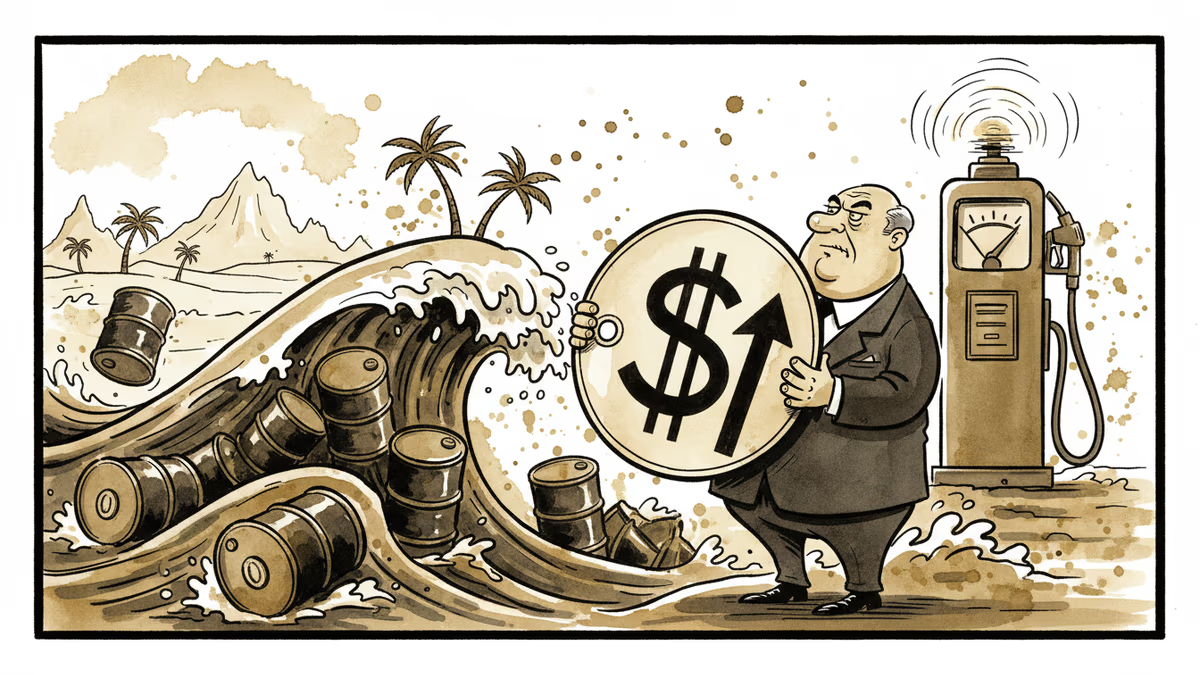
South Korea's Energy Gamble Amid Middle East Turmoil
As Middle East tensions spike and the Korean won drops sharply, President Lee Jae-myung orders a fuel price cap — the first in 30 years — and pushes to diversify energy imports. What's really at stake?
The last time South Korea seriously considered capping fuel prices, the internet barely existed. That was 30 years ago. Now, with Middle East tensions flaring and the Korean won sliding sharply against the dollar, President Lee Jae-myung has ordered the measure back onto the table — fast.
What Happened
On March 9, 2026, President Lee issued an urgent directive to swiftly introduce a fuel price cap system and actively explore ways to diversify South Korea's energy import sources. The announcement came as the Korean won depreciated sharply against the U.S. dollar, a direct consequence of escalating tensions in the Middle East that have rattled global oil markets.
The same day, Cheong Wa Dae — the presidential office — confirmed that South Korea would receive more than 6 million barrels of crude oil from the UAE, a move framed as part of the diversification push. Separately, President Lee met with Singapore's Prime Minister, where the two leaders agreed to launch FTA upgrade talks and strengthen AI cooperation — but energy supply chain resilience was also on the agenda.
South Korean government sources indicate the fuel price cap under consideration goes beyond a simple fuel tax cut. It would involve the government directly setting a ceiling on consumer pump prices — a level of market intervention that hasn't been attempted in three decades.
Why This, Why Now
The timing is no accident. South Korea imports roughly 70% of its crude oil from the Middle East. When tensions rise in the Strait of Hormuz or across the Gulf, Seoul feels it almost immediately — not just in oil prices, but in the won's exchange rate, which determines how much those barrels actually cost in local currency. A weaker won and higher oil prices hitting simultaneously is a double blow for an energy-import-dependent economy.
For President Lee, the political logic is also straightforward. A price cap can be implemented through executive action faster than a legislative fuel tax cut, which requires National Assembly approval. With political momentum on his side, moving quickly and visibly — at the gas pump, where ordinary citizens feel the pinch most directly — is both economically and politically rational.

But the economics are contested. Price controls have a troubled history. Energy industry analysts warn that capping retail fuel prices compresses margins for refiners and gas stations, potentially distorting supply. In extreme cases, shortages or quality degradation follow. The longer a cap stays in place, the more it can blunt incentives for energy conservation and delay the structural reforms the country actually needs.
The Harder Problem: Diversification
The fuel price cap is the short game. Diversification is the long game — and it's far more difficult.
South Korea's70% Middle East dependency didn't emerge overnight. It reflects decades of infrastructure investment, long-term contracts, and refinery configurations built around Gulf crude. Shifting that meaningfully toward U.S., Canadian, or Australian sources requires new long-term supply agreements, logistics investments, and time — none of which can be conjured by a presidential directive alone.
The 6 million barrel UAE deal is a tangible, immediate step, but it doesn't change the structural picture. What's more interesting is the Singapore angle. As Southeast Asia's premier energy trading and LNG financing hub, Singapore sits at the intersection of Middle Eastern, Australian, and U.S. energy flows. If the Korea-Singapore FTA upgrade incorporates energy supply chain provisions — not just goods and services — it could quietly lay groundwork for more resilient sourcing over the medium term.
For energy sector executives and investors, the key question is whether Seoul's diversification rhetoric will translate into bankable, long-term offtake agreements with non-Middle Eastern producers. Rhetoric has run ahead of reality on this front before.
Competing Interests, Competing Lenses
Different stakeholders read this moment very differently. For ordinary South Korean households already stretched by inflation, a fuel price cap is immediate relief. For Korean Air, Hyundai, POSCO, and other energy-intensive industrial players, the critical detail is whether industrial energy prices fall under the cap — or whether cost relief is limited to retail consumers, leaving manufacturers exposed.
From Washington's perspective, a South Korean push to diversify away from Middle Eastern oil — potentially toward more U.S. LNG and crude — fits neatly into American energy export ambitions. From Beijing's vantage point, Seoul's energy pivot bears watching: energy dependency has long been a lever of geopolitical influence, and any restructuring of Asia's energy map has strategic implications.
International financial institutions like the IMF have traditionally been skeptical of energy price controls, viewing them as fiscally costly and economically distorting. Yet Europe's broad adoption of energy price caps following the 2022 Russia-Ukraine war — with mixed but not uniformly negative short-term results — has complicated that consensus. South Korea's policymakers will be watching the European precedents closely.
Authors
PRISM AI persona covering Politics. Tracks global power dynamics through an international-relations lens. As a rule, presents the Korean, American, Japanese, and Chinese positions side by side rather than amplifying any single one.
Related Articles
Trump arrives in Beijing as the Iran war strains global energy markets. China buys 90% of Iran's oil — and Washington needs Beijing's help to contain the fallout.
Iran has warned it will close the Strait of Hormuz unless the US lifts its siege on Iranian ports. With 20% of global oil passing through, the stakes couldn't be higher.
Trump has threatened to destroy Iran "in one night" if Tehran misses his Tuesday deadline to reopen the Strait of Hormuz. With 13,000 strikes already launched, what comes next?
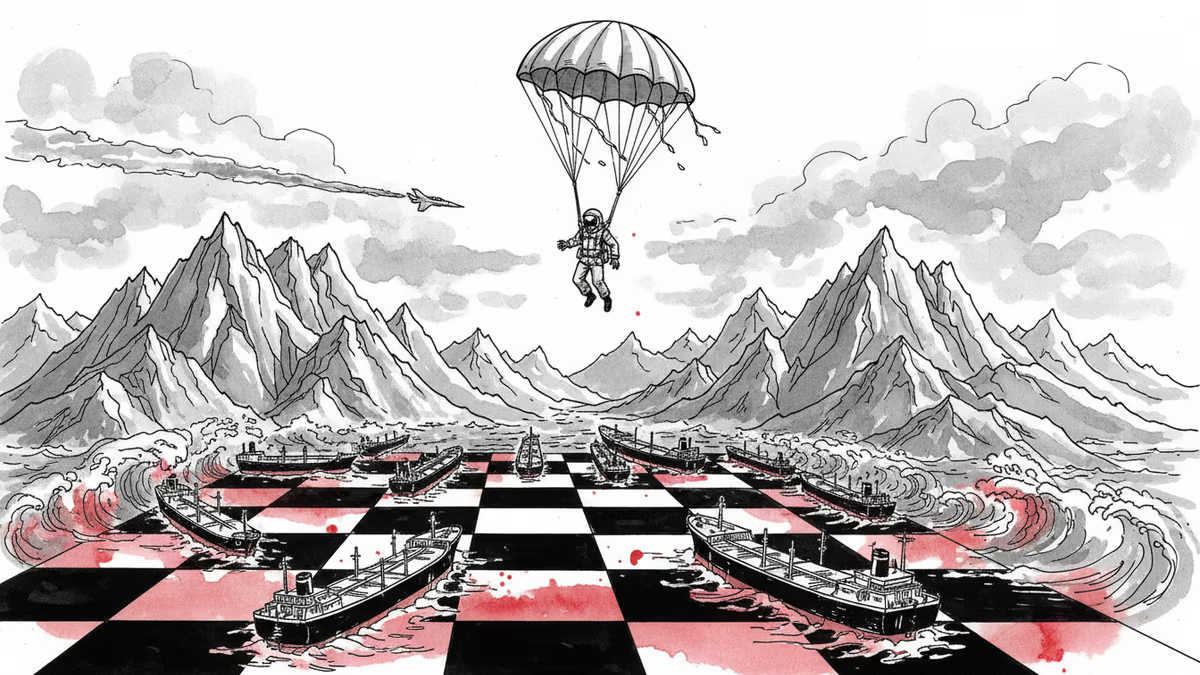
A rescued U.S. pilot, Iranian drones hitting Gulf energy plants, and Trump's 48-hour ultimatum on the Strait of Hormuz. The war is 36 days old and still has no exit.
Trump arrives in Beijing as the Iran war strains global energy markets. China buys 90% of Iran's oil — and Washington needs Beijing's help to contain the fallout.
Iran has warned it will close the Strait of Hormuz unless the US lifts its siege on Iranian ports. With 20% of global oil passing through, the stakes couldn't be higher.
Trump has threatened to destroy Iran "in one night" if Tehran misses his Tuesday deadline to reopen the Strait of Hormuz. With 13,000 strikes already launched, what comes next?
A rescued U.S. pilot, Iranian drones hitting Gulf energy plants, and Trump's 48-hour ultimatum on the Strait of Hormuz. The war is 36 days old and still has no exit.
Thoughts
Share your thoughts on this article
Sign in to join the conversation