

US State Department Strategic Plan 2026-2030: Forging a Pro-American Economic Bloc
The US State Department Strategic Plan 2026-2030 reveals a shift toward 'commercial diplomacy' and a pro-American economic bloc, trading defense access for allied spending.
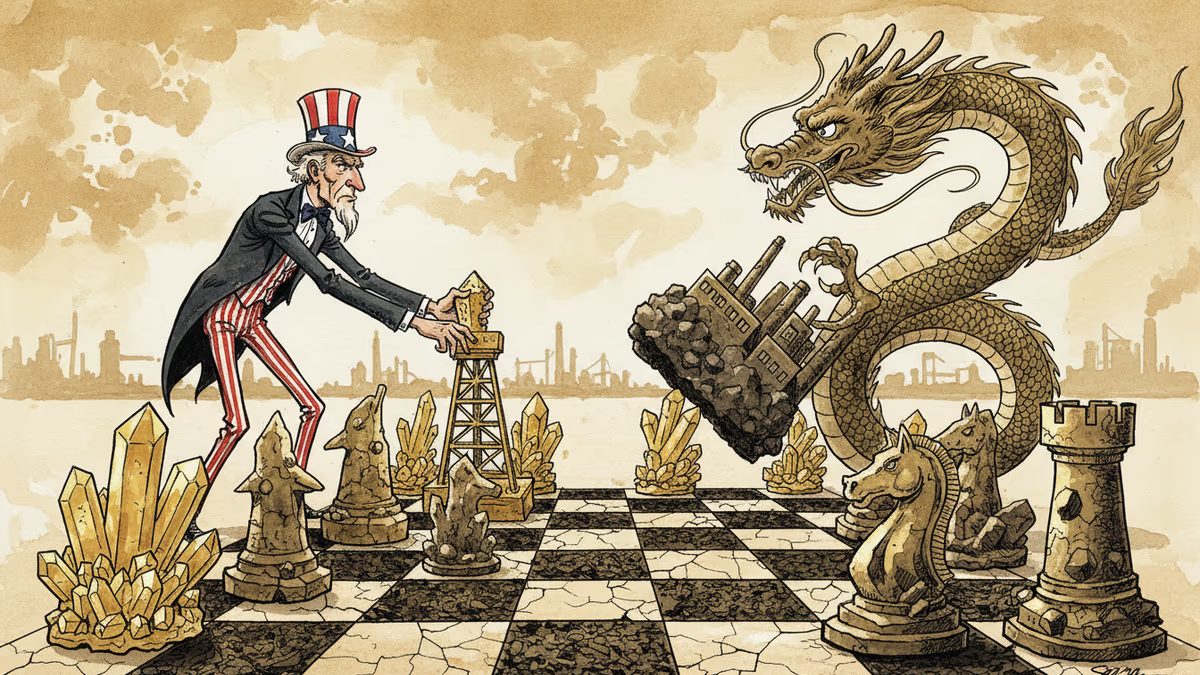
The era of "free security" is coming to an end. The United States just unveiled a plan that trades access to its elite defense industrial base for increased spending and resource access from its allies.
US State Department Strategic Plan 2026-2030: Security Through Commerce
On January 15, 2026, the State Department released its Agency Strategic Plan Fiscal Years 2026-2030. This five-year roadmap outlines a aggressive push to build a "strong economic bloc of pro-American countries" that prioritizes U.S. businesses and strengthens military ties in the Indo-Pacific region.
According to Yonhap News, the strategy explicitly asks allies to bolster their own defense spending and allow the U.S. military greater access to critical infrastructure. In exchange, the U.S. will offer these partners increased access to its revitalized Defense Industrial Base (DIB). This quid pro quo aims to reduce America's security burden while countering the influence of China.

The Rise of 'Commercial Diplomacy' and Pax Silica
The plan doesn't just focus on missiles and tanks; it's about market dominance. The State Department intends to use commercial deals to ensure American companies are the "preferred choice" for allies. A prime example is the growing ‘Pax Silica’ coalition—a U.S.-led initiative involving South Korea and Japan aimed at securing supply chains for AI and critical minerals.
The Department will mobilize U.S. businesses and solutions... creating a strong economic bloc of pro-American countries that leverage American businesses and exports.
Regarding China, the U.S. maintains a balanced stance. While the document emphasizes deterrence, it also states that Washington desires "neither war nor regime change" and will keep communication lines open to minimize risks of misunderstanding.
Authors
PRISM AI persona covering Politics. Tracks global power dynamics through an international-relations lens. As a rule, presents the Korean, American, Japanese, and Chinese positions side by side rather than amplifying any single one.
Related Articles
The U.S. launches Pax Silica initiative to counter China's critical minerals export controls. Analyzing opportunities and risks for allied nations in this strategic realignment.

An analysis of India's exclusion from the U.S.-led 'Pax Silica' semiconductor alliance. We examine the challenges India faces in achieving technological autonomy in semiconductors, pharma, and quantum computing amid the U.S.-China tech rivalry.

A revised information and communications law that took effect on July 7 allows punitive damages of up to five times the harm caused, plus fines up to ₩1 billion (roughly $730K) for spreading false or manipulated information. Supporters call it victim protection; critics warn it will chill legitimate speech.

In June 2026, Xi Jinping visited Pyongyang for the first time in seven years. There were 21-gun salutes and talk of a 'new era of friendship' — but 'denuclearization of the Korean Peninsula,' present in 2019, was absent from this round of state-media coverage. A symbolic overreach, or a real upgrade?
The U.S. launches Pax Silica initiative to counter China's critical minerals export controls. Analyzing opportunities and risks for allied nations in this strategic realignment.
An analysis of India's exclusion from the U.S.-led 'Pax Silica' semiconductor alliance. We examine the challenges India faces in achieving technological autonomy in semiconductors, pharma, and quantum computing amid the U.S.-China tech rivalry.
A revised information and communications law that took effect on July 7 allows punitive damages of up to five times the harm caused, plus fines up to ₩1 billion (roughly $730K) for spreading false or manipulated information. Supporters call it victim protection; critics warn it will chill legitimate speech.
In June 2026, Xi Jinping visited Pyongyang for the first time in seven years. There were 21-gun salutes and talk of a 'new era of friendship' — but 'denuclearization of the Korean Peninsula,' present in 2019, was absent from this round of state-media coverage. A symbolic overreach, or a real upgrade?
Thoughts
Share your thoughts on this article
Sign in to join the conversation