
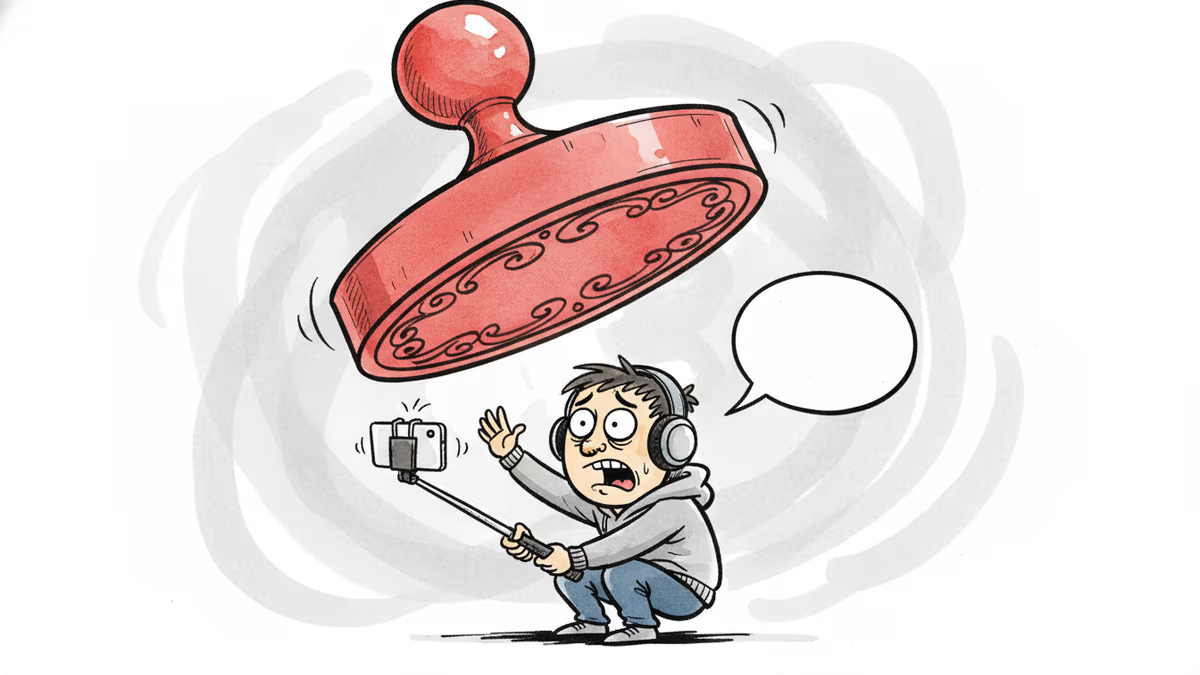
A Single YouTube Video Could Cost $730K: South Korea's Amended Network Act Takes Effect Amid Backlash
A revised information and communications law that took effect on July 7 allows punitive damages of up to five times the harm caused, plus fines up to ₩1 billion (roughly $730K) for spreading false or manipulated information. Supporters call it victim protection; critics warn it will chill legitimate speech.
One video. One message in an open chat room. Up to ₩1 billion (roughly $730,000) on the line. As of July 7, 2026, speaking online in South Korea carries new weight.
The amended Network Act (formally the Information and Communications Network Act), pushed through by the ruling Democratic Party, took effect that day. Two provisions sit at its core. Deliberately spreading false or manipulated information that harms someone now carries damages of up to five times the loss. And distributing information that has been formally ruled false two or more times can trigger a fine of up to ₩1 billion (roughly $730,000).
The targets are spelled out. YouTubers with 100,000-plus subscribers, influencers pulling more than 100,000 monthly views, KakaoTalk open chat rooms and the like all fall under it. The bigger your reach, the heavier the liability — that's the design.
Supporters lead with victim protection. As deepfake composites and malicious falsehoods have caused real harm to a growing number of people, the argument runs, steep damages act as a deterrent. If a channel watched by hundreds of thousands pushes bad information, responsibility should match that reach, and the platforms where information changes hands should carry more of the management burden too.

The opposing worry centers on the "chilling effect." Faced with fivefold damages and a ₩1 billion fine, people may hold back even lawful criticism or a legitimate question. Cha Jin-a, a professor at Korea University Law School, and Lee Seong-yeop, head of the Korean Association of Information and Communications Law, have raised two problems: who decides what counts as "false," and the risk of prior censorship.
The fight will feel familiar to anyone following Europe. The EU's Digital Services Act and Germany's NetzDG have pressed platforms to police illegal content, and free-speech advocates there voice the same fear, that the threat of penalties nudges platforms and users toward over-removal and self-censorship.
The pushback showed up in the numbers, too. A national petition opposing the amendment drew 142,248 signatures, well past the 50,000 needed to qualify. The mechanism works a bit like the UK Parliament's petition system: clear a signature threshold and the National Assembly is obliged to take it up. Among people in their 20s and 30s, on university forums and among everyday users, the phrase that keeps surfacing is "self-censorship."
This content is AI-generated based on source articles. While we strive for accuracy, errors may occur. We recommend verifying with the original source.
Related Articles

A Paris court has convicted 10 people for cyber-bullying Brigitte Macron with gender-based conspiracy theories. Read about the Brigitte Macron cyber-bullying verdict 2026.
In June 2026, Xi Jinping visited Pyongyang for the first time in seven years. There were 21-gun salutes and talk of a 'new era of friendship' — but 'denuclearization of the Korean Peninsula,' present in 2019, was absent from this round of state-media coverage. A symbolic overreach, or a real upgrade?
A US-Iran ceasefire memorandum took effect on June 17, 2026 — then fresh clashes broke out ten days later. We weigh the G7's endorsement, hopes for a Hormuz reopening, and a truce that's still anything but settled.
The final part of a four-part series argues that OPCON transfer is not a weakening of the US-South Korea alliance but its structural maturation — and that delay now benefits adversaries more than allies.
A Paris court has convicted 10 people for cyber-bullying Brigitte Macron with gender-based conspiracy theories. Read about the Brigitte Macron cyber-bullying verdict 2026.
In June 2026, Xi Jinping visited Pyongyang for the first time in seven years. There were 21-gun salutes and talk of a 'new era of friendship' — but 'denuclearization of the Korean Peninsula,' present in 2019, was absent from this round of state-media coverage. A symbolic overreach, or a real upgrade?
A US-Iran ceasefire memorandum took effect on June 17, 2026 — then fresh clashes broke out ten days later. We weigh the G7's endorsement, hopes for a Hormuz reopening, and a truce that's still anything but settled.
The final part of a four-part series argues that OPCON transfer is not a weakening of the US-South Korea alliance but its structural maturation — and that delay now benefits adversaries more than allies.
Thoughts
Share your thoughts on this article
Sign in to join the conversation