
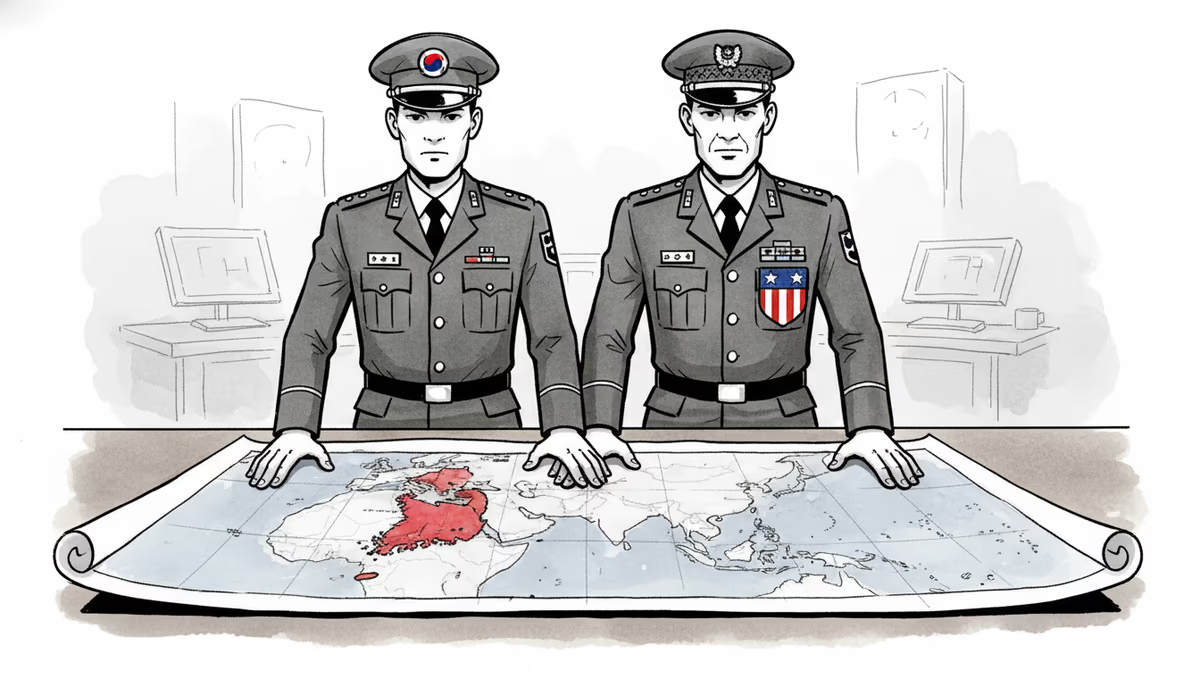
After OPCON Transfer, What Kind of Alliance?
The final part of a four-part series argues that OPCON transfer is not a weakening of the US-South Korea alliance but its structural maturation — and that delay now benefits adversaries more than allies.
For 70 years, the United States has held wartime operational control over South Korean forces. The question is no longer whether to hand it back — it's whether the alliance can afford to keep waiting.
On May 11, 2026, Defense Secretary Pete Hegseth and South Korean Defense Minister Ahn Kyu-back reaffirmed OPCON transfer and alliance modernization as core agenda items in their bilateral talks. The reaffirmation itself is not new. What is new is the degree to which both sides appear to be designing the structure that comes after the transfer, not merely debating whether to proceed.
This final installment of a four-part series makes the case that OPCON transfer is not the weakening of an alliance — it is the alliance's structural maturation.
The Cost of Standing Still
The existing Combined Forces Command structure has been tested across more than seven decades. Both sides know their roles. Procedures are deeply institutionalized. The arguments for staying put are real, not imaginary.
But the series' central argument cuts through that comfort: maintaining the current structure is not a strategy — it is a decision to let structural drift determine the alliance's future. Every year of delay carries compounding costs. South Korea loses national momentum around military capability development. Washington remains bound to a static deterrence posture on the peninsula at a moment when Indo-Pacific demands require strategic flexibility. And in a dynamic that should give both governments pause, the accelerating pace of North Korea's nuclear program, China's long-term military buildup, and Russia's deepening defense relationship with Pyongyang are collectively making the case for OPCON transfer more effectively than the allies themselves.
Outright cancellation is not a viable option. Even deceleration carries costs that are difficult to quantify but easy to underestimate.

What the Post-Transfer Alliance Actually Looks Like
The proposed architecture centers on a Future Combined Forces Command (F-CFC) that functions as an integration hub — the interface through which US strategic assets and extended deterrence connect to Korean-led conventional operations. South Korea leads the conventional fight; the United States provides nuclear deterrence and strategic enablers. The ROK Strategic Command integrates the three-axis system and serves as Seoul's platform for executing the ROK-US Conventional-Nuclear Integration strategy alongside US extended deterrence assets.
The practical military argument is specific: continuous Korean command authority from peacetime through wartime eliminates the response-time gap created by the current dual command structure. North Korean provocations would face a system capable of responding in seconds, without the command transition windows that adversaries could exploit. The Nuclear Consultative Group deterrence guidelines, once implemented within this structure, can move from consultation to genuine operational integration — a level of coordination the current structure cannot support.
The series is careful to note that the NCG extended deterrence consultations, the ROK Strategic Command's development, and the ROK-US CNI framework are not substitutes for OPCON transfer. They are parallel tracks that will function most effectively once the new command structure is in place to support them.
Beyond the Peninsula: The Structural Argument
The more consequential argument may be geographic. East Asian security has long operated on a hub-and-spoke model — South Korea, Japan, and Australia each maintaining bilateral ties with Washington, with limited direct coordination among themselves. That architecture is under pressure, and OPCON transfer is one mechanism through which the transition becomes manageable rather than destabilizing.
For Washington, a South Korea exercising full wartime OPCON frees US Forces Korea from its role as a static peninsular deterrent, unlocking the strategic flexibility the broader Indo-Pacific increasingly demands. For Seoul, it means graduating from passive beneficiary of security guarantees to active participant in the region's evolving security architecture.
The material basis for that transition is already forming. South Korea's investments in AI-enabled manned-unmanned teaming, space domain operations, cyber capabilities, and precision strike are building a genuine technology partnership — one in which capability flows in both directions. South Korea's shipbuilding capacity supporting US Navy maintenance, repair, and overhaul operations directly addresses contested logistics challenges across the Indo-Pacific. The MASGA investment cooperation framework signals an alliance whose shared value is extending into economic security.
Two programs still in development — South Korea's nuclear-powered submarine and the US nuclear-armed sea-launched cruise missile (SLCM-N) — represent a potential material link among allies across East Asia that could extend the reach of combined deterrence well beyond the peninsula. Both remain subject to ongoing policy deliberation, but their trajectory points toward a more distributed and interconnected regional deterrence architecture.
This content is AI-generated based on source articles. While we strive for accuracy, errors may occur. We recommend verifying with the original source.
Related Articles
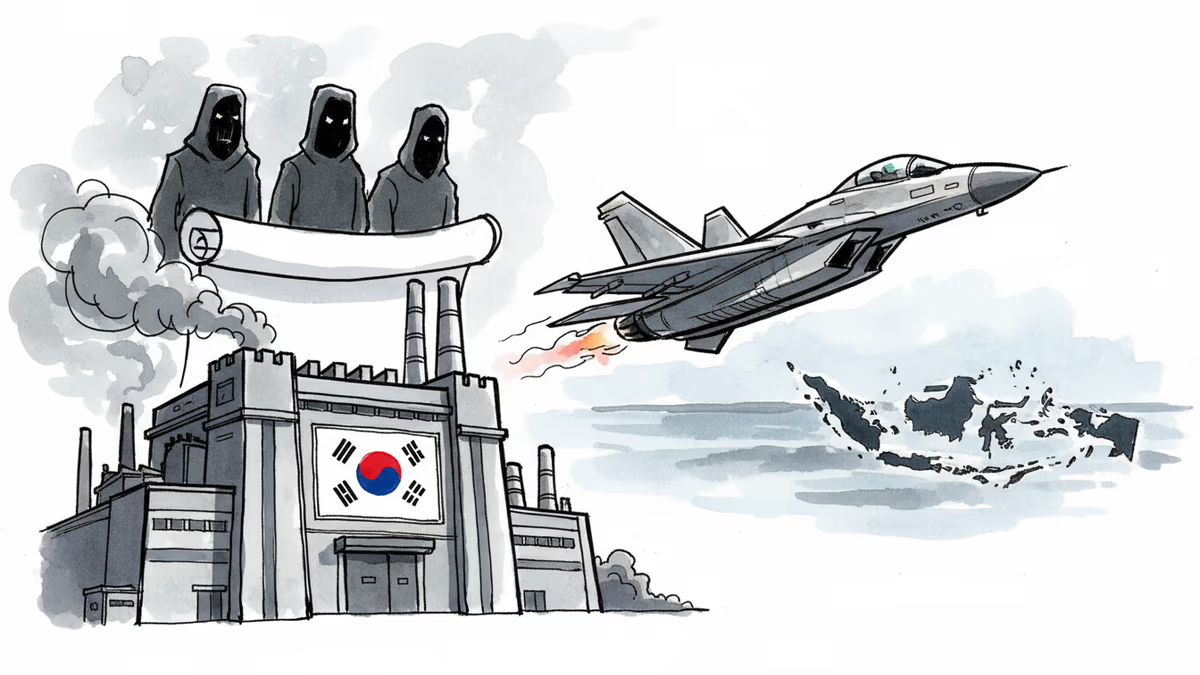
South Korea is set to sign a deal to export 16 KF-21 fighter jets to Indonesia, marking the first overseas sale of a Korean-made combat aircraft—despite a fraught history of payment disputes and alleged technology theft.
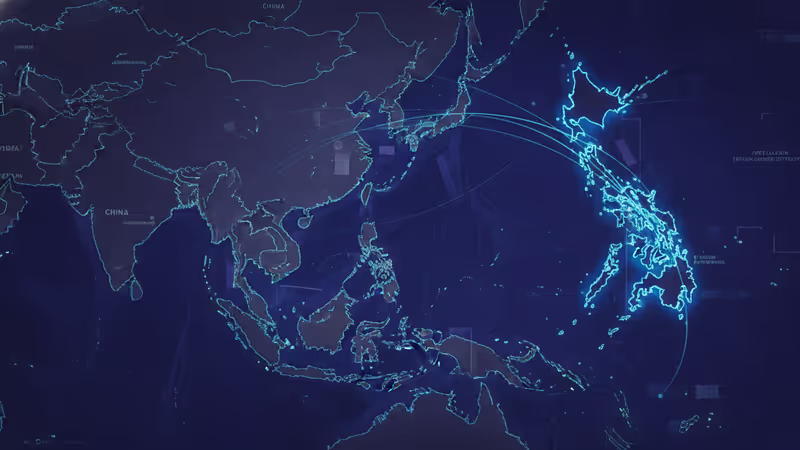
The Pentagon's US Indo-Pacific Defense Strategy 2026 outlines a plan to deter China using strength and alliance-building along the first island chain.

Japanese PM Sanae Takaichi and Italian PM Giorgia Meloni agreed to strengthen critical mineral supply chains and upgrade ties to a special strategic partnership.

Defense Minister Ahn Gyu-back reaffirms the South Korea-US joint military drills 2026 as a 'lifeline' for readiness. Plans for nuclear submarines and 2030 OPCON transfer were also highlighted.
South Korea is set to sign a deal to export 16 KF-21 fighter jets to Indonesia, marking the first overseas sale of a Korean-made combat aircraft—despite a fraught history of payment disputes and alleged technology theft.
The Pentagon's US Indo-Pacific Defense Strategy 2026 outlines a plan to deter China using strength and alliance-building along the first island chain.
Japanese PM Sanae Takaichi and Italian PM Giorgia Meloni agreed to strengthen critical mineral supply chains and upgrade ties to a special strategic partnership.
Defense Minister Ahn Gyu-back reaffirms the South Korea-US joint military drills 2026 as a 'lifeline' for readiness. Plans for nuclear submarines and 2030 OPCON transfer were also highlighted.
Thoughts
Share your thoughts on this article
Sign in to join the conversation