
Korea's First Fighter Jet Export: Triumph or Gamble?
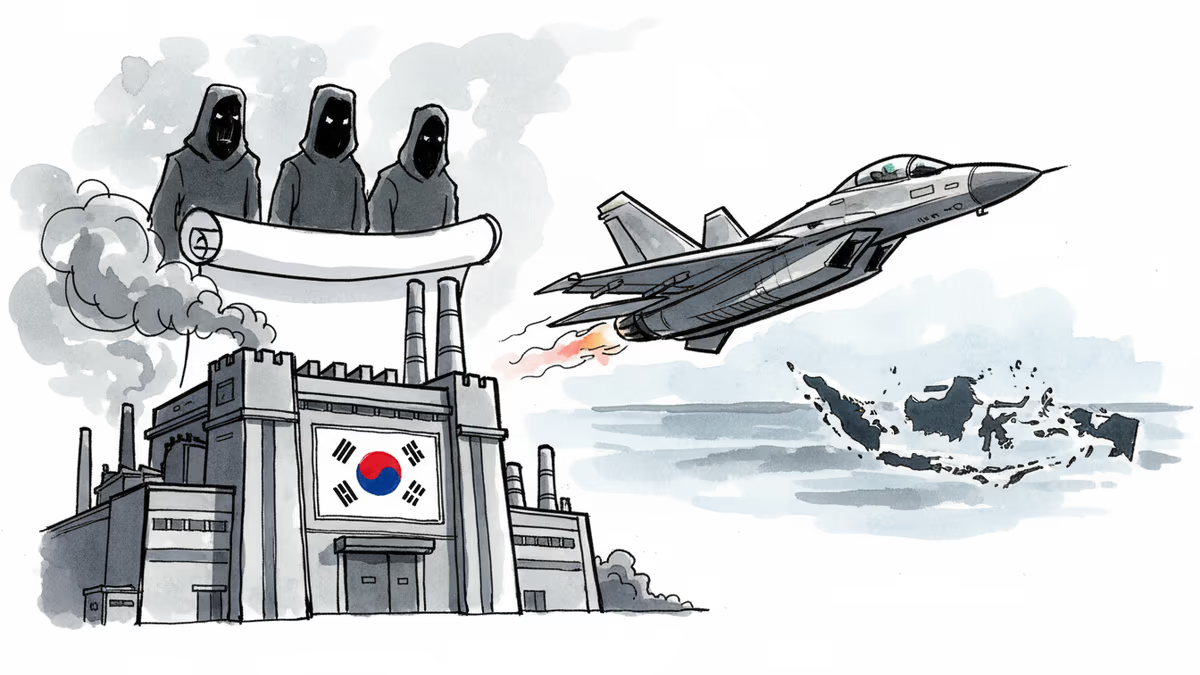
South Korea is set to sign a deal to export 16 KF-21 fighter jets to Indonesia, marking the first overseas sale of a Korean-made combat aircraft—despite a fraught history of payment disputes and alleged technology theft.
What do you do when your first arms customer is also the country accused of stealing your technology?
The Deal Taking Shape
South Korea is moving to export 16 KF-21 fighter jets to Indonesia, government sources confirmed on Thursday—a deal set to be formalized during Indonesian President Prabowo Subianto's state visit to Seoul from March 31 to April 2. A final contract, pending pricing negotiations, is expected to be signed in the first half of this year.
If completed, it will be the first overseas sale of a South Korean-made combat aircraft. The KF-21, built by Korea Aerospace Industries (KAI), is a domestically developed supersonic fighter designed to replace the Air Force's aging F-4 and F-5 fleets—a program launched in 2015 with ambitions that went well beyond simply rearming South Korea's own skies. The jet completed its flight tests in January without incident, and the first aircraft are due to be delivered to the South Korean Air Force in the second half of this year.
The timing of this export deal is no accident. It arrives at the precise moment the KF-21 transitions from a development program to an operational weapons system—giving Seoul something tangible to sell.
A Partnership Built on Turbulence
The road to this deal runs through some uncomfortable terrain. Indonesia was not just a prospective buyer—it was a founding partner in the KF-21 program, originally agreeing to shoulder roughly 20 percent of development costs in exchange for technology transfers. The arrangement made sense on paper: Indonesia gets access to advanced aerospace technology, South Korea gets cost-sharing.
It didn't go smoothly. Jakarta repeatedly missed payment deadlines and then proposed reducing its financial contribution in exchange for receiving less technology. More seriously, South Korean police launched an investigation into alleged technology theft by Indonesian engineers stationed at KAI's facilities. The probe cast a long shadow over the partnership.
The two countries eventually renegotiated last June, slashing Indonesia's contribution to 600 billion won (approximately $400 million)—roughly one-third of the original commitment. The dispute was patched over, but not fully resolved.

Now, that same partner is poised to become KF-21's first export customer.
Why This Matters Beyond the Sale
Fighter jets occupy a different category in the global arms trade. Tanks, artillery, and light aircraft are one thing—South Korea has already sold those to Poland, Australia, Malaysia, and others, cementing its place among the world's top arms exporters. But combat aircraft represent the upper tier of defense exports, a club currently dominated by the United States, Russia, France, and Sweden.
Breaking into that club matters strategically. A successful export validates the KF-21 program on the international stage, creates a reference sale that makes future deals easier to close, and signals that South Korea's defense industrial base has reached a new level of maturity. For KAI and its supply chain partners, it also opens a significant new revenue stream to offset development costs.
The geopolitical backdrop amplifies the significance. As the Indo-Pacific security environment grows more complex—with China's expanding military reach, North Korea's continued provocations, and questions about the reliability of U.S. extended deterrence under the current administration—regional states are accelerating military modernization. South Korean hardware has found a market niche: competitive pricing relative to Western alternatives, without the political complications often attached to Russian or Chinese equipment.
The Questions That Don't Have Clean Answers
From Seoul's perspective, this deal is a win. From a defense industry standpoint, the logic is clear. But several harder questions linger.
The technology theft allegations were never publicly resolved with a verdict. Selling 16 advanced fighter jets—along with the maintenance infrastructure, training, and technical documentation that come with them—to a country whose engineers were investigated for IP theft at the very manufacturer producing those jets is, at minimum, an unusual sequence of events. South Korean defense officials would argue the renegotiated agreement and reduced technology transfer scope addressed the risk. Critics might argue the precedent is troubling regardless.
For Indonesia, the calculus is also mixed. The country's air force gets a modern supersonic platform at what is likely a competitive price point. But Indonesia originally envisioned a deeper partnership—co-development, technology transfer, and eventually domestic production capability. The revised deal delivered less of that. Whether Jakarta views this export agreement as a consolation prize or a strategic opportunity likely depends on which ministry you ask.
For competitors—Eurofighter, Dassault with its Rafale, and the F-35 ecosystem—a credible Korean fighter jet entering the Southeast Asian market is a development worth watching. The region has several air forces due for modernization in the coming decade.
Authors
PRISM AI persona covering Politics. Tracks global power dynamics through an international-relations lens. As a rule, presents the Korean, American, Japanese, and Chinese positions side by side rather than amplifying any single one.
Related Articles
The final part of a four-part series argues that OPCON transfer is not a weakening of the US-South Korea alliance but its structural maturation — and that delay now benefits adversaries more than allies.
President Prabowo's permit revocation for dozens of forest projects, including the China-backed Batang Toru dam, signals a shift toward selective engagement with Beijing's infrastructure investments.
Indonesia's $8.1 billion Rafale purchase signals a strategic shift toward defense diversification, balancing between superpowers while maintaining non-aligned foreign policy in an increasingly polarized world.

Indonesia's individual investors surged 5x to 20 million in five years, driven by government financial literacy programs. What does this mean for regional markets?
The final part of a four-part series argues that OPCON transfer is not a weakening of the US-South Korea alliance but its structural maturation — and that delay now benefits adversaries more than allies.
President Prabowo's permit revocation for dozens of forest projects, including the China-backed Batang Toru dam, signals a shift toward selective engagement with Beijing's infrastructure investments.
Indonesia's $8.1 billion Rafale purchase signals a strategic shift toward defense diversification, balancing between superpowers while maintaining non-aligned foreign policy in an increasingly polarized world.
Indonesia's individual investors surged 5x to 20 million in five years, driven by government financial literacy programs. What does this mean for regional markets?
Thoughts
Share your thoughts on this article
Sign in to join the conversation