

What Is the Universe Made Of? The Answer Keeps Changing
Particles are the smallest things we've found, but that doesn't make them fundamental. A deep dive into why the question of what reality is made of remains stubbornly, fascinatingly open.
Every time we think we've hit the bottom, the floor opens up.
Atoms were supposed to be indivisible—the word itself comes from the Greek for "uncuttable." Then we split them. Inside were protons and neutrons. Inside those, quarks. And quarks, as far as our best instruments can tell, sit inside a framework—the Standard Model—that describes 17 fundamental particles governing matter and force with an accuracy that matches experiment to 10 decimal places.
And yet. Writing for Aeon, physicist and philosopher Felix Flicker makes a case that should unsettle anyone who finds comfort in that precision: particles may be the smallest things nature has shown us, but that doesn't mean they're fundamental. The question of what the universe is actually made of remains, stubbornly and fascinatingly, unanswered.
The Standard Model Is Brilliant. It's Also Incomplete.
The Standard Model is one of the genuine triumphs of 20th-century science. It correctly predicted the existence of the Higgs boson decades before CERN's Large Hadron Collider confirmed it in 2012. It explains why electrons have the mass they do, why protons hold together, why light behaves as it does. No other scientific framework has been tested so rigorously and survived so completely.
But physicists know it's not the whole story. Gravity—the force you feel every second of your life—doesn't fit inside it. Dark matter, which accounts for roughly 27% of the universe's total mass-energy, corresponds to none of its particles. And there's a more conceptually vertiginous problem: within the Standard Model itself, particles aren't really things. They're excitations of fields.
An electron isn't a tiny ball. It's a localized disturbance in an electron field that permeates all of space. The Higgs boson isn't a particle in the intuitive sense—it's a temporary ripple in the Higgs field, summoned into brief existence by a collision and gone in an instant. If particles are patterns in fields, then fields are more fundamental than particles. And if that's true, what are fields made of?
When Physics Runs Out of Road, Philosophy Steps In
This isn't a new problem. Democritus proposed indivisible atoms in the 5th century BCE. Aristotle countered with form and matter. For millennia the debate was purely philosophical because no one could actually look. Then science built the tools to look—and found that the philosophers had been asking the right questions all along, just without the data.
Today, the frontier theories each offer a different answer to "what's fundamental":
String Theory proposes that what we call particles are actually one-dimensional vibrating strings, with different vibrational modes producing different particles. It's mathematically elegant and experimentally untestable—at least with any instrument we could plausibly build.

Loop Quantum Gravity suggests that spacetime itself is not continuous but made of discrete, quantized loops—that there is a minimum length to the universe, roughly 10⁻³⁵ meters, below which "space" loses meaning.
Digital physics, in its more radical forms, proposes that the universe is fundamentally information—that matter, energy, and spacetime are all emergent properties of an underlying computational substrate.
Three frameworks. Three different answers to the same question. None confirmed by experiment.
The Silence After the Higgs
Since 2012, the LHC has been running at higher and higher energies, searching for particles that theories beyond the Standard Model predict should exist—supersymmetric partners, extra dimensions, signs of new physics. It has found nothing.
Physicists call this the "desert"—an energy landscape where theory says something should live, and nothing does. It's the most expensive silence in the history of science. The LHC cost roughly €7.5 billion to build, and its null results have ruled out entire classes of theories that physicists spent decades developing.
This is the context in which Flicker's question lands with particular weight. When experiments stop producing new answers, the field is forced back to first principles. What are we actually looking for? What would count as fundamental? These are not questions physics alone can answer.
Not Everyone Thinks "Fundamental" Is the Right Word
The late physicist Steven Weinberg argued that the concept of fundamentality in physics is pragmatic rather than metaphysical—some layers of description reduce to others, and we call the lower layer more fundamental because it has greater explanatory reach, not because it's more "real."
Philosopher Nancy Cartwright goes further. In her view, the laws of physics hold precisely only in highly idealized conditions. The real world is layered, messy, and irreducibly complex. The assumption that going deeper always yields simpler truth—reductionism—is itself a metaphysical choice, not a discovered fact.
This matters. If Cartwright is right, the hunt for a single fundamental substrate might be a category error—like asking what color the number seven is. The universe might not have a bottom layer in the sense physicists are searching for. It might be turtles all the way down, or it might be that "all the way down" isn't a coherent destination.
What AI and Quantum Computing Change
There's one genuinely new element in this ancient debate. AI-assisted theoretical physics and quantum simulation are beginning to let researchers explore corners of theory space that were previously computationally inaccessible. Calculations that once took decades can now be run in hours. Lattice QCD simulations of quark behavior are reaching new precision. String theory's landscape of 10⁵⁰⁰ possible vacuum states—once a source of despair—is beginning to be mapped statistically.
This doesn't answer the philosophical question. But it changes the pace at which we can eliminate wrong answers. The question of what the universe is made of is moving, slowly, from pure philosophy toward something that might eventually be computable—even if not yet measurable.
This content is AI-generated based on source articles. While we strive for accuracy, errors may occur. We recommend verifying with the original source.
Related Articles

A speculative spacecraft journey near the speed of light reveals that time dilation isn't science fiction—it's physics. And it's asking us harder questions than we expected.

Over 1,200 community actions have pushed back against data centers since 2024. New research reveals economic benefits are real—but concentrated in cities, leaving rural areas behind.
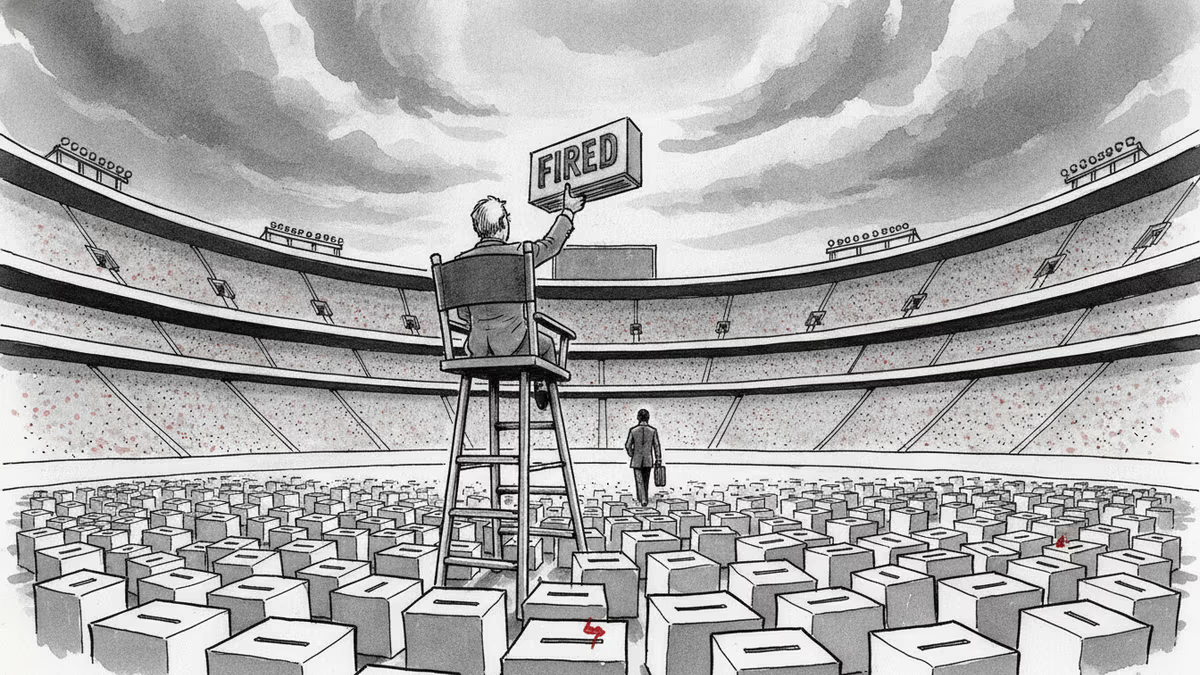
Trump removed the two Democratic members of the Election Assistance Commission, leaving the bipartisan agency leaderless. A Supreme Court ruling made it legal. Here's why a non-crisis can still be a warning sign.

Lebanon and Israel signed a framework agreement in June 2026. Hezbollah rejected it. Israel kept fighting. History suggests this moment is real—and fragile.
A speculative spacecraft journey near the speed of light reveals that time dilation isn't science fiction—it's physics. And it's asking us harder questions than we expected.
Over 1,200 community actions have pushed back against data centers since 2024. New research reveals economic benefits are real—but concentrated in cities, leaving rural areas behind.
Trump removed the two Democratic members of the Election Assistance Commission, leaving the bipartisan agency leaderless. A Supreme Court ruling made it legal. Here's why a non-crisis can still be a warning sign.
Lebanon and Israel signed a framework agreement in June 2026. Hezbollah rejected it. Israel kept fighting. History suggests this moment is real—and fragile.
Thoughts
Share your thoughts on this article
Sign in to join the conversation