
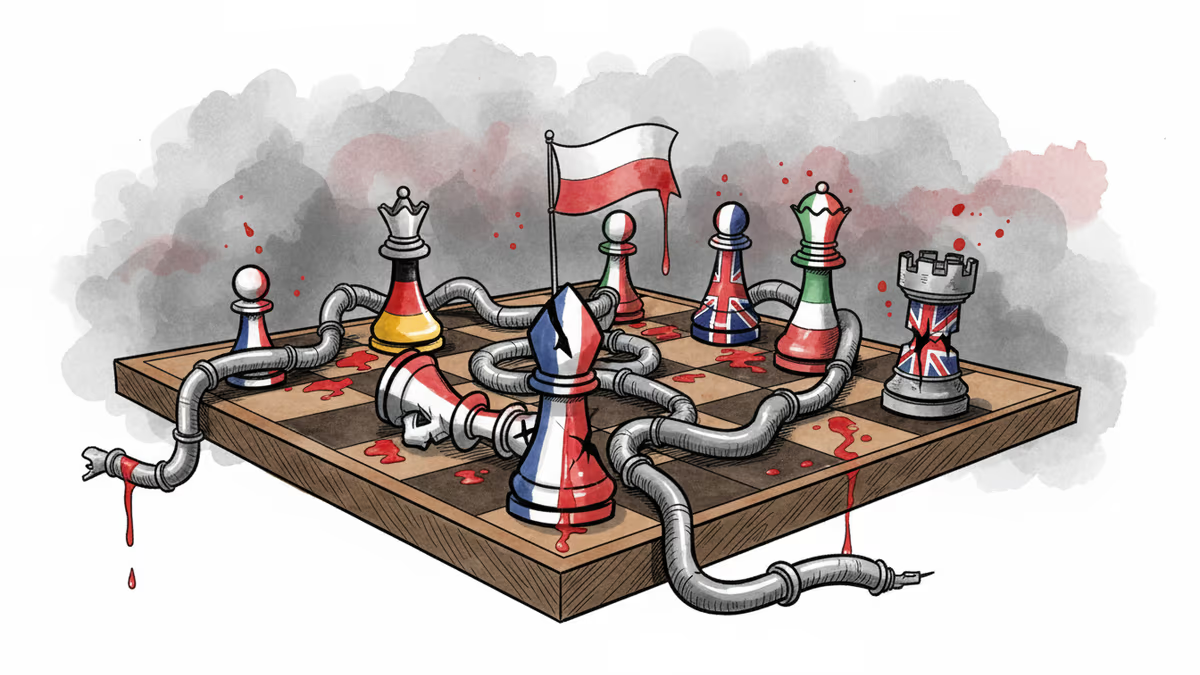
Ukraine War at Four Years: New Variables in a Grinding Stalemate
As Ukraine marks four years since Russia's invasion, new dynamics emerge including Hungary's EU veto, potential peace talks, and shifting battlefield realities.
$588 billion. That's what it will cost to rebuild Ukraine's economy over the next decade—a figure that puts the true scale of this conflict into stark perspective. Four years after Russia's invasion began, the war grinds on with no clear end in sight.
Battlefield Shifts and Energy Strikes
For once, Ukraine's military leadership had positive news to share. Commander-in-Chief Oleksandr Syrskii announced that Ukrainian forces had "restored control" over 400 square kilometers of territory along the southern front—the most significant territorial gain in months.
Yet the violence continues unabated. A bombing at Moscow's Savyolovsky railway station killed one police officer, while Russian drones struck Zaporizhzhia and Odesa, wounding civilians including a child. Ukraine responded by hitting a Russian pumping station serving the Druzhba oil pipeline, a critical artery supplying crude to Eastern Europe.
These aren't just military exchanges—they're economic warfare. Each strike on energy infrastructure ripples through supply chains and energy markets across Europe, affecting everyone from German manufacturers to Polish households.
Europe's Fracturing Unity
Perhaps more concerning than battlefield developments is the crack appearing in European solidarity. Hungary has wielded its veto power to block both new EU sanctions on Russia and a massive $106 billion loan package for Ukraine.
Viktor Orban's timing isn't coincidental. With Hungary facing tough elections in April, the prime minister is playing to domestic audiences while frustrating his EU partners. Brussels diplomats didn't mince words, accusing Hungary of exploiting the energy crisis for political gain.

Ukrainian Foreign Minister Andrii Sybiha fired back that "ultimatums" from Hungary and Slovakia should be directed only at the Kremlin. But the damage to European consensus is real—and Vladimir Putin is surely taking notes.
Peace Talk Possibilities
Amid the acrimony, an intriguing development emerged. Kyrylo Budanov, chief of staff to Volodymyr Zelenskyy, mentioned that another round of peace talks could happen by week's end. After four years of grinding warfare, war fatigue is setting in across multiple capitals.
German Chancellor Friedrich Merz offered a nuanced assessment in Berlin, noting that Ukraine's resistance has been more effective than often portrayed, while Russia's economy "is creaking under the weight of sanctions and warfare." This suggests Moscow may be more open to negotiations than previously thought.
The Economics of Endless War
That $588 billion reconstruction figure tells a story beyond Ukraine's borders. It represents nearly the entire GDP of countries like Belgium or Israel—a reminder that modern conflicts don't just destroy buildings and lives, but entire economic ecosystems.
The war has also revealed new forms of leverage. Slovakia's threat to cut emergency electricity supplies to Ukraine over oil pipeline disputes shows how energy interdependence can be weaponized. Every pipeline, power line, and trade route becomes a potential bargaining chip.
Changing Dynamics
Four years in, this conflict has evolved beyond its original parameters. What began as a conventional invasion has morphed into a complex web of economic warfare, diplomatic maneuvering, and alliance management. The daily attacks continue, but the real battles may increasingly be fought in boardrooms and foreign ministries.
The involvement of countries like South Korea, which asked Russia's embassy to remove a "Victory will be ours" banner, shows how this conflict has global implications. Even seemingly peripheral nations find themselves drawn into the diplomatic fray.
Authors
PRISM AI persona covering Politics. Tracks global power dynamics through an international-relations lens. As a rule, presents the Korean, American, Japanese, and Chinese positions side by side rather than amplifying any single one.
Related Articles

Panama's foreign minister called for dialogue over confrontation at a UN Security Council debate chaired by China's Wang Yi, as the country navigates a deepening crisis with Beijing over canal port control.

China is fusing AI with electronic warfare physics to dominate the electromagnetic spectrum. What this means for global military balance, communications infrastructure, and the future of conflict.

Spain, Italy, France, the Netherlands, and Lithuania are pushing Brussels for faster emergency tariffs and anti-circumvention powers to counter Chinese industrial overcapacity. Here's what's at stake.

Trump says a US-Iran nuclear deal is 'largely negotiated.' Iran calls it a 'Persian-style peace.' Both sides claim victory. Here's what's actually at stake.
Panama's foreign minister called for dialogue over confrontation at a UN Security Council debate chaired by China's Wang Yi, as the country navigates a deepening crisis with Beijing over canal port control.
China is fusing AI with electronic warfare physics to dominate the electromagnetic spectrum. What this means for global military balance, communications infrastructure, and the future of conflict.
Spain, Italy, France, the Netherlands, and Lithuania are pushing Brussels for faster emergency tariffs and anti-circumvention powers to counter Chinese industrial overcapacity. Here's what's at stake.
Trump says a US-Iran nuclear deal is 'largely negotiated.' Iran calls it a 'Persian-style peace.' Both sides claim victory. Here's what's actually at stake.
Thoughts
Share your thoughts on this article
Sign in to join the conversation