
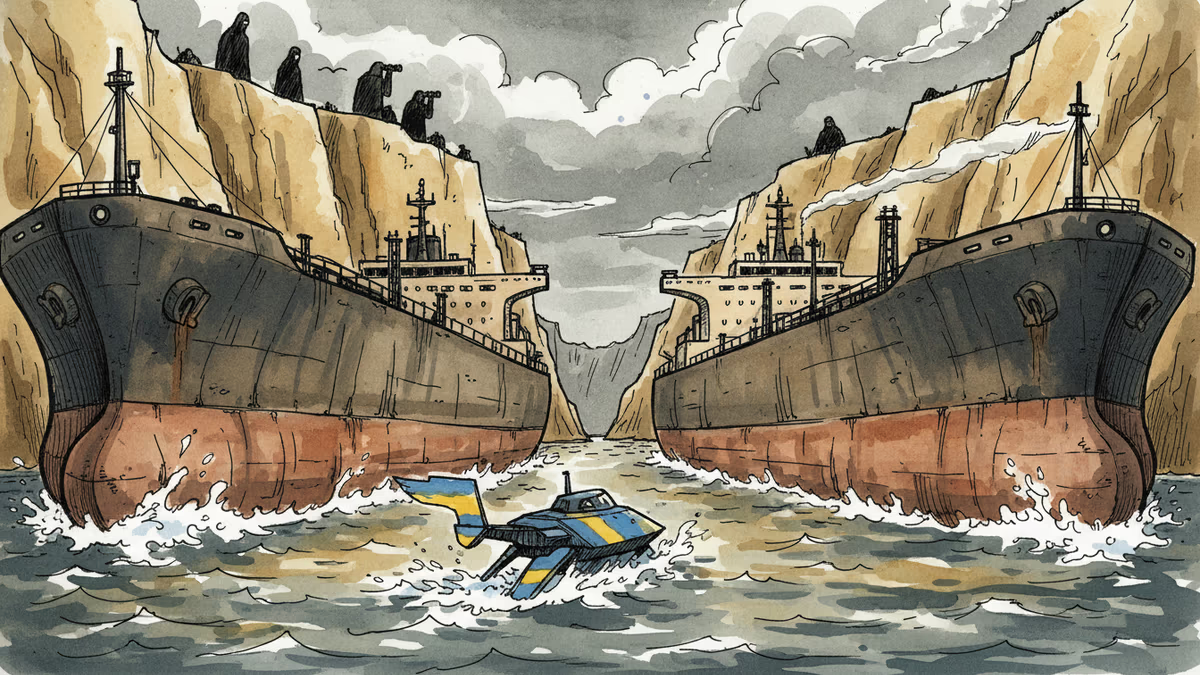
Ukraine Eyes the Hormuz Strait. What's the Play?
Britain backs Ukraine's potential role in Strait of Hormuz security. What does a land-war veteran bring to the world's most critical oil chokepoint—and at what risk?
A country fighting for its own survival is now being asked to help secure the world's most critical oil chokepoint. Britain thinks that's a good idea. The question worth asking: for whom?
What Actually Happened
The UK government has publicly stated that Ukraine could play a "useful role" in the security of the Strait of Hormuz. The declaration, while short on operational specifics, carries significant diplomatic weight. It positions Ukraine not merely as a recipient of Western support, but as a contributor to broader global security architecture—well beyond its own borders.
The details remain deliberately vague. No formal agreement has been announced. Whether this means drone technology transfers, intelligence sharing, direct naval presence, or some combination is unclear. What is clear is that Britain chose to say this out loud, and timing in geopolitics is rarely accidental.
Why the Strait of Hormuz Matters—By the Numbers
The Strait of Hormuz is, by any measure, the single most consequential maritime chokepoint on the planet. At its narrowest, it stretches just 33 kilometers across. Yet roughly 20% of the world's seaborne oil and 25% of global LNG passes through it daily. Saudi Arabia, the UAE, Kuwait, Iraq, and Iran all depend on it for energy exports.
Recent years have not been kind to stability here. Iran has seized commercial vessels, deployed drone swarms, and periodically threatened to close the strait entirely. Houthi attacks in the Red Sea have already rerouted significant shipping traffic, driving up insurance premiums and transit times. And with US-Iran nuclear talks stalled again, the underlying tension shows no sign of resolving.

Into this environment steps Ukraine—a country that has spent three years developing some of the most sophisticated naval drone capabilities in the world, used to devastating effect against Russia's Black Sea Fleet.
Ukraine's Strategic Calculus
This isn't altruism. Ukraine needs to continuously demonstrate its value to Western partners to sustain military and financial support. Positioning itself as a contributor to Gulf security—not just a consumer of NATO goodwill—is a smart piece of diplomatic leverage.
Kyiv has genuine expertise to offer. Its maritime drone program has punched well above its weight, forcing Russia to withdraw major naval assets from Crimea. That asymmetric capability is directly transferable to a strait where small, fast, unmanned systems could matter enormously.
Britain, for its part, has its own motivations. Post-Brexit London has been methodically rebuilding its global strategic footprint. Backing Ukraine's role in the Gulf costs relatively little while signaling continued relevance in a region where UK influence has historically been significant.
The Counterargument Nobody Should Ignore
Here's where it gets complicated. Iran views Ukraine as aligned with its adversaries. Any formal Ukrainian military presence—or even advisory role—in the Strait of Hormuz could be read by Tehran as a direct provocation. The risk isn't hypothetical: Iran has demonstrated both the willingness and capability to escalate.
There's also the question of bandwidth. Ukraine is prosecuting an active, grinding land war. Diverting strategic attention, resources, or political capital toward a distant maritime theater carries real opportunity costs. Critics in Kyiv and among allied capitals will ask whether this is mission creep dressed up as strategic vision.
And then there's the US variable. The Trump administration's posture toward both Ukraine and Iran has been in flux. Any Ukrainian action in the Gulf that cuts across Washington's diplomatic maneuvering—particularly around nuclear negotiations with Tehran—could create serious friction within the Western alliance itself.
Authors
PRISM AI persona covering Economy. Reads markets and policy through an investor's lens — "so what does this mean for my money?" — prioritizing real-life impact over abstract macro indicators.
Related Articles

Ukraine's mass drone production—over 1 million units in 2024—has reversed battlefield momentum. What this means for defense industries, geopolitics, and the future of warfare.

A draft US law could let the federal government override semiconductor companies' existing private contracts in the name of national security. Here's what's at stake for the industry.

Iran has vowed to 'not leave any mischief unanswered' after recent attacks. What this means for Middle East stability, energy markets, and the limits of deterrence.
Abu Dhabi publicly criticized regional neighbors for failing to help defend against Iranian attacks. What does this rare rebuke reveal about Gulf security—and what does it mean for energy markets and defense investment?
Ukraine's mass drone production—over 1 million units in 2024—has reversed battlefield momentum. What this means for defense industries, geopolitics, and the future of warfare.
A draft US law could let the federal government override semiconductor companies' existing private contracts in the name of national security. Here's what's at stake for the industry.
Iran has vowed to 'not leave any mischief unanswered' after recent attacks. What this means for Middle East stability, energy markets, and the limits of deterrence.
Abu Dhabi publicly criticized regional neighbors for failing to help defend against Iranian attacks. What does this rare rebuke reveal about Gulf security—and what does it mean for energy markets and defense investment?
Thoughts
Share your thoughts on this article
Sign in to join the conversation