
Why VCs Bet $2M on College Students Running an Accelerator
Stanford students raised $2M for Breakthrough Ventures, targeting college founders nationwide. What makes their approach different from existing programs, and why now?
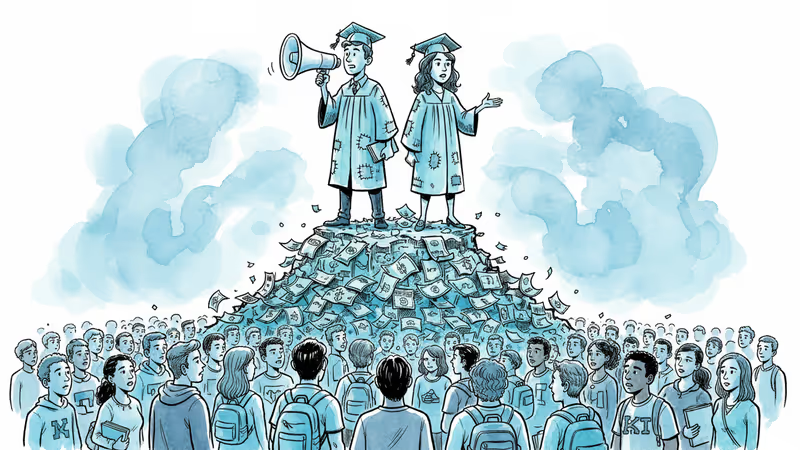
Two Stanford students just raised $2 million before they even graduated. Roman Scott and Itbaan Nafi convinced seasoned VCs like Mayfield and Collide Capital to back their accelerator Breakthrough Ventures—but here's the twist: they're targeting college students nationwide, not Silicon Valley insiders.
In a world where accelerators are everywhere, why did investors bet on the youngest players in the game?
The "By Students, For Students" Differentiator
Scott and Nafi didn't start with grand ambitions. They began hosting Demo Days at Stanford in 2024, watching student founders achieve unexpected success. "This fundraise turns Breakthrough from just being a seasonal accelerator into a lifelong partnership with our founders," Nafi, still a master's candidate, told TechCrunch.
The landscape isn't exactly empty. UC Berkeley runs Free Ventures, MIT has its Sandbox Innovation Fund, and Stanford itself operates StartX, LaunchPad, and Cardinal Ventures. So what's different?
"Students have enjoyed how we've brought together so many others from different American colleges," Nafi explains, comparing their approach to Stanford'sTreehacks hackathon. But it's more than networking—it's about understanding the unique challenges student founders face.
"Students really feel like we get them, and that's because we are students," Nafi adds. This isn't just marketing speak; it shapes everything from program structure to support offerings.
Hybrid Model Meets Real-World Resources
Breakthrough operates a hybrid model: in-person meetups at powerhouse VC firms, culminating in a Demo Day at Stanford. But the real draw lies in the resources: up to $100,000 in grant funding, compute credits through Microsoft and the Nvidia Inception program, legal support, Waymo ride credits, and mentorship from executives like Waymo CEO Tekedra Mawakana.
The kicker? A $50,000 follow-on investment opportunity at program completion. Over three years, they aim to incubate at least 100 companies across AI, health, consumer, deep tech, and sustainability sectors.
"We've nailed the student-founder experience to a T," Nafi claims. "Hence why we offer the resources we do and have structured the program in this way."

Gen Z's Economic Anxiety Drives Innovation
Nafi frames their mission around something deeper than startup success: addressing "the anxiety many young people feel about their economic future." This isn't hyperbole—it's data-driven reality.
Gen Z faces unique economic headwinds: skyrocketing housing costs, gig economy uncertainty, and diminishing traditional career paths. For many, entrepreneurship isn't just opportunity—it's necessity.
"We hope that by supporting young entrepreneurs, we're able to uplift as many stories as possible to then inspire many more across the world to use the tools and knowledge around them to pursue entrepreneurship not only to change their communities, but also gain economic stability for themselves and their families," Nafi explains.
The language is telling: "economic stability," not "unicorn exits" or "disruption." This generation views entrepreneurship as a path to security, not just wealth.
The Ecosystem Play
Nafi's ultimate goal is ambitious: making Breakthrough "the hub for Gen Z entrepreneurship and thought leadership." This isn't just about individual startups—it's about building an entire ecosystem.
The timing makes sense. Traditional corporate ladders are crumbling, remote work has democratized access to opportunities, and AI tools have lowered technical barriers to entry. Student founders today have advantages previous generations couldn't imagine.
Yet they also face challenges older accelerators might not fully grasp: managing school schedules, limited credit histories, family expectations around "safe" career paths, and the unique social dynamics of college life.
Beyond the Hype: Real Questions Remain
While the student-led approach sounds compelling, questions linger. Can young founders provide the deep industry expertise and network connections that seasoned accelerator leaders offer? Will their "by students, for students" model scale beyond the initial enthusiasm?
The $2 million raise suggests investors believe the answer is yes. But the real test will come when their first cohort graduates and faces the harsh realities of building sustainable businesses.
The accelerator space is notoriously difficult, with many programs struggling to demonstrate clear ROI. Breakthrough's success will depend not just on their ability to understand student founders, but on their capacity to deliver tangible business outcomes.
Authors
Related Articles
With a 0.4% acceptance rate and higher equity demands than YC, a16z's Speedrun accelerator is reshaping how startups think about early-stage funding.

Samsung Electronics' union branch revealed that 84% of survey respondents oppose the government's roughly $290 billion (₩400 trillion) semiconductor megaproject in Gwangju. Government, management, the union and shareholders are all reading the same national project in sharply different ways.

Nvidia shipped roughly a billion RISC-V cores in 2024, then announced it would run CUDA on the open standard. We break down how royalty-free instruction sets and open software stacks are trying to route around CUDA's lock-in. Part 2 of the Semiconductor Sovereignty series.

US AI-chip export controls split into three layers in the first half of 2026 — January easing, a May crackdown on circumvention, and a pending bill. Nvidia erased China from its guidance and still posted a record $81.6 billion quarter. A look at the export policy that both shields and cages it.
With a 0.4% acceptance rate and higher equity demands than YC, a16z's Speedrun accelerator is reshaping how startups think about early-stage funding.
Samsung Electronics' union branch revealed that 84% of survey respondents oppose the government's roughly $290 billion (₩400 trillion) semiconductor megaproject in Gwangju. Government, management, the union and shareholders are all reading the same national project in sharply different ways.
Nvidia shipped roughly a billion RISC-V cores in 2024, then announced it would run CUDA on the open standard. We break down how royalty-free instruction sets and open software stacks are trying to route around CUDA's lock-in. Part 2 of the Semiconductor Sovereignty series.
US AI-chip export controls split into three layers in the first half of 2026 — January easing, a May crackdown on circumvention, and a pending bill. Nvidia erased China from its guidance and still posted a record $81.6 billion quarter. A look at the export policy that both shields and cages it.
Thoughts
Share your thoughts on this article
Sign in to join the conversation