
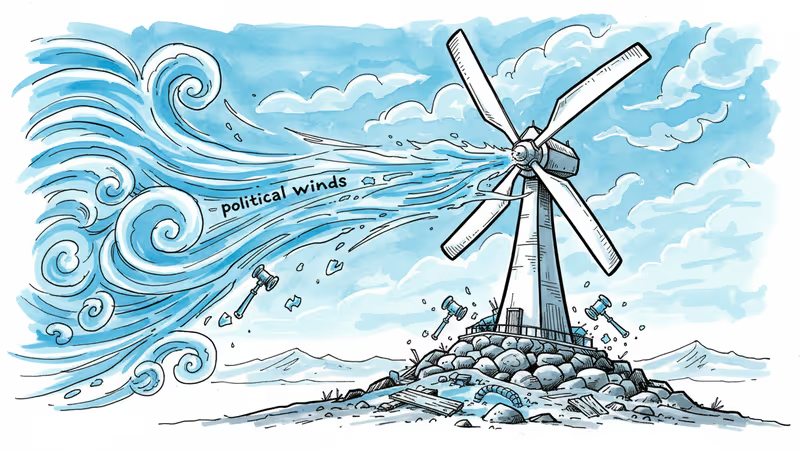
Trump's War on Wind Power Hits Legal Reality Check
Trump administration's attempts to block offshore wind projects face unanimous court defeats. Five companies, five lawsuits, five wins reveal the limits of executive power.
Five companies. Five lawsuits. Five wins. The Trump administration's crusade against offshore wind power has hit a wall—specifically, a wall of federal judges who aren't buying the "classified national security risk" argument.
Trump's Personal Vendetta Against Wind
The Trump administration dislikes renewable energy broadly, but reserves special animosity for wind power. Trump himself has repeatedly spread false claims about wind energy costs, global adoption rates, and environmental impacts. This hostility translated into an executive order blocking all offshore wind permitting and some land-based projects—an order courts later struck down as "arbitrary and capricious."
But blocking future developments wasn't enough. The administration set its sights on the five offshore wind projects already under construction, representing billions in investment and years of regulatory approval.
The 'Classified Threat' That Convinced No One
After temporarily halting two projects without clear justification, the Department of Interior settled on its trump card in late December: a classified national security risk that supposedly required immediate construction stops.
The industry response was swift and uniform. Every affected company—Vineyard Wind, South Fork Wind, Revolution Wind, Sunrise Wind, and Ocean Wind 1—filed federal lawsuits challenging the order.
The results? As of Monday, the administration's batting average sits at a perfect .000. Four different judges across three federal courts have issued temporary injunctions allowing construction to continue. The unanimity is striking, especially given the different legal teams, jurisdictions, and judicial backgrounds involved.

What Courts Are Really Saying
This isn't just about wind power—it's about the limits of executive authority. Federal judges are essentially telling the administration that "national security" can't be wielded as a magic wand to undo years of environmental review, regulatory approval, and billions in committed capital.
The projects in question passed rigorous environmental assessments under the previous administration. Courts are skeptical of last-minute security concerns that somehow escaped detection during extensive federal review processes involving multiple agencies.
The Economics Behind the Legal Wins
These aren't small ventures easily derailed by regulatory whiplash. The five projects represent over $15 billion in investment and are backed by major energy companies with deep pockets and experienced legal teams. Ørsted, Avangrid, and Dominion Energy didn't build their offshore wind portfolios overnight—they've spent years navigating American regulatory complexity.
The economic stakes extend beyond individual projects. The U.S. offshore wind industry employs thousands and has attracted significant foreign investment, particularly from European companies with decades of offshore experience.
Global Energy Reality vs. Political Theater
While Trump wages war on American wind power, the global energy transition accelerates. China installed more offshore wind capacity in 2023 than the U.S. has ever built. European offshore wind generates enough electricity to power 30 million homes. The administration's hostility isn't just fighting domestic policy—it's fighting global economic reality.
Investors are watching closely. The renewable energy sector has attracted over $1.8 trillion globally in the past decade. Legal uncertainty in the world's largest economy creates ripple effects across international markets and supply chains.
Authors
Related Articles

After Trump administration officials publicly promoted leucovorin as a potential autism treatment, new prescriptions for children surged 71% in three months. What happens when government rhetoric moves faster than science?
A Norwegian startup plans to submerge data centers offshore, powered by wind turbines. Could this solve AI's massive energy appetite, or create new problems? We examine multiple perspectives.
Scientists crack the molecular code for storing summer heat until winter arrives. Could this breakthrough finally make fossil fuel heating obsolete?
Trump administration set to revoke EPA's 17-year scientific finding on greenhouse gas dangers, dismantling legal foundation for climate action amid record-breaking heat and extreme weather costs.
After Trump administration officials publicly promoted leucovorin as a potential autism treatment, new prescriptions for children surged 71% in three months. What happens when government rhetoric moves faster than science?
A Norwegian startup plans to submerge data centers offshore, powered by wind turbines. Could this solve AI's massive energy appetite, or create new problems? We examine multiple perspectives.
Scientists crack the molecular code for storing summer heat until winter arrives. Could this breakthrough finally make fossil fuel heating obsolete?
Trump administration set to revoke EPA's 17-year scientific finding on greenhouse gas dangers, dismantling legal foundation for climate action amid record-breaking heat and extreme weather costs.
Thoughts
Share your thoughts on this article
Sign in to join the conversation