
When Fossil Fuels Freeze: What America's Snowstorm Reveals About Grid Resilience
Massive fossil fuel outages during East Coast snowstorm show grid vulnerabilities, while Texas batteries prove their worth. What does this mean for energy security in an era of extreme weather?
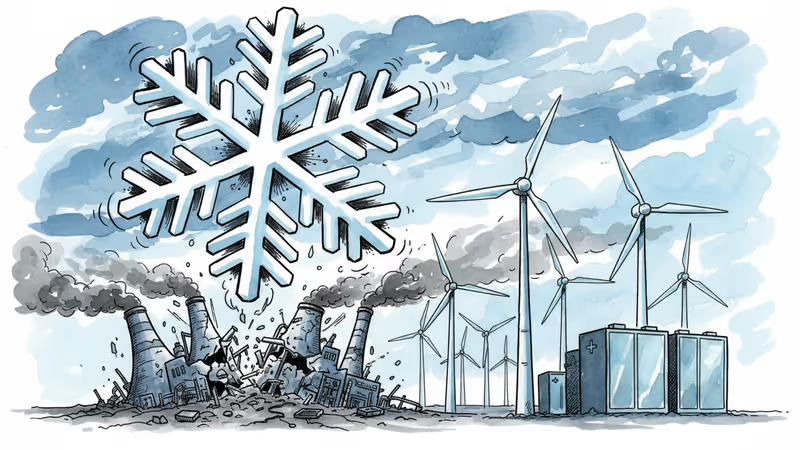
When 67 million Americans woke up to a winter wonderland last weekend, their power grid was quietly experiencing a crisis. The culprit wasn't what you'd expect—it was the very fossil fuel plants we've long considered our most reliable backup.
The PJM Interconnection, America's largest grid operator, saw 20 gigawatts of unplanned outages during Sunday's storm peak. That's roughly 16% of the afternoon's total demand—enough to power about 15 million homes. While backup plants prevented widespread blackouts, the underlying story reveals something fascinating about our energy assumptions.
The Great Fossil Fuel Failure
Analysts at Energy Innovation dug into the publicly available data and found something striking: natural gas plants were producing about 10 gigawatts less power on Sunday compared to Saturday's peak, despite electricity prices soaring to levels that would make operation highly profitable.
This wasn't an economic decision—it was physics. When temperatures plummet, natural gas pipeline pressures drop. Compression stations freeze. Coal piles turn into frozen mountains. The very fuels we've depended on for "baseload" reliability proved vulnerable to the exact conditions when we need them most.
Michelle Solomon from Energy Innovation puts it bluntly: if plants aren't running when prices are sky-high, they're likely physically unable to operate.
Texas Gets It Right This Time
Remember 2021? Texas faced a winter storm that killed at least 246 people and left millions without power for days. The state learned hard lessons from that catastrophe, implementing winter weatherization for power plants and transmission systems.
But here's the game-changer: Texas flooded its grid with batteries. These storage systems proved crucial during this weekend's cold snap, especially during morning demand peaks. While the East Coast struggled with fossil fuel outages, Texas batteries stepped up to fill the gaps.
The contrast is stark. Texas, once the poster child for grid failure, weathered this storm far better than the supposedly more prepared East Coast.

Emergency Measures and Dirty Backup Plans
The situation got serious enough that the US Department of Energy issued emergency orders allowing power plants to ignore emissions regulations. Several grids were authorized to tell data centers and other facilities to fire up backup generators—typically diesel-powered and highly polluting.
These emergency measures kept the lights on but at a significant environmental cost. It's exactly the kind of scenario we should be engineering our way out of, not accepting as inevitable.
The Renewable Resilience Paradox
Here's where the story gets interesting: while fossil fuels faltered, renewables largely held steady. Offshore wind, in particular, tends to produce reliable power during winter months. Solar obviously struggles with snow cover, but wind often picks up during storm systems.
The irony isn't lost on energy experts. The sources we've traditionally viewed as "intermittent" and "unreliable" proved more dependable than our "always-on" fossil plants when extreme weather hit.
Storage: The Missing Link
Solomon argues that more energy storage could be transformational for future winter storms. Batteries provide the flexibility to ride out the worst periods, whether that's a fossil plant going offline or renewable output dropping unexpectedly.
The technology exists. Texas proved it works. The question is whether other regions will invest in this infrastructure before the next crisis hits.
Beyond the Next Storm
Climate scientists warn that extreme weather events will become more frequent and severe. The old playbook of relying heavily on fossil fuels with minimal storage looks increasingly risky.
No single energy source will solve the resilience puzzle. But this weekend's events suggest that a diversified portfolio heavy on renewables and storage might actually be more reliable than our current fossil-heavy mix when the chips are down.
Authors
Related Articles
Qatar gets 99% of its drinking water from the sea. As the Middle East prepares to spend $25 billion expanding desalination capacity, this once-niche technology is becoming critical global infrastructure.
Amazon, Google, Meta and others pledge to pay for their data centers' power infrastructure, but the agreement lacks enforcement and ignores basic economics
A Norwegian startup plans to submerge data centers offshore, powered by wind turbines. Could this solve AI's massive energy appetite, or create new problems? We examine multiple perspectives.
Oil prices surge 13% after Iran's leader killed. Strait of Hormuz traffic near zero. Analysts predict crude could hit $100+ as Middle East chaos spreads.
Qatar gets 99% of its drinking water from the sea. As the Middle East prepares to spend $25 billion expanding desalination capacity, this once-niche technology is becoming critical global infrastructure.
Amazon, Google, Meta and others pledge to pay for their data centers' power infrastructure, but the agreement lacks enforcement and ignores basic economics
A Norwegian startup plans to submerge data centers offshore, powered by wind turbines. Could this solve AI's massive energy appetite, or create new problems? We examine multiple perspectives.
Oil prices surge 13% after Iran's leader killed. Strait of Hormuz traffic near zero. Analysts predict crude could hit $100+ as Middle East chaos spreads.
Thoughts
Share your thoughts on this article
Sign in to join the conversation