
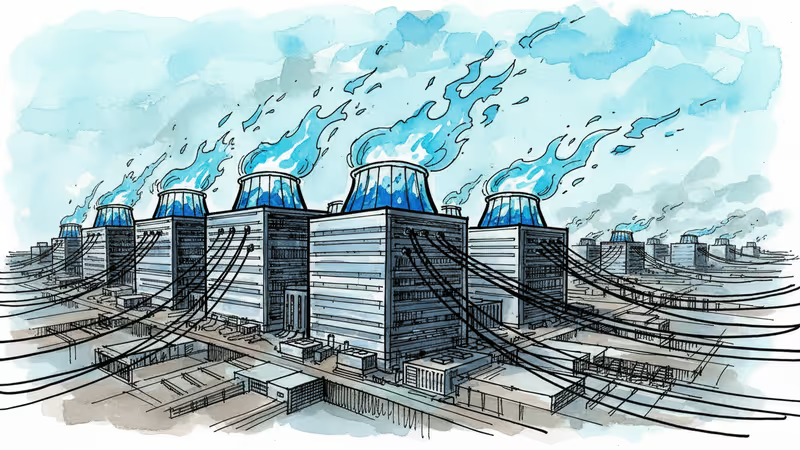
Data Centers Triple US Gas Power Demand in Two Years
Data center boom drives 252 GW of new gas power development in the US, equivalent to 50% expansion of current gas fleet. The hidden energy cost of AI revealed.
252 gigawatts. That's enough power to increase America's entire gas-fired fleet by nearly 50%. The twist? Data centers are driving this massive energy expansion.
New research from Global Energy Monitor reveals that data centers have caused US gas power demand to nearly triple over just two years. More than one-third of this new demand explicitly targets data center power needs—energy equivalent to powering tens of millions of American homes.
The AI Energy Explosion
The numbers tell a dramatic story. In early 2024, only 4 gigawatts of gas power development were earmarked for data centers. By 2025, that figure skyrocketed to over 97 gigawatts—a 25-fold increase in just one year.
"About a year and a half ago, we started to see this increase in proposals for data centers specifically," says Jenny Martos, the Global Energy Monitor research analyst who led the study.
The culprit? The generative AI boom. Services like ChatGPT, Claude, and Gemini require massive computational power for both training and inference. Traditional grid connections can't keep pace, forcing developers to build dedicated power infrastructure.
The Clean Energy Paradox
Here's where it gets complicated. Tech giants like Google, Microsoft, and Amazon have made ambitious carbon-neutral commitments. Yet their AI ambitions are simultaneously driving a gas power renaissance.

Natural gas burns cleaner than coal, but it's far from clean. Gas accounted for 35% of US energy-related CO2 emissions in 2022. The bigger concern? Methane leaks during extraction. Methane is 80 times more potent than CO2 over a 20-year period.
"Gas is cleaner when burnt than coal, but when you're talking about this much gas, you're talking about a lot of CO2 associated with it, too," warns Jonathan Banks, senior climate adviser at Clean Air Task Force.
Reality Check: What Actually Gets Built
Not all 252 gigawatts will materialize. Data center developers often shop multiple utilities, inflating apparent demand. A global turbine shortage also constrains what can actually be built—two-thirds of tracked projects lack committed manufacturers.
Still, even partial build-out matters. Projects under construction would add nearly 30 gigawatts to the grid. Another 159 gigawatts are in preconstruction phases, involving serious planning and financing.
"We're in that phase where we're seeing the explosion in proposals," Martos explains. "What materializes is yet to be determined."
The Trump Factor
Timing matters. This gas expansion coincides with the Trump administration's pro-fossil fuel stance. Recent moves include extending deadlines for methane leak regulations and encouraging data center development without stringent environmental oversight.
The administration is also extending coal plant retirement dates, giving the dirtiest power sources new life. While gas is cleaner than coal, the scale of expansion threatens to overwhelm any climate benefits.
Authors
Related Articles
Amazon, Google, Meta and others pledge to pay for their data centers' power infrastructure, but the agreement lacks enforcement and ignores basic economics
Nvidia's $2B investments in Lumentum and Coherent signal a shift from GPU wars to data transmission battles. The real bottleneck in AI isn't compute—it's connection.
Oil prices surge 13% after Iran's leader killed. Strait of Hormuz traffic near zero. Analysts predict crude could hit $100+ as Middle East chaos spreads.
As Europe faces a power crisis, the Nordic countries have become the unexpected hotbed for AI data centers. What's driving this Arctic gold rush?
Amazon, Google, Meta and others pledge to pay for their data centers' power infrastructure, but the agreement lacks enforcement and ignores basic economics
Nvidia's $2B investments in Lumentum and Coherent signal a shift from GPU wars to data transmission battles. The real bottleneck in AI isn't compute—it's connection.
Oil prices surge 13% after Iran's leader killed. Strait of Hormuz traffic near zero. Analysts predict crude could hit $100+ as Middle East chaos spreads.
As Europe faces a power crisis, the Nordic countries have become the unexpected hotbed for AI data centers. What's driving this Arctic gold rush?
Thoughts
Share your thoughts on this article
Sign in to join the conversation