
AI Is Already Here—But Are We Ready for What Comes Next?
From potty training to health advice, AI has quietly become as essential as Google search. But trust remains low and tough questions about jobs, privacy, and safety loom large.
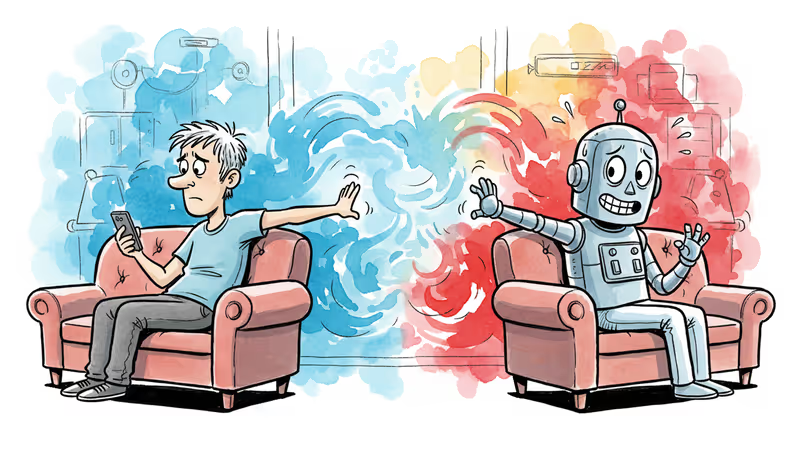
Nearly two-thirds of US teens use chatbots daily. Yet only 5 percent of adults trust AI "a lot." This contradiction captures our current moment perfectly—we're already living in an AI-powered world, even as we grapple with what that means.
A recent survey by WIRED reveals just how seamlessly artificial intelligence has woven itself into daily life. Anthropic cofounder Daniela Amodei used Claude to potty-train her son and diagnose her daughter's symptoms. Wicked director Jon M. Chu turns to LLMs for parenting advice. UC Berkeley students use AI for everything from poetry editing to presentation prep.
"I use a lot of LLMs to answer any questions I have throughout the day," says Angel Tramontin, a Berkeley business student. The comparison to search engines isn't accidental—AI has achieved that same level of integration, becoming the go-to tool for mundane, practical tasks.
The Trust Paradox
But here's where things get complicated. While 35 percent of US adults use AI daily, trust remains remarkably low. An Ipsos poll showed global trust in AI companies to protect personal data actually fell from 2023 to 2024. 41 percent of Americans are actively distrustful of AI.
"I think a lot of them put financial gain over morality, and that's one of the biggest dangers," says UC Berkeley student Sienna Villalobos, who actively avoids AI tools. Her concern isn't unfounded—a series of high-profile lawsuits over alleged AI harms has further strained public confidence.
Cloudflare CEO Matthew Prince, whose company has confronted AI firms over data scraping practices, emphasizes that trust must come before deployment. "I think a lot of [companies] put financial gain over morality," echoes the student sentiment even among industry leaders.

The Questions Nobody's Answering
The development pace shows no signs of slowing, despite mounting concerns about mental health, environmental impact, and societal disruption. In this regulatory vacuum, companies are essentially self-policing—a responsibility many seem unprepared for.
"'What might go wrong?' is a really good and important question that I wish more companies would ask," says Mike Masnick, founder of tech policy site Techdirt. Anthropic's Amodei suggests companies ask themselves: "Is this something that I would be comfortable giving to my own child to use?"
The stakes are particularly high for employment. "A lot of people are really stressed on campus about whether or not the field they're going into is going to still be a field," says Berkeley student Abigail Kaufman. Recent Stanford research confirms these fears aren't misplaced—employment opportunities for young people are already declining, with multiple tech giants citing AI as justification for workforce restructuring.
Different Lenses, Different Futures
The response to AI's rapid integration varies dramatically depending on your perspective. Students worry about career prospects and data privacy. Healthcare professionals like physician Eric Topol see both promise and peril: "We also don't want to have new [errors], or make that any worse by AI."
Meanwhile, Circle CEO Jeremy Allaire focuses on broader economic implications: "The change in the nature of labor and how that can impact people and the economy... no one really seems to have good answers."
Yet optimism persists. Despite his company's confrontational stance on AI data practices, Cloudflare's Prince remains bullish: "I'm pretty optimistic about AI. I think it's actually going to make humanity better, not worse."
This split reflects a deeper tension. AI has already proven its utility—from OpenAI's announcement that "hundreds of millions" use ChatGPT for health queries weekly, to students using it for creative writing enhancement. The technology works. The question is whether we're building the right guardrails around it.
Authors
Related Articles
Ten years after AlphaGo's victory, AI has revolutionized Go completely. Yet fans still prefer watching humans play. The reason reveals something profound about what makes us human.
Perplexity's Computer tool orchestrates AI agents to handle long-term projects autonomously. Is this the future of work automation or just clever marketing?
Riley Walz, creator of viral web stunts, joins OpenAI to reinvent human-AI interaction. What this hiring reveals about the next phase of AI competition.
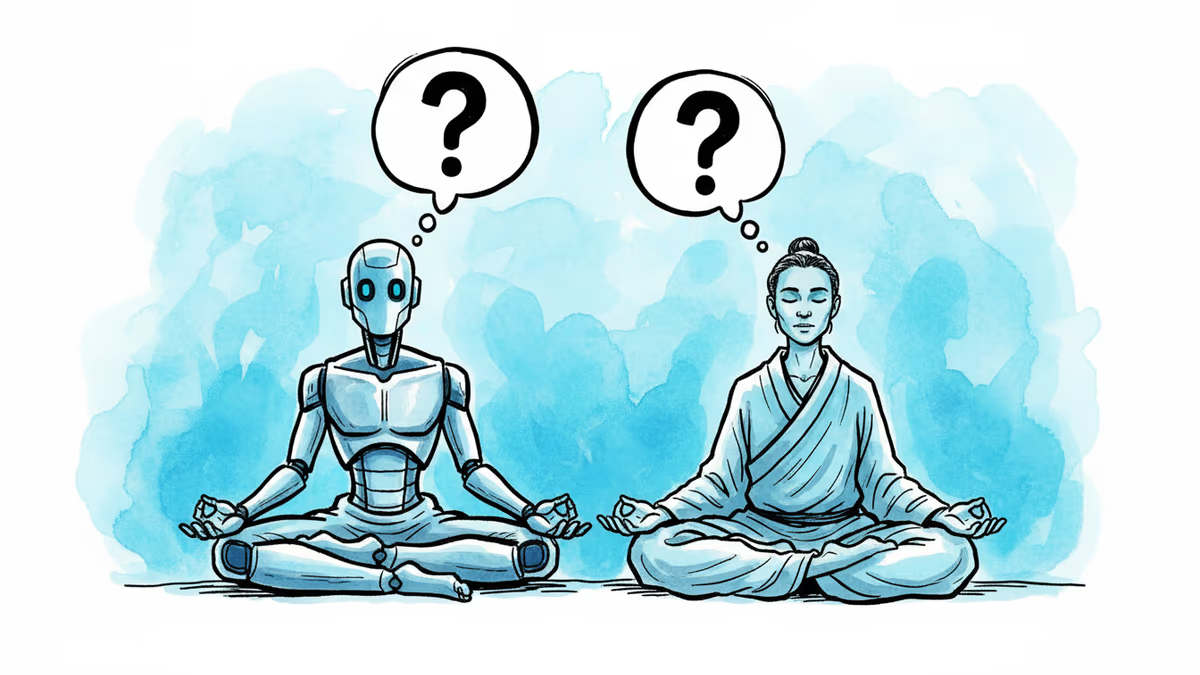
Computer scientists declared 'no obvious barriers' to building conscious AI. The fundamental question of human identity has begun.
Ten years after AlphaGo's victory, AI has revolutionized Go completely. Yet fans still prefer watching humans play. The reason reveals something profound about what makes us human.
Perplexity's Computer tool orchestrates AI agents to handle long-term projects autonomously. Is this the future of work automation or just clever marketing?
Riley Walz, creator of viral web stunts, joins OpenAI to reinvent human-AI interaction. What this hiring reveals about the next phase of AI competition.
Computer scientists declared 'no obvious barriers' to building conscious AI. The fundamental question of human identity has begun.
Thoughts
Share your thoughts on this article
Sign in to join the conversation