

Your Voice Is Your Brand in the Digital Age
Poor audio quality makes you 8% less trustworthy in virtual meetings, Yale research reveals. How AI-powered audio technology is reshaping business communication rules.
8%. That's how much less trustworthy you appear when your audio quality is poor during virtual meetings. It's not a guess—it's science from Yale University.
We obsess over lighting, check our hair, and perfect our virtual backgrounds. But the one thing we can't see—how we sound—might matter more than everything we can.
Since the pandemic transformed video calls from occasional necessity to daily routine, we've learned to navigate the visual aspects of virtual presence. Yet most people still use whatever microphone came with their setup, never giving a second thought to their audio footprint.
That's a costly oversight.
The Hidden Psychology of Sound
Brian Scholl, director of Yale's Perception & Cognition Laboratory, discovered this audio bias through a deceptively simple experiment. He played identical 30-second audio clips to different groups—same words, same speaker, but different audio quality.
The results were striking. When audio quality was poor, listeners rated speakers as:
- 8% less hireable
- 8% less intelligent
- 8% less credible
- Even less attractive as potential dates
"We know that poor sound doesn't reflect the people themselves, but we really just can't stop ourselves from having those impressions," Scholl explains. The effect was unconscious but consistent.
The research emerged from Scholl's own experience during early pandemic faculty meetings. A colleague speaking from a home recording studio sounded "better than real life," while another using a laptop's built-in microphone seemed less convincing than usual—despite Scholl knowing both personally for years.
AI Transforms the Audio Landscape
The pandemic accelerated audio innovation in ways nobody anticipated. When classrooms and boardrooms shifted online overnight, problems like keyboard clicking, echo, and background noise became business-critical issues.
Erik Vaveris, VP of Product Management at Shure, witnessed this transformation firsthand. "If you're willing to take a little bit of time with your audio setup, you can really get across the full power of your message and the full power of who you are," he notes.
Today's AI-powered audio processing delivers:
- Real-time noise suppression: Keyboard clicks and chip-crunching sounds have virtually disappeared
- Echo cancellation: Advanced algorithms eliminate audio feedback
- Voice isolation: Microsoft Teams now offers voice print features that filter out everything except your voice
- De-reverberation: AI removes room echo and reflections

These aren't just convenience features—they're business necessities. Poor audio quality forces listeners to devote cognitive resources to simply parsing words, leaving less mental bandwidth for processing your actual message.
The New Consumer: AI Meeting Assistants
A fascinating shift has emerged: AI meeting assistants have become a new "consumer" of audio quality. These tools need clean transcriptions to summarize meetings, create action plans, and attribute comments to specific speakers.
"For AI agents to work properly, audio quality is as important as ever for humans, but it's also critical for the technology," Vaveris explains. The requirements are different—AI needs word-perfect transcription and the ability to detect sentiment and emotion.
This creates a feedback loop: better audio improves human perception and enables more sophisticated AI assistance, which in turn makes meetings more productive.
Democratizing Broadcast Quality
The creator economy has fundamentally changed content production standards. Individual creators can now achieve broadcast-quality audio with USB-connected microphones and AI-powered processing.
This shift impacts corporate marketing strategies. Companies increasingly collaborate with influencers and creators, but audio quality has become a selection criterion. High production values are no longer the exclusive domain of major studios.
Even C-suite executives are becoming their own content creators. Vaveris notes that his company's CEO produces internal videos directly from her desk, using simple software and high-quality microphones to achieve professional results without traditional production overhead.
ROI in the Invisible Medium
Quantifying audio technology's return on investment presents unique challenges. Unlike product launches with clear metrics, audio improvements deliver benefits through:
- Shorter, more productive meetings
- Faster decision-making
- Reduced meeting fatigue
- Enhanced collaboration across time zones
IDC Research found that over two-thirds of companies have invested in communication technology improvements. The ROI calculation requires looking across the entire enterprise, measuring cumulative productivity gains rather than direct cost savings.
Interestingly, these investments may be easier to justify because everyone—from CEOs to entry-level employees—uses collaboration technology daily. Decision-makers understand intuitively when meetings work well and when they don't.
Global Communication Barriers
Audio technology promises to break down language barriers in unprecedented ways. Real-time captioning in native languages is already available, but the next frontier involves voice manipulation—hearing a speaker's actual voice translated into your native language.
This could revolutionize global business communication, making international collaboration more natural and inclusive. For companies with distributed teams, high-quality audio levels the playing field between remote and in-office participants.
The Future of Filtered Reality
Scholl's research opens intriguing questions about audio manipulation. Just as photo filters have become standard in social media, audio filters may soon follow. "You can imagine that you record yourself saying a little message and then you filter it this way or that way," he suggests.
This raises fascinating questions about authenticity in digital communication. When technology can make anyone sound like a professional broadcaster, what happens to genuine human connection?
Authors
Related Articles

Thunderbolt 5 docking stations are reshaping how we think about portable computing. As the line between laptops and desktops blurs, one cable connection is becoming the bridge between mobility and productivity.

Ten years after AlphaGo's victory, AI has revolutionized Go completely. Yet fans still prefer watching humans play. The reason reveals something profound about what makes us human.
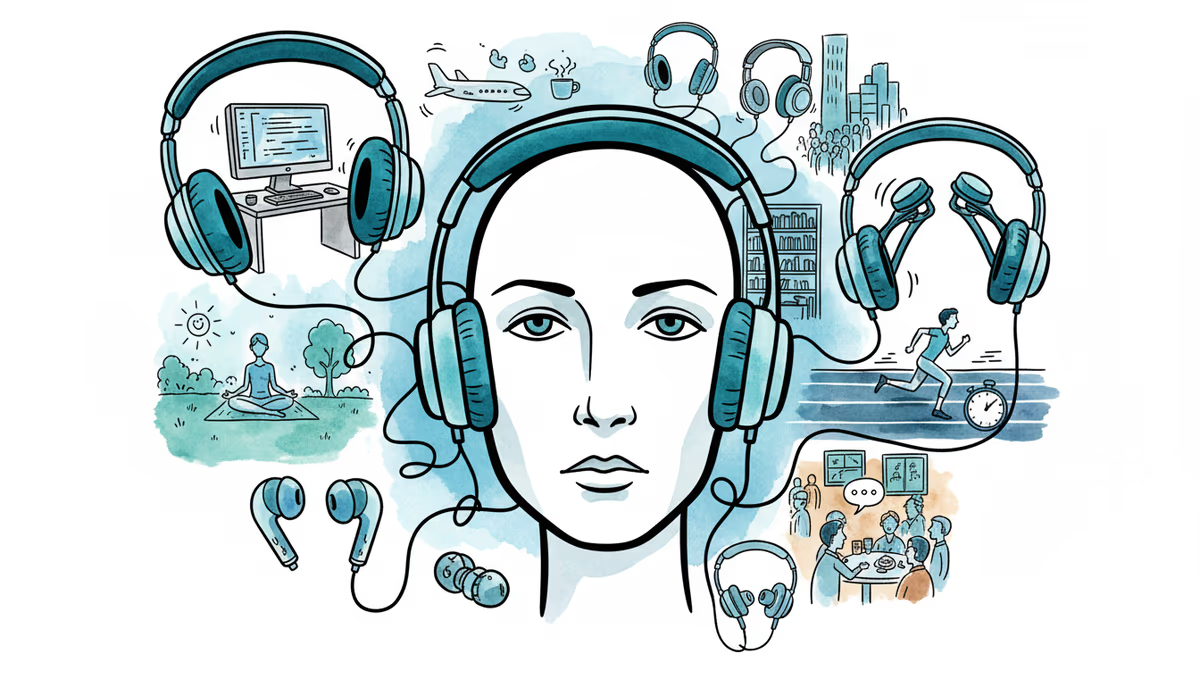
The one-size-fits-all headphone era is over. From workout buds to noise-canceling cans, the audio market has fractured into specialized categories—and consumers are buying in.
Riley Walz, creator of viral web stunts, joins OpenAI to reinvent human-AI interaction. What this hiring reveals about the next phase of AI competition.
Thunderbolt 5 docking stations are reshaping how we think about portable computing. As the line between laptops and desktops blurs, one cable connection is becoming the bridge between mobility and productivity.
Ten years after AlphaGo's victory, AI has revolutionized Go completely. Yet fans still prefer watching humans play. The reason reveals something profound about what makes us human.
The one-size-fits-all headphone era is over. From workout buds to noise-canceling cans, the audio market has fractured into specialized categories—and consumers are buying in.
Riley Walz, creator of viral web stunts, joins OpenAI to reinvent human-AI interaction. What this hiring reveals about the next phase of AI competition.
Thoughts
Share your thoughts on this article
Sign in to join the conversation