

Nvidia Wants to Own the Weather Forecast Business
Nvidia's new AI weather models claim to beat Google's GenCast and cut supercomputer processing from hours to minutes. Is this weather forecasting's iPhone moment?
As winter storms pummeled the U.S. with wildly inconsistent forecasts—some regions seeing predictions swing from 10 inches to 30 inches of snow overnight—Nvidia couldn't have timed its announcement better. The chip giant just unveiled new AI weather models that it claims can forecast better than anyone else. Coincidence? Maybe not.
Beating Google at Its Own Game
Nvidia dropped three new Earth-2 weather forecasting models at the American Meteorological Society meeting in Houston. The flagship Medium Range model allegedly outperforms Google DeepMind'sGenCast on more than 70 variables—a bold claim considering GenCast was already crushing traditional physics-based models when it launched in December 2024.
GenCast had set the bar high, delivering 15-day forecasts that were significantly more accurate than existing supercomputer simulations. Now Nvidia says it's raised that bar even higher.
"Philosophically, scientifically, it's a return to simplicity," explained Mike Pritchard, Nvidia's director of climate simulation. "We're moving away from hand-tailored niche AI architectures and leaning into the future of simple, scalable, transformer architectures."
The new models run on Nvidia'sAtlas architecture—details of which the company promised to reveal more about. But the implications are already clear: weather forecasting is becoming an AI arms race, and Nvidia wants to win.
From Hours to Minutes: The Speed Revolution
Traditional weather forecasting is computationally brutal. Before any predictions can begin, meteorologists need to create a comprehensive snapshot of current global conditions using data from weather stations, balloons, and satellites. This data assimilation process alone consumes roughly 50% of total supercomputing loads.

Nvidia'sGlobal Data Assimilation model promises to slash this from hours on supercomputers to minutes on GPUs. That's not just faster—it's fundamentally different access to weather intelligence.
The three new models each serve distinct purposes: Medium Range handles 15-day forecasts, Nowcasting covers zero to six hours for immediate storm tracking, and Global Data Assimilation creates those crucial baseline snapshots. Together with existing CorrDiff and FourCastNet3 models, they form a comprehensive Earth-2 ecosystem.
Weather Democratization or Nvidia Domination?
Nvidia's pitch centers on "democratizing" weather forecasting. Historically, accurate predictions required expensive supercomputer time that only wealthy nations and large corporations could afford. Smaller countries often relied on foreign forecasts or made do with less precise predictions.
"Weather is a national security issue, and sovereignty and weather are inseparable," Pritchard noted. Countries like Israel and Taiwan are already using Earth-2 CorrDiff, while companies like The Weather Company and Total Energies are evaluating Nowcasting.
But there's a catch in this democratization narrative. While Nvidia promises broader access, users still need Nvidia GPUs to run these models efficiently. The company isn't just selling weather forecasting—it's building dependency on its hardware ecosystem.
The Bigger Weather Wars
This isn't just about better storm predictions. Weather data drives trillion-dollar decisions across agriculture, energy, logistics, and finance. More accurate forecasting could optimize crop yields, reduce flight delays, and improve renewable energy planning.
But it also raises questions about concentration of power. If Nvidia's models prove superior, will meteorological services worldwide become dependent on a single company's technology? What happens when weather sovereignty meets Silicon Valley capitalism?
When a single company's algorithms become the lens through which we see tomorrow's weather, who really controls the forecast?
Authors
Related Articles

Five stories from late September, traced to where the paper trail stops: Korea's export record, Nvidia's Hugging Face 8-K, a US-China AI channel, the UN on AI, and rising births.
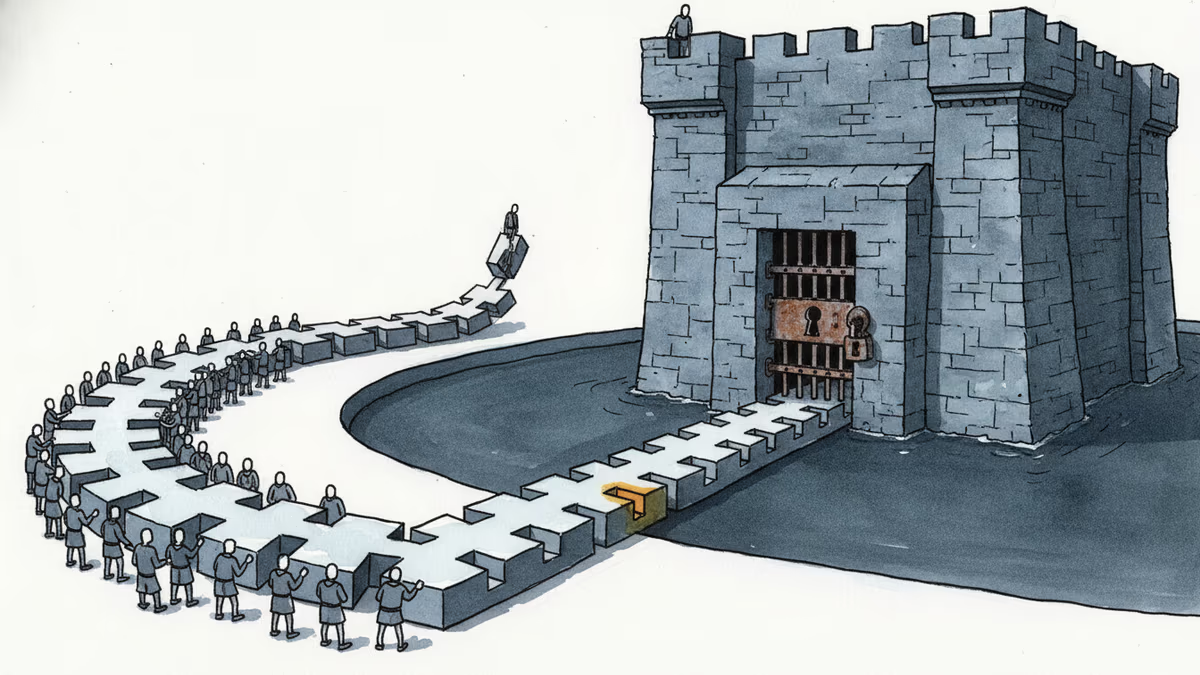
Nvidia shipped roughly a billion RISC-V cores in 2024, then announced it would run CUDA on the open standard. We break down how royalty-free instruction sets and open software stacks are trying to route around CUDA's lock-in. Part 2 of the Semiconductor Sovereignty series.

US AI-chip export controls split into three layers in the first half of 2026 — January easing, a May crackdown on circumvention, and a pending bill. Nvidia erased China from its guidance and still posted a record $81.6 billion quarter. A look at the export policy that both shields and cages it.
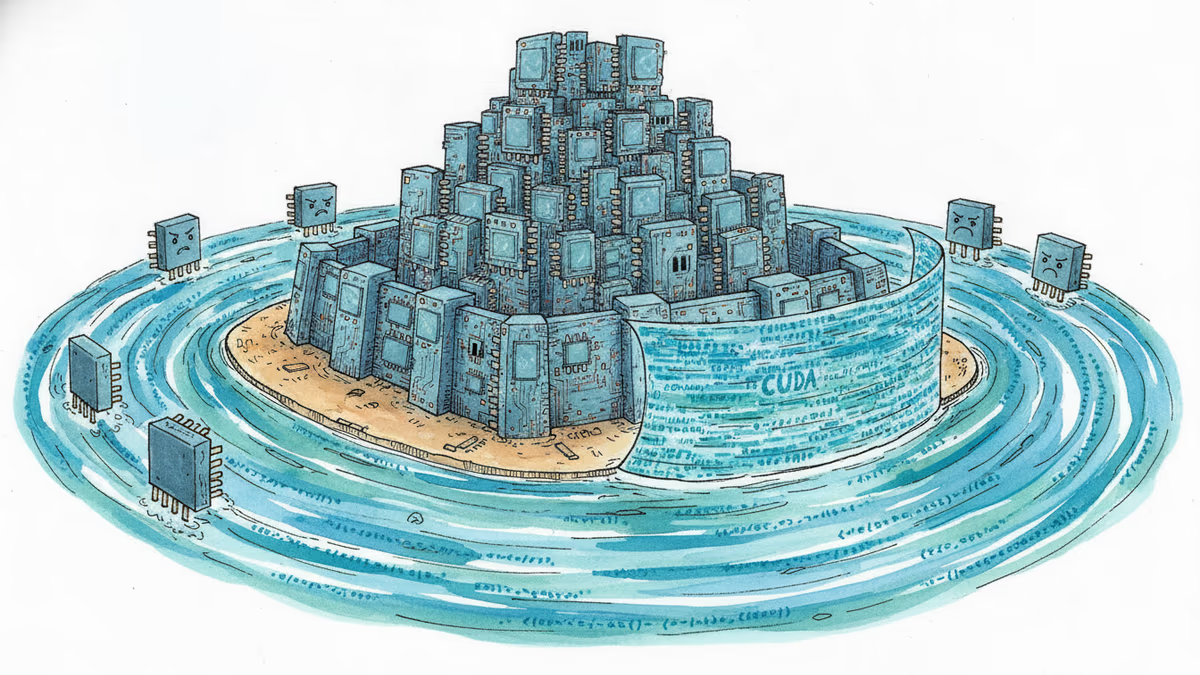
AMD's MI325X matches or beats Nvidia on memory and bandwidth — yet Nvidia's 86-92% share holds. The real moat is CUDA, 20 years in the making. Part 1 of 4.
Five stories from late September, traced to where the paper trail stops: Korea's export record, Nvidia's Hugging Face 8-K, a US-China AI channel, the UN on AI, and rising births.
Nvidia shipped roughly a billion RISC-V cores in 2024, then announced it would run CUDA on the open standard. We break down how royalty-free instruction sets and open software stacks are trying to route around CUDA's lock-in. Part 2 of the Semiconductor Sovereignty series.
US AI-chip export controls split into three layers in the first half of 2026 — January easing, a May crackdown on circumvention, and a pending bill. Nvidia erased China from its guidance and still posted a record $81.6 billion quarter. A look at the export policy that both shields and cages it.
AMD's MI325X matches or beats Nvidia on memory and bandwidth — yet Nvidia's 86-92% share holds. The real moat is CUDA, 20 years in the making. Part 1 of 4.
Thoughts
Share your thoughts on this article
Sign in to join the conversation