
Why Google Really Invested in a Battery Recycling Company
Google and Nvidia aren't backing Redwood Materials for recycling—they're betting on a new energy storage business that could power AI data centers and solve the electricity crisis.
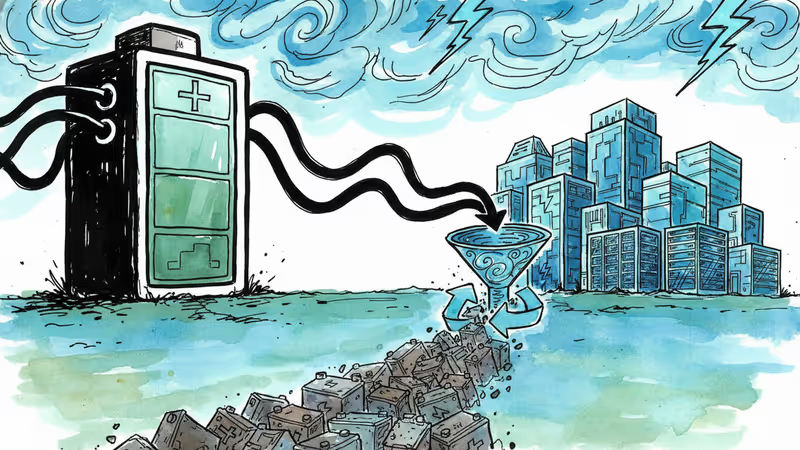
Google and Nvidia just poured $425 million into a battery recycling company. But recycling isn't what they're really after.
Redwood Materials, founded by former Tesla CTO JB Straubel, initially raised $350 million in a Series E round led by Eclipse Ventures last October. Nvidia's venture arm NVentures joined as a strategic investor, and since then, newcomers including Google have piled in, pushing the total to $425 million. The company's post-money valuation now exceeds $6 billion, according to sources familiar with the deal.
From E-Waste to EV Batteries
Redwood Materials started in 2017 with a straightforward mission: create a circular supply chain for batteries. The Nevada-based company began by recycling scrap from battery production and consumer electronics—think old smartphone and laptop batteries. They'd extract valuable materials like nickel and lithium, then sell these recovered materials to manufacturers like Panasonic for new battery production.
It was solid business. The company now processes more than 70% of all used or discarded battery packs in North America. But Straubel had bigger ambitions.
Over the years, Redwood expanded beyond recycling into cathode production. Then last summer, they launched something entirely different: an energy storage business that takes EV batteries not quite ready for recycling and repurposes them into micro-grids.
The AI Power Problem
This new venture, called Redwood Energy, addresses a pressing issue: the skyrocketing electricity demand from AI data centers. As the company puts it, "energy storage is no longer optional; it is essential infrastructure."

The numbers tell the story. Redwood currently holds more than 1 gigawatt-hour worth of batteries in inventory and expects to receive another 4 gigawatt-hours in the coming months. By 2028, they plan to deploy 20 gigawatt-hours of grid-scale storage.
That's enough to power hundreds of thousands of homes—or several major AI data centers running 24/7.
Why Tech Giants Are Paying Attention
For Google and Nvidia, this isn't just about environmental responsibility. It's about solving a fundamental infrastructure challenge. AI workloads are incredibly power-hungry, and traditional grid infrastructure often can't keep up with demand spikes.
Redwood's approach offers a compelling solution: instead of building new power plants or waiting for grid upgrades, companies can deploy repurposed EV batteries as backup power sources. These batteries have already proven their reliability in vehicles—they just need a second life in a different form factor.
The timing couldn't be better. As AI adoption accelerates, the competition for reliable, clean power is intensifying. Data center operators are increasingly looking beyond traditional power sources, and energy storage offers both reliability and sustainability.
The Circular Economy Meets Big Tech
Redwood's evolution reflects a broader shift in how we think about resource cycles. The company started by solving an environmental problem—what to do with dead batteries. Now they're solving an infrastructure problem—how to power the AI revolution sustainably.
This dual purpose makes them particularly attractive to investors. Environmental benefits are nice, but solving critical infrastructure needs while generating strong returns? That's the kind of business model that gets Google and Nvidia to write big checks.
The company's total funding now stands at $4.9 billion, making it one of the most well-capitalized players in the battery space. But unlike pure-play battery manufacturers, Redwood controls multiple parts of the value chain—from recycling to production to energy storage.
Authors
Related Articles
In a post-Google I/O interview, Sundar Pichai acknowledged flawed search results, real AI anxiety, and an AGI timeline that makes the label irrelevant. Here's what he said — and what it means.
Google is building AI agents that search the web proactively, without user prompting. That's not just a product update — it's a fundamental shift in who controls the information you receive.
Google unveiled the 'Googlebook' platform to replace Chromebook and ChromeOS—but revealed zero hardware specs. What's the strategy, and what does it mean for users, manufacturers, and the education market?
After 15 years of fragmented mobile messaging, Apple and Google are rolling out end-to-end encrypted RCS messaging between iPhones and Android devices. Here's what changed, why it took so long, and what it means for your privacy.
In a post-Google I/O interview, Sundar Pichai acknowledged flawed search results, real AI anxiety, and an AGI timeline that makes the label irrelevant. Here's what he said — and what it means.
Google is building AI agents that search the web proactively, without user prompting. That's not just a product update — it's a fundamental shift in who controls the information you receive.
Google unveiled the 'Googlebook' platform to replace Chromebook and ChromeOS—but revealed zero hardware specs. What's the strategy, and what does it mean for users, manufacturers, and the education market?
After 15 years of fragmented mobile messaging, Apple and Google are rolling out end-to-end encrypted RCS messaging between iPhones and Android devices. Here's what changed, why it took so long, and what it means for your privacy.
Thoughts
Share your thoughts on this article
Sign in to join the conversation