
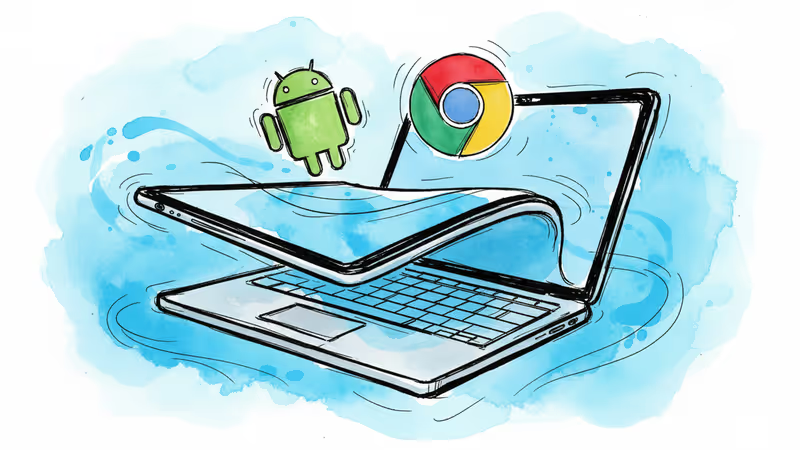
Google Accidentally Reveals Aluminum OS in Action
Google inadvertently leaked footage of Aluminum OS, showing Android and ChromeOS hybrid platform running on PC for the first time. What does this mean for the future of computing?
After months of speculation, Google's most secretive project just got its most public debut—completely by accident. The tech giant inadvertently revealed Aluminum OS, its long-rumored hybrid of Android and ChromeOS, through a routine bug report.
Yesterday, Google published a Chrome Incognito tab bug report to its public Issue Tracker, complete with two screen recordings captured from a device running Aluminum OS. 9to5Google spotted the leak before Google restricted access to the report, but the cat was already out of the bag.
Android Meets Desktop Reality
The leaked footage showed exactly what we'd expect from a hybrid platform: Android running naturally in a PC environment. The interface looked like a seamless blend of Android's mobile-first design with ChromeOS's desktop functionality—no awkward scaling or forced adaptations.
The bug tracker mentioned an "ALOS" software version, previously confirmed as the initialism for Aluminum OS. This marks our first concrete glimpse of Google's attempt to bridge the gap between mobile and desktop computing, a project that's been rumored since 2022.
Why the Hybrid Approach Matters Now
Google's timing isn't coincidental. Microsoft has been pushing Windows 11's Android app support, while Apple continues tightening the integration between macOS and iOS. Google risks being left behind if it can't offer a unified experience across devices.

For developers, Aluminum OS could be a game-changer. Instead of maintaining separate codebases for mobile and desktop, they could potentially deploy Android apps across all form factors. This could level the playing field against Apple's ecosystem advantage and Microsoft's desktop dominance.
The Competitive Landscape Shifts
The leak comes at a crucial time for Google's hardware ambitions. Chromebook sales have plateaued, and the company needs a compelling reason for consumers to choose its ecosystem over established alternatives. Aluminum OS could be that differentiator—if it works.
But questions remain. Will Android apps truly feel native on larger screens? Can Google convince developers to optimize for this hybrid experience? And perhaps most importantly, do consumers actually want their phone and computer to feel identical?
Samsung, Lenovo, and other Chromebook manufacturers are likely watching closely. A successful Aluminum OS could reinvigorate the Chromebook market and create new opportunities for hardware partnerships.
What We Still Don't Know
Google hasn't officially announced Aluminum OS, and the leaked footage raises more questions than it answers. The interface looked polished, suggesting the project is further along than many expected. Industry insiders predict a beta release could come later this year.
The bigger question isn't technical—it's philosophical. As the lines between mobile and desktop computing continue to blur, are we heading toward a future where all our devices feel the same? Or will there always be value in platform-specific experiences?
Authors
Related Articles

In a post-Google I/O interview, Sundar Pichai acknowledged flawed search results, real AI anxiety, and an AGI timeline that makes the label irrelevant. Here's what he said — and what it means.
Google is building AI agents that search the web proactively, without user prompting. That's not just a product update — it's a fundamental shift in who controls the information you receive.
Google unveiled the 'Googlebook' platform to replace Chromebook and ChromeOS—but revealed zero hardware specs. What's the strategy, and what does it mean for users, manufacturers, and the education market?

After 15 years of fragmented mobile messaging, Apple and Google are rolling out end-to-end encrypted RCS messaging between iPhones and Android devices. Here's what changed, why it took so long, and what it means for your privacy.
In a post-Google I/O interview, Sundar Pichai acknowledged flawed search results, real AI anxiety, and an AGI timeline that makes the label irrelevant. Here's what he said — and what it means.
Google is building AI agents that search the web proactively, without user prompting. That's not just a product update — it's a fundamental shift in who controls the information you receive.
Google unveiled the 'Googlebook' platform to replace Chromebook and ChromeOS—but revealed zero hardware specs. What's the strategy, and what does it mean for users, manufacturers, and the education market?
After 15 years of fragmented mobile messaging, Apple and Google are rolling out end-to-end encrypted RCS messaging between iPhones and Android devices. Here's what changed, why it took so long, and what it means for your privacy.
Thoughts
Share your thoughts on this article
Sign in to join the conversation