
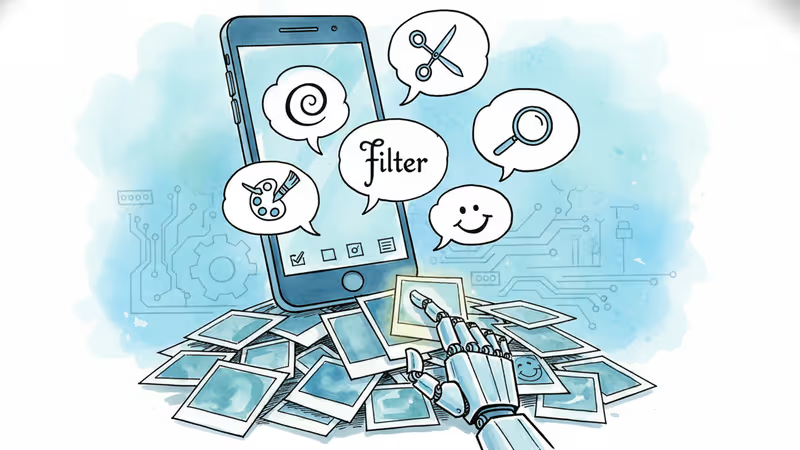
Google Photos AI Editing Goes Global with Natural Language Commands
Google expands AI-powered photo editing to Australia, India, and Japan, supporting six local languages including Hindi. Users can now edit photos with simple text commands instead of complex tools.
"Remove the motorcycle in the background." "Make my friend open their eyes." "Restore this old photo." What sounds like magic is now reality for millions more users worldwide. Google announced Tuesday it's expanding natural language-based photo editing in Google Photos to Australia, India, and Japan—turning complex editing tasks into simple conversations.
From Sliders to Speech
The "Help me Edit" feature, first launched for Pixel 10 users in the U.S. last August, eliminates the need for complicated editing software. Users simply tap the edit option on a photo, then either select from suggested prompts or type their own requests in plain language.
The AI can handle surprisingly specific requests. Want to edit a friend's pose? Remove their glasses? Have them open their eyes in a photo where they blinked? Google's Nano Banana image model processes these commands directly within the app, requiring no internet connection for the actual editing.
The feature works on any Android device with at least 4GB of RAM running Android 8.0 or higher—meaning it's not limited to Google's own Pixel phones. This broad compatibility could democratize advanced photo editing for hundreds of millions of users.
Breaking Language Barriers
Perhaps more significant than the geographic expansion is the language support. Beyond English, Google is adding Hindi, Tamil, Marathi, Telugu, Bengali, and Gujarati—six languages that unlock the feature for millions of users in their native tongues.

This move signals Google's serious intent in the Indian market, where linguistic diversity has often been a barrier to tech adoption. By supporting regional languages, the company isn't just expanding its user base—it's fundamentally changing how people interact with AI tools.
The Authenticity Question
Google is also rolling out C2PA Content Credentials support, which adds metadata indicating when an image was created or edited using AI. As AI-generated and AI-edited images flood social media, this technical standard becomes crucial for distinguishing authentic from artificial content.
Social media platforms have been grappling with how to label AI content, and credentials like C2PA help users understand what they're looking at. It's a proactive step in an era where "seeing is believing" no longer holds true.
Google's AI Photo Blitz
This expansion is part of Google's aggressive AI integration strategy. Last November, the company expanded AI-powered search capabilities to over 100 countries with support for more than 17 languages. It also introduced AI templates that convert photos into different artistic styles.
Just last week, Google rolled out a "Meme me" feature that lets users combine reference templates with their own images to create memes. The photo app is evolving from a simple storage solution into a creative powerhouse.
Authors
Related Articles
In a post-Google I/O interview, Sundar Pichai acknowledged flawed search results, real AI anxiety, and an AGI timeline that makes the label irrelevant. Here's what he said — and what it means.
Google is building AI agents that search the web proactively, without user prompting. That's not just a product update — it's a fundamental shift in who controls the information you receive.
Google unveiled the 'Googlebook' platform to replace Chromebook and ChromeOS—but revealed zero hardware specs. What's the strategy, and what does it mean for users, manufacturers, and the education market?
After 15 years of fragmented mobile messaging, Apple and Google are rolling out end-to-end encrypted RCS messaging between iPhones and Android devices. Here's what changed, why it took so long, and what it means for your privacy.
In a post-Google I/O interview, Sundar Pichai acknowledged flawed search results, real AI anxiety, and an AGI timeline that makes the label irrelevant. Here's what he said — and what it means.
Google is building AI agents that search the web proactively, without user prompting. That's not just a product update — it's a fundamental shift in who controls the information you receive.
Google unveiled the 'Googlebook' platform to replace Chromebook and ChromeOS—but revealed zero hardware specs. What's the strategy, and what does it mean for users, manufacturers, and the education market?
After 15 years of fragmented mobile messaging, Apple and Google are rolling out end-to-end encrypted RCS messaging between iPhones and Android devices. Here's what changed, why it took so long, and what it means for your privacy.
Thoughts
Share your thoughts on this article
Sign in to join the conversation