
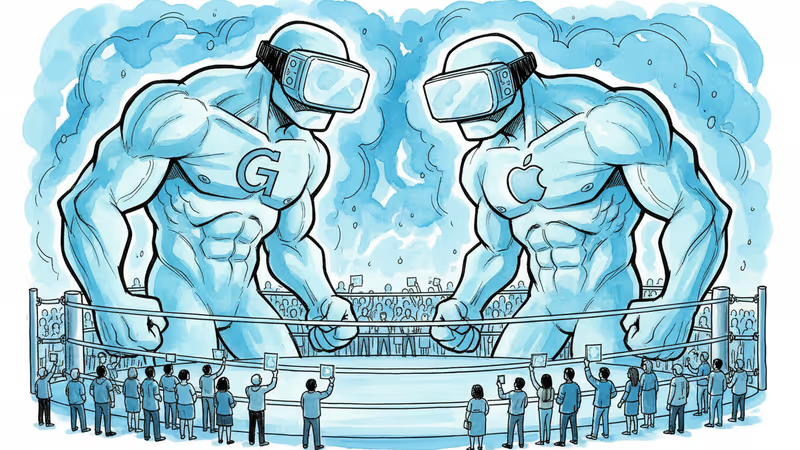
Google Glass Returns to Battle Meta's Smart Glasses Empire
Google's smart glasses comeback targets Meta's Ray-Ban dominance with Gemini AI and Android XR. The battle for your face is heating up in 2025.
The $2 billion smart glasses market is about to get a lot more interesting. Google's preparing to ship refreshed smart glasses this year, and this time, they're not just trying to avoid another Glass disaster—they're gunning directly for Meta's Ray-Ban throne.
Meta's Current Dominance
Meta owns the smart glasses battlefield right now, and it's not even close. Their partnership with EssilorLuxottica—parent company of Ray-Ban and Oakley—has produced frames that people actually want to wear in public. The company recently doubled down by laying off Metaverse workers to focus on XR and AI gadgets, with Bloomberg reporting plans to scale production capacity to 20-30 million units by late 2026.
"Even though Google was first, they're still kind of playing catch-up right now," says IDC tech analyst Jitesh Urbani. That's a remarkable position for the company that literally invented the smart glasses category with the original Google Glass.
Google's taking a two-pronged approach this time. They're positioning Android XR as a way to get familiar mobile apps running on glasses immediately, while partnering with eyewear manufacturers to create something people might actually be excited to wear. Samsung is likely releasing beefier smart glasses this year, all running Android XR and slotting into Google's computing ecosystem.
The Gemini Advantage
Google's not-so-secret weapon? Gemini, their AI model that's been making competitors like OpenAI and Meta nervous enough to accelerate their own development. The AI is so good that even Apple partnered with Google to power features in their new Siri. That gives Google unprecedented reach.
"They get to monetize Gemini outside of Android and they get the benefit of basically the entire iOS ecosystem optimizing for Gemini as well," says Anshel Sag, tech analyst at Moor Insights and Strategy. "It's the closest I think we've come to an AI winner."
Meta has positioned AI as their smart glasses' most useful feature, but Meta AI's conversational abilities don't match what Google's accomplished with Gemini. Features like Meta's language translation or image recognition don't always work smoothly in real-world scenarios.
"Every time I use Meta AI, I wish it were Gemini," Sag admits while speaking through a pair of Meta Oakley Vanguards. "I think we haven't fully realized the capability of AI in smart glasses until we get it in Gemini on a pair of Google glasses."

The Trust Factor
Meta also carries baggage that Google might exploit. "Meta is not the most trusted technology brand, shall we say, by some distance, when it comes to data privacy and security," notes Ben Hatton, tech analyst at CCS Insights. "That may be holding the market back. If Meta is the only player, and Google can come in and say, this is all on device, this is all secure, this is all just kept within your device, then more heads may be turned."
Style Wars
But here's where Meta still has the edge: fashion. Their EssilorLuxottica partnership has created smart glasses that generally look like something you'd happily wear in public. Even the chunky new Meta Display glasses earn style points despite being bulky and "computer glasses."
Google's new glasses will almost certainly look heavy and weird. Demo videos from this month show thick-framed devices that scream "tech prototype." Google's partnerships with Warby Parker and Gentle Monster could yield more appealing aesthetics, but those glasses will likely have fewer features than the powerful models from Samsung and other Android XR partners.
"I don't think Meta's in trouble at all right now," Urbani says. "Google is great as a tech company, but there's a lot they have to learn in terms of fashion and selling glasses."
The Platform Play
Google's broader goal extends beyond just selling glasses—they want to establish Android XR as the dominant platform. Even if Google can't nail the fashion element, their software could attract third parties who can.
"Nobody actually wants to ship a pair of glasses and build an entire operating system and foundational AI model to run on it," Sag explains. "I think people want to build glasses with an operating system that already exists and with an application ecosystem that's already built."
Timeline: Summer 2025?
"I certainly expect them to be out by the middle of the year," Hatton predicts. "If they're going to bring out sunglasses as a form factor, you probably want them out for spring so people can start thinking about buying them for the summer."
That timeline would put Google's glasses in direct competition with Meta's established lineup during peak sunglasses season—a bold move that could either establish Google as a serious player or highlight exactly why Meta's been winning.
Authors
Related Articles

Samsung and SK unveiled a chip and AI investment package worth thousands of trillions of won on June 29. The headline number swings wildly by outlet, but the real contest isn't capital — it's water and power.
In a post-Google I/O interview, Sundar Pichai acknowledged flawed search results, real AI anxiety, and an AGI timeline that makes the label irrelevant. Here's what he said — and what it means.
Google is building AI agents that search the web proactively, without user prompting. That's not just a product update — it's a fundamental shift in who controls the information you receive.

Viral videos show 2026 graduates jeering executives who praise AI at commencement ceremonies. It's not just rudeness — it's a signal about who pays for technological optimism.
Samsung and SK unveiled a chip and AI investment package worth thousands of trillions of won on June 29. The headline number swings wildly by outlet, but the real contest isn't capital — it's water and power.
In a post-Google I/O interview, Sundar Pichai acknowledged flawed search results, real AI anxiety, and an AGI timeline that makes the label irrelevant. Here's what he said — and what it means.
Google is building AI agents that search the web proactively, without user prompting. That's not just a product update — it's a fundamental shift in who controls the information you receive.
Viral videos show 2026 graduates jeering executives who praise AI at commencement ceremonies. It's not just rudeness — it's a signal about who pays for technological optimism.
Thoughts
Share your thoughts on this article
Sign in to join the conversation